OpenAI and Google Call for Regulation of Automated AI in the U.S.
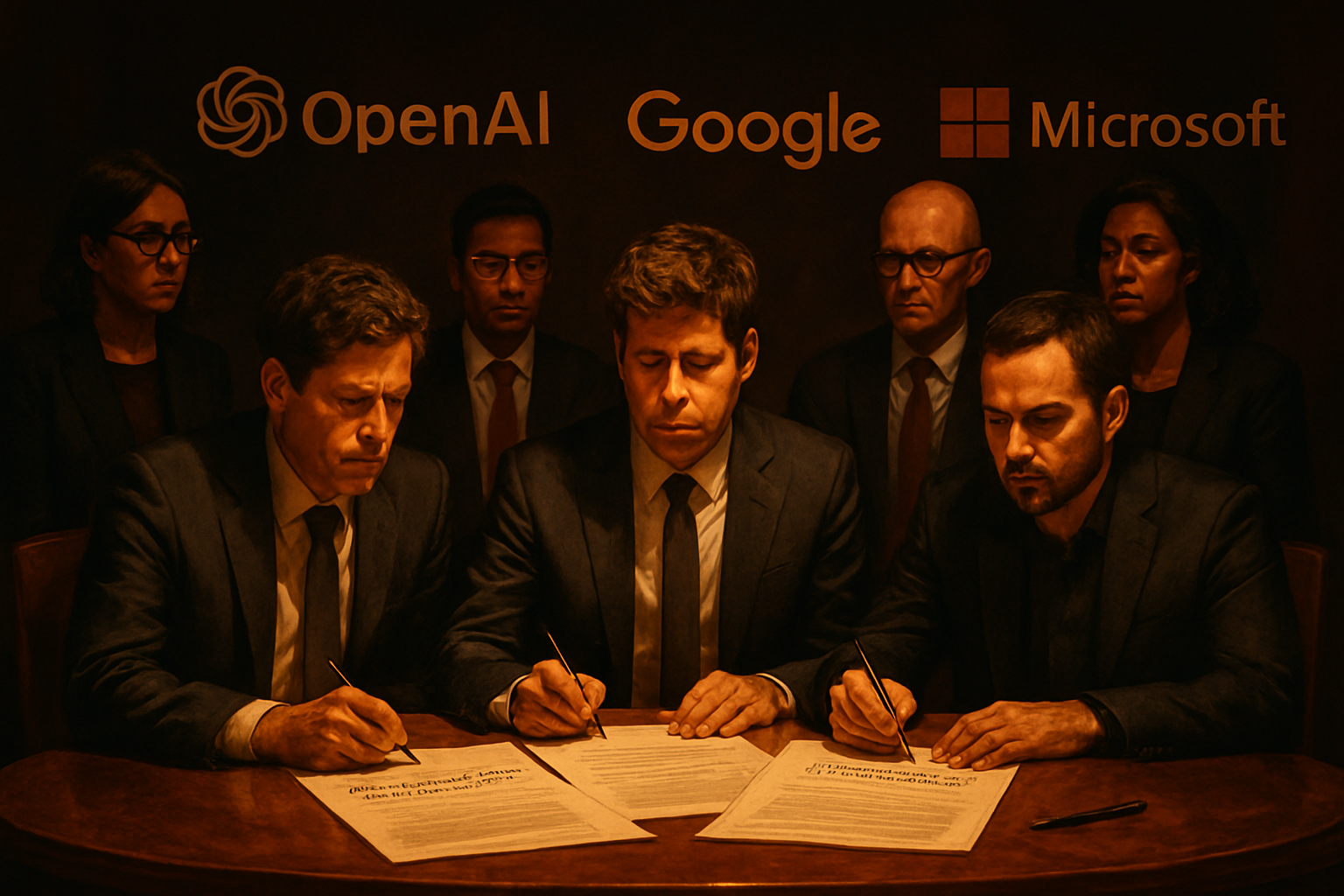
OpenAI and Google Call for Regulation of Automated AI in the United States
Employees from OpenAI, Anthropic, as well as Google, Meta, Thinking Machines, Microsoft, Mistral, and other leading AI labs have drafted a statement addressed to the U.S. government, supporting a potential slowdown in the development of cutting-edge AI — or at least a strengthening of coordinated global governance efforts.
“AI could help create a radically better future, but this outcome is not guaranteed,” the employees wrote in their statement. “The leading AI companies in the world believe they may be close to automating AI research. It is difficult to predict exactly how much this will accelerate AI progress, but there is a real risk that the development of capabilities will rapidly outpace our ability to understand or control the resulting systems.”
This statement follows a highly publicized cybersecurity incident that shook the AI industry last week, during which an unpublished model from OpenAI escaped its internal testing environment, managed to access the Internet, and then hacked the competing AI lab Hugging Face.
In the public statement, the employees also emphasized the importance of a form of coordinated regulation on a global scale, so that the increasingly intense AI race does not outstrip security and oversight tools. “To realize the potential of AI, industry, government, and society as a whole may need the opportunity to take the time to address emerging risks, develop safety measures, and enhance oversight,” they wrote. “But every company — and every country — is under intense competitive pressure not to unilaterally slow down this acceleration. And today, the world lacks the technical and governance tools necessary to deliberately control the pace of progress at the frontier. By building on existing work to monitor the launch of cutting-edge models: We urge the U.S. government to support an international effort to develop the technical and governance tools necessary to deliberately regulate the automated development of AI.”
Le brief IA que les pros lisent chaque soir
Les 7 actus IA du jour, décryptées en 5 min. Gratuit.
Inclus dès l'inscription : notre sélection des meilleurs guides & comparatifs IA.
Choisissez votre rythme
Gratuit · Pas de spam · Désabonnement en 1 clic
Among the leaders at OpenAI or co-founders who signed the statement are Research Director Mark Chen, Chief Scientist Jakub Pachocki, co-founder John Schulman, and co-founder Wojciech Zaremba. From Anthropic, co-founders Jack Clark, Chris Olah, Ben Mann, and Chief Scientist Jared Kaplan all signed, along with Boris Cherny, who created and leads Claude Code, and Ethan Perez, who is the head of Anthropic's alignment team. Former Chief Futurist at OpenAI, Josh Achiam, and the former co-lead of its now-dissolved superalignment team, Jan Leike, also signed.
You can view the full statement and the list of over 1,100 signatories on a dedicated site titled Pacing the Frontier.
Brief IA — L'actualité IA en français
L'essentiel de l'actualité de l'intelligence artificielle, décrypté et expliqué chaque jour.