OpenAI and AI: Altman Proposes a Share for Every American Household
Le brief IA que les pros lisent chaque soir
Les 7 actus IA du jour, décryptées en 5 min. Gratuit.
Inclus dès l'inscription : notre sélection des meilleurs guides & comparatifs IA.
Choisis ton rythme
Gratuit · Pas de spam · Désabonnement en 1 clic
OpenAI: A Share of AI for Every American Household
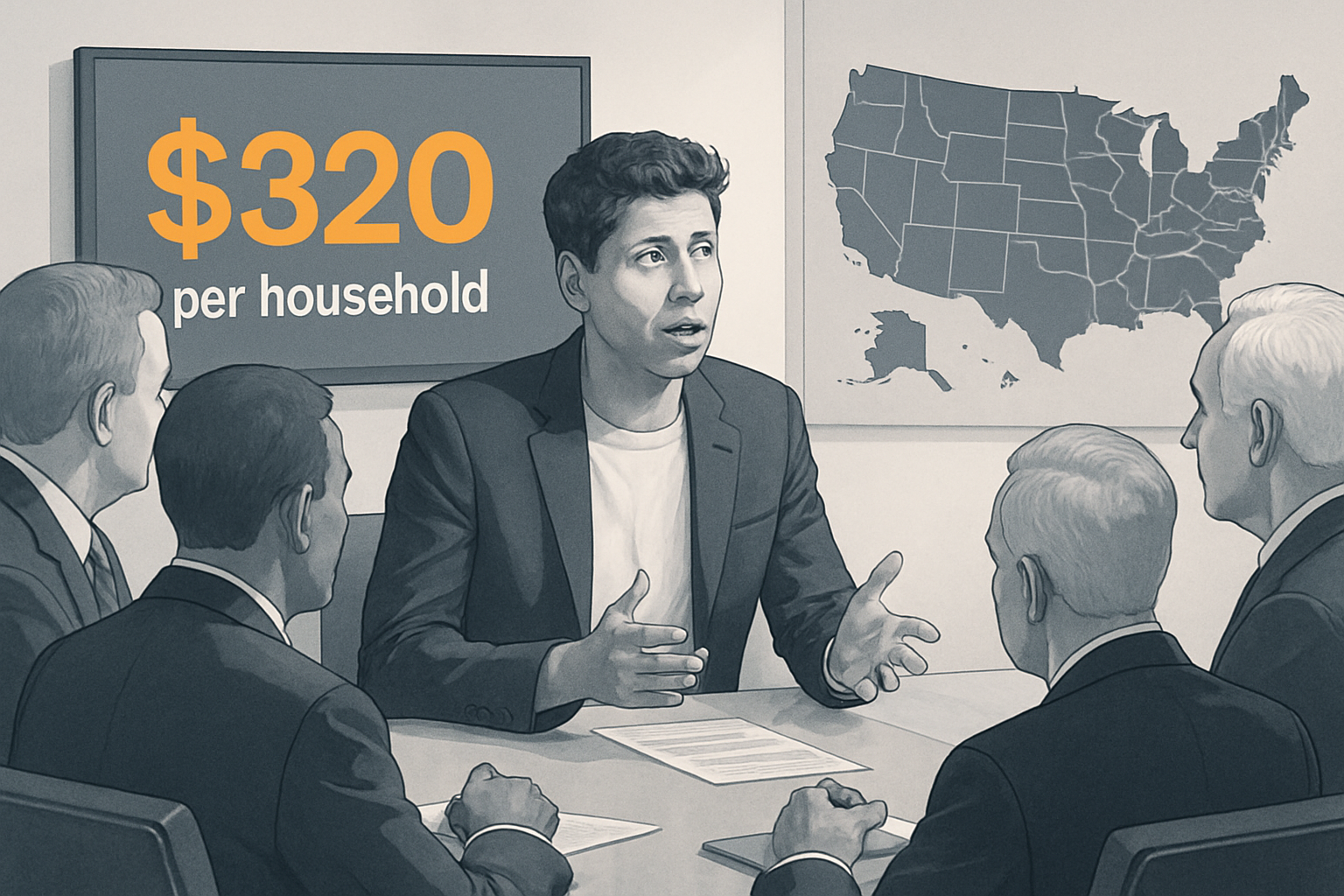
Sam Altman, the CEO of OpenAI, has put forth a bold proposal: to offer the U.S. government a 5% stake in OpenAI. This initiative aims to redistribute the wealth generated by artificial intelligence directly to citizens. Current estimates suggest that this share would represent about $320 per American household. The idea is to compensate the human labor that fuels these technologies while providing protection against potential disruptions in the job market caused by AI.
However, despite the appeal of this proposal, concrete details remain vague. The idea seems more like a political lever than a genuine action plan. It raises questions about how such redistribution could be implemented and its actual impact on the economy and society.
Tech News in Brief
An Overvalued AI Market?
A recently leaked report from the U.S. Treasury compares the current AI market to the dot-com bubble of the early 2000s. This comparison sharply contrasts with the optimism expressed by the U.S. administration regarding AI's potential. Analysts fear that the market may be overvalued, and that the apparent benefits of AI mask deeper economic risks.
Samsung and the AI Chip Boom
Samsung has announced a staggering 1,800% increase in profits thanks to the sale of AI-dedicated chips. This success marks the third consecutive quarter of record profits for the company. However, despite these impressive figures, Samsung's stock has fallen. Investors are worried about a potential slowdown in demand for AI technologies, which could affect the company's future performance.
Using Mythos for Cybersecurity
CISA, a U.S. cybersecurity agency, has begun using Anthropic's model, Mythos, to audit government code. This use aims to identify and fix potential bugs in critical systems, thereby enhancing the security of the government's digital infrastructure.
Illinois Adopts Strict AI Legislation
The governor of Illinois has signed a law considered the strictest in the country regarding AI regulation. This legislation aims to protect citizens from the risks associated with the increasing use of artificial intelligence by imposing rigorous standards for its deployment and use.
Claude Code and Secret Surveillance
A hidden tracker in the Claude Code software has been discovered and removed. This tracker was secretly monitoring users in China, raising major concerns about privacy and surveillance.
Russian Drones in Europe
Russia is suspected of using drones for operations in Europe, launching them from commercial ships. These clandestine activities raise concerns about the security and sovereignty of European airspaces.
AI Actor Tilly Norwood Makes Debut
Tilly Norwood, an AI-generated actor, is set to make her debut in a feature film. This movie, a comedy-drama titled "Misaligned," marks a significant milestone in the use of AI in the film industry.
U.S. Companies Turning to China
Faced with rising AI costs, many U.S. companies are exploring Chinese models as more economical alternatives. This trend could transform the global tech landscape by redistributing innovation hubs.
Advances in Quantum Proofs
Researchers have demonstrated that quantum proofs can surpass classical proofs in certain cases. They have identified a problem that classical methods cannot solve, paving the way for new applications of quantum computing.
Earth and the Sun: A Secure Future
New scientific models suggest that Earth will never be engulfed by the sun. However, living conditions could become extremely difficult long before this becomes a concern.
Reflections on AI and Humanity
Journalist Sarah O’Connor, in her book We Are Not Machines, expresses a growing concern: in striving to create machines in our image, we risk transforming ourselves into their image. This reflection invites awareness of the impact of AI on our identity and society.
Genetic Explorations: A Look into the Past
Eske Willerslev, an expert in ancient DNA, has made significant advances in studying DNA recovered from ancient bones and objects. Among his discoveries is the first nearly complete genome of an ancient human and genetic material over 2.4 million years old from Greenland. These studies reveal that what is now an Arctic desert was once a forest populated by poplars, birches, and mastodons.
These discoveries are part of a revolution in the study of ancient DNA, offering insights into human migrations and extinct ecosystems. Scientists hope that this research can also provide clues about modern diseases and help improve food supply in a warming world. Eske Willerslev remains optimistic about the future of this research and its potential to transform our understanding of the past and the future.
Brief IA — L'actualité IA en français
L'essentiel de l'actualité de l'intelligence artificielle, décrypté et expliqué chaque jour.