OpenAI, Google, and Anthropic Design AI Chips
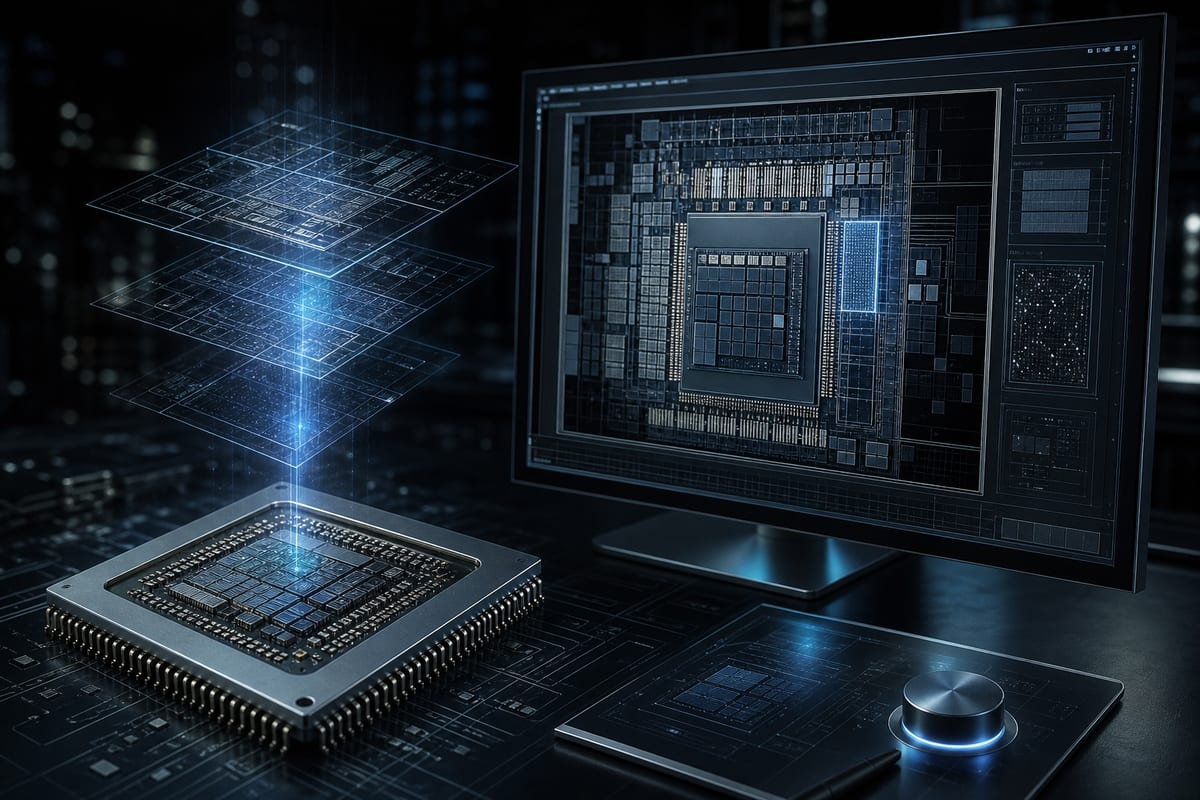
OpenAI, Google, and Anthropic are employing AI to develop their own chips; OpenAI began its work on Jalapeño in early 2025. These major Nvidia clients are exploring alternatives to its GPUs, while the company develops open models. However, design advancements do not eliminate manufacturing constraints or the risk of obsolescence.
Manufacturing Still Requires Billions
A designed chip still needs to be manufactured, tested, and produced in volume with sufficient reliability. These operations require specialized teams, industrial partners like Taiwan Semiconductor Manufacturing Co., and billions of dollars.
Years can separate initial plans from installation in a data center. In contrast, just a few months can significantly transform AI models. This lag exposes custom processors to rapid obsolescence.
Custom Chips to Competing Software
The versatility of Nvidia hardware is not essential for all its clients. OpenAI or Anthropic could eliminate certain functions to obtain chips that precisely match their needs and are less expensive. Even modest savings can add up when repeated across billions of queries.
Software represents another competitive arena. CUDA, Nvidia's environment for running AI applications on its hardware, has long helped retain developers within the manufacturer’s ecosystem. AI now facilitates the programming of the tools necessary for model operation and could simplify the creation of equivalents for other chips.
The founder of the startup Infinity claims that programming agents enabled the recreation of comparable software for D-Matrix, a competing manufacturer, in just 10 hours. Such tools could make it easier for companies to leave the Nvidia ecosystem. However, Nvidia also states that it employs AI in its engineering, particularly to develop CUDA more quickly.
OpenAI Measures Gains on Its Circuits
For the past year, the industry has debated recursive improvement: a system contributes to the capabilities of its successor, whose advancements then serve subsequent generations. Primarily associated with software, this logic is beginning to apply to hardware. In the long run, it could weaken Nvidia's dominance, regardless of its leadership.
On November 18, OpenAI, which develops ChatGPT, presented results on circuit design. One of the goals is to increase the amount of circuits and calculations housed in a given space. For two significant components of Jalapeño, the company reports reduced required areas of about 10% and 13%. It also reports a redesigned circuit occupying approximately 15% less space, with computation time cut in half.
Le brief IA que les pros lisent chaque soir
Les 7 actus IA du jour, décryptées en 5 min. Gratuit.
Inclus dès l'inscription : notre sélection des meilleurs guides & comparatifs IA.
Choisissez votre rythme
Gratuit · Pas de spam · Désabonnement en 1 clic
OpenAI has also worked on existing hardware with AMD, a rival to Nvidia. The developer announces up to 14% gains on certain performance and efficiency metrics. AMD has incorporated some of the modifications into plans sent for manufacturing.
Additionally, OpenAI has asked several generations of models to accelerate two publicly accessible processor architectures. According to the company, the latest and most powerful models generally achieve the fastest processors. Their results were better when starting from written instructions to design a processor rather than from an architecture to modify.
Google Designs Its TPUs, Anthropic Forms a Team
Google has been applying this approach for several years. Introduced in 2024 by its research division DeepMind, AlphaChip organizes the internal components of processors. Google claims that tasks previously performed by engineers over several weeks or months can now take just a few hours.
This technology has contributed to successive generations of Google’s TPUs since 2020. These processors are used for the training and efficient execution of Gemini, but they also represent a lucrative business. At the end of last year, Anthropic signed a contract for these chips worth several billion dollars.
The developer of Claude also announced in August that it was forming an internal team dedicated to chips. Engineers from Google and OpenAI have joined this team. In preparation for its IPO, scheduled for this month, Anthropic has released its most advanced model to date and claims a major breakthrough in circuit design.
However, the company limits certain uses of its most advanced models. Among the few prohibited areas is the creation of operating systems intended for certain AI-specialized chips.
Nvidia Develops Its Open Models Nemotron
Before the ousting of its co-founder Jensen Huang, who has since been reinstated as CEO, Nvidia had significantly ramped up its activities around open-weight models. These can be downloaded, adapted, and then used independently by companies, unlike the main services marketed by OpenAI and Anthropic. The scandal surrounding Huang disrupted this ecosystem.
Nvidia has created the Nemotron family and supported startups Reflection AI and Poolside. The manufacturer has also attempted to acquire Hugging Face, a platform distributing open AI technologies.
This direction could compete with the business models of OpenAI and Anthropic while expanding Nvidia's opportunities. Businesses, startups, cloud service providers, and governments could adopt these models to gain more control over their usage and reduce their expenses. An increase in the number of models running on its chips would multiply sales opportunities for the manufacturer.
Brief IA — L'actualité IA en français
L'essentiel de l'actualité de l'intelligence artificielle, décrypté et expliqué chaque jour.