OpenAI Launches Astra and Luna in Medical Administration
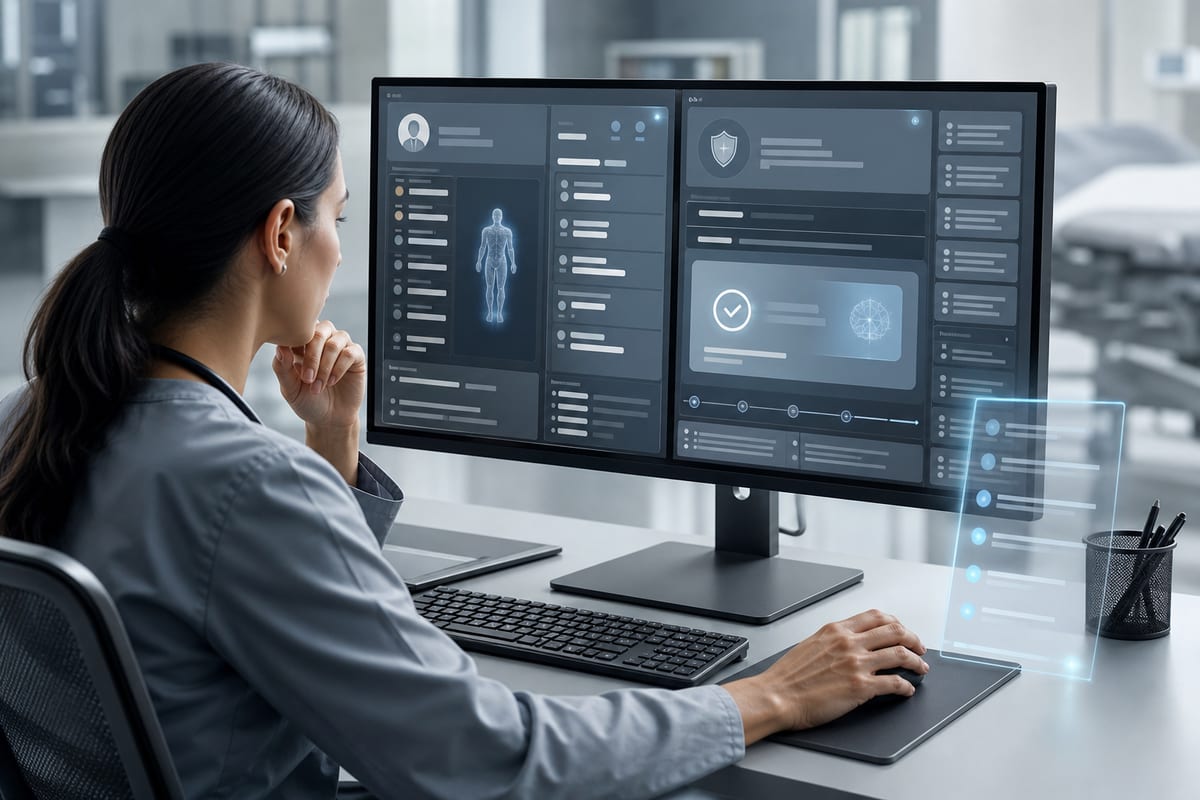
OpenAI deploys GPT-6 Astra and GPT-6 Luna to perform operations in medical software and insurance portals. The offering targets the United States, where CVS Health is already using these agents to guide patients. The results announced by OpenAI are accompanied by requirements for human validation and data protection.
CVS Monitors Agent Operations
At CVS, monitoring involves screenshots and action histories. OpenAI assures that the data remains within the infrastructure controlled by CVS, without specifying where the screenshots are processed or how long they are retained. The agents have direct access to electronic medical records containing sensitive information.
OpenAI claims to exclude data from organizations from the training of its base models. The company also states that ChatGPT for Healthcare includes role-based permissions and audit trails. Institutions can limit agents' access to only the records and operations necessary for their tasks.
To handle protected health information in accordance with HIPAA, organizations must enter into a Business Associate Agreement, or BAA, with OpenAI. They must utilize covered services and adhere to the imposed settings for security and retention. The responsibility for appropriate use falls on the institutions, while OpenAI retains its own obligations as a contractor under HIPAA.
The free individual version, ChatGPT for Clinicians, also allows verified healthcare professionals in the United States to sign a BAA, but only for the functions covered by this agreement. OpenAI does not provide indications regarding compliance with the European GDPR for this offering.
Cigna Aggregates Patient Information
At the insurer Cigna Healthcare, the models aggregate patient information scattered across more than 10 systems. Assort, for its part, employs these capabilities in Codex to finalize patient referrals within office software: their APIs do not allow for the final necessary action.
At CVS Health, the processing of referrals and specialty consultations involves several distinct systems. According to OpenAI, one agent absorbed a backlog of several months regarding documents to be sent over a weekend; another handles the IT operations of tens of thousands of consultations per day. CVS has made its architecture accessible on GitHub, under the name Agent Kit.
Le brief IA que les pros lisent chaque soir
Les 7 actus IA du jour, décryptées en 5 min. Gratuit.
Inclus dès l'inscription : notre sélection des meilleurs guides & comparatifs IA.
Choisissez votre rythme
Gratuit · Pas de spam · Désabonnement en 1 clic
Abridge develops agents intended for preparing clinical discharges. Ambience demonstrated a safety device in which an ambiguous record causes the agent to stop, prompting it to seek clarification from a physician.
Caregivers Must Validate Drafts
The role OpenAI envisions for Astra and Luna is that of digital administrative employees, tasked with reducing the challenges associated with the fragmentation of the healthcare system. In the absence of APIs, these agents manipulate the already available interfaces and transfer information between electronic records and external portals. These computing capabilities joined Agents API at the end of September; they are accessible via API as well as in ChatGPT for Healthcare and ChatGPT for Clinicians.
OpenAI provides the example of a patient reporting back pain: the agent would be responsible for retrieving useful prior results, then preparing an MRI prescription and a response message. It would also need to create the prior authorization request in the insurer's portal. Clinicians and competent administrative staff must review these proposals before they are published.
OpenAI Prices Luna at 8.5 Cents per Task
OpenAI reports successful tests for medical administrative tasks and announces a cost of about 8.5 cents per task for Luna, which is 98% lower than that of Astra. Designed for low API rates, Luna achieves, according to the company, 91.8% of the points on HealthAdminBench, compared to 94.3% for Astra. This independent evaluation, created by researchers at Stanford University, serves to measure procedures such as prior authorizations, calls, or medical supply orders. Both models were tested with their reasoning effort set to maximum.
Another evaluation presented by OpenAI focuses on tasks received in the messaging systems of electronic medical records. Astra notably prepared a dosage of ibuprofen for a child with a broken arm. According to the company, the physicians responsible for the evaluation deemed 99% of the 325 reviewed tasks clinically safe. The preparatory work was rated as very or extremely helpful in 93% of the 646 evaluations.
Wider adoption may depend, in addition to the announced costs and accuracy, on reliable connections to existing software and effective monitoring in real-world situations. The necessity of reserving clinically or legally relevant decisions for a human remains an open question.
Brief IA — L'actualité IA en français
L'essentiel de l'actualité de l'intelligence artificielle, décrypté et expliqué chaque jour.