OpenAI Launches Decisions, More Expensive than Jev
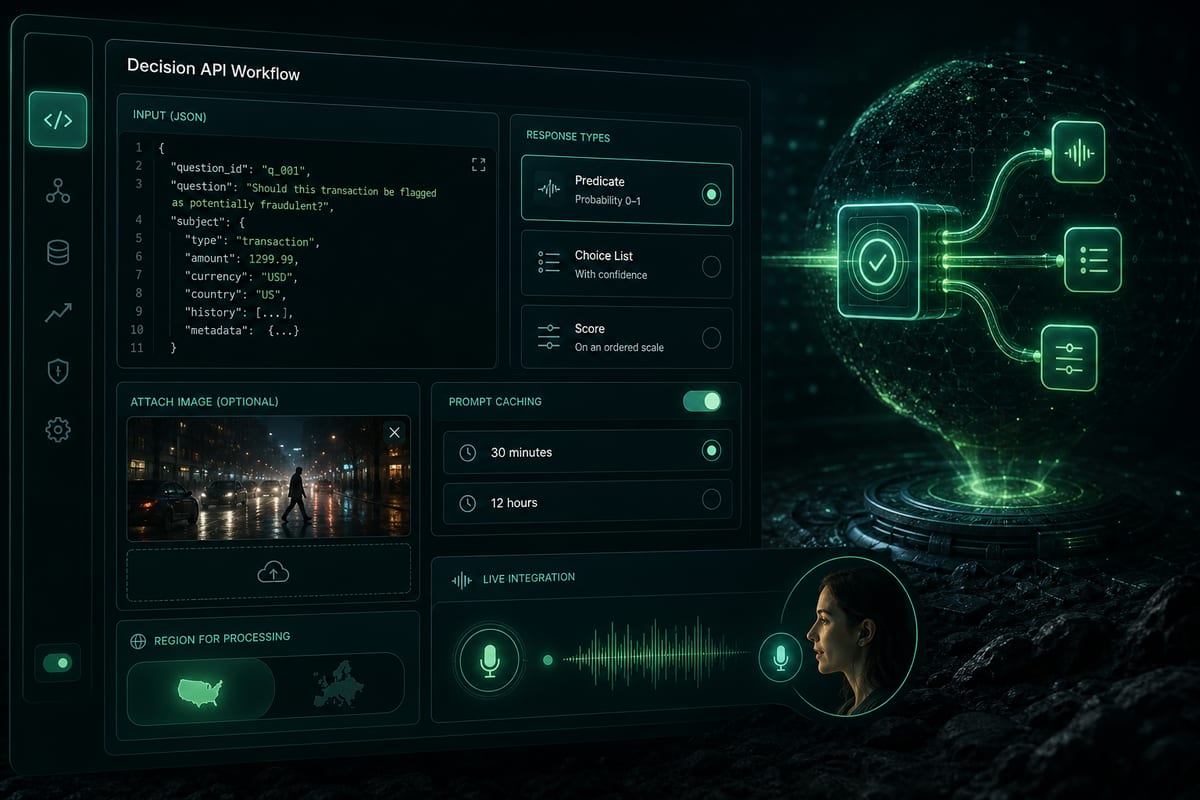
OpenAI has ended the beta phase of its Decisions API, a service designed to respond with choices, scores, or probabilities rather than generating text. Based on GPT-6 Luna and touted as being up to 10 times faster than Luna via the Responses API, the offering adopts an entry-only billing model and gains features like JSON support, caching, and integration with GPT-Live. Despite this launch, independent rankings still place Jev, the model from TypeSafe AI, ahead of OpenAI's implementation.
Rankings Dominated by Others and Pricing Above Jev
In the AIM System One Index and the Artificial Analysis Decision Index, OpenAI's Decisions model ranks behind Jev, while Liquid's D1 Ultra and Base Lab's Elephant-1 occupy the top spots. In terms of pricing, Decisions costs $0.10 per million tokens for input and $0.01 per million tokens for caching, with no fees for output tokens. Caching is billed separately for durations of 30 minutes or 12 hours, and regional processing may incur additional costs. This pricing structure places OpenAI's offering at more than double the price of Jev, which was announced at $0.042 per million tokens for input at its launch.
Three Typed Responses to Drive Workflows
Using Decisions requires formulating a question, defining possible responses, and providing context, whether through text or images. The API does not produce text but provides a structured response, allowing the application to continue its workflow. Three response formats are offered: Predicate, which gives a probability between 0 and 1 that a condition is true; Choice, which selects an option from a list with probabilities and confidence scores; and Score, which assigns a rating on an ordered scale. A request can group up to 400 questions, twice as many as in beta, all pertaining to the same content and evaluated separately. If one question depends on another, a separate request must be sent.
Le brief IA que les pros lisent chaque soir
Les 7 actus IA du jour, décryptées en 5 min. Gratuit.
Inclus dès l'inscription : notre sélection des meilleurs guides & comparatifs IA.
Choisissez votre rythme
Gratuit · Pas de spam · Désabonnement en 1 clic
A Reoriented Luna Model and Claimed Performance
OpenAI has not trained a specific model for Decisions. The API relies on GPT-6 Luna, modified to accelerate inference. According to OpenAI, focusing Luna on bounded responses would allow decisions to be made up to ten times faster than Luna used via the Responses API.
Native JSON, Caching, US/EU Regions, and Integration with GPT-Live
The final version of Decisions accepts inputs in native JSON and allows images to be integrated directly into instructions. A prompt caching system reuses the common part of a request, such as a reference document. Inference can be processed in the United States or the European Union, along with a Zero Data Retention option for eligible clients. Decisions also natively integrates with GPT-Live, OpenAI's voice model, enabling a support agent to decide in conversation whether to clarify a request or escalate it to a human.
Positioning Against Jev, but Without Image Advantage
Decisions adopts the structure of Jev, featuring the same three types of questions and billing limited to input tokens; OpenAI's Predicate corresponds to Jev's Noul. The main difference lies in the architecture: TypeSafe AI has designed a dedicated model and training, while OpenAI adapts an existing language model. Image support is not a distinguishing factor, as Jev has also added it in its latest version. OpenAI explains that the API aims to reduce latency and costs associated with multiplying small decisions in workflows, a segment recently popularized by Jev. Decisions is now available, following a presentation on September 29 and the end of beta, and can be tested via the Decisions Playground, with documentation accessible for developers.
Brief IA — L'actualité IA en français
L'essentiel de l'actualité de l'intelligence artificielle, décrypté et expliqué chaque jour.