OpenAI Links Genetic Mutations to Literature in 32 Minutes
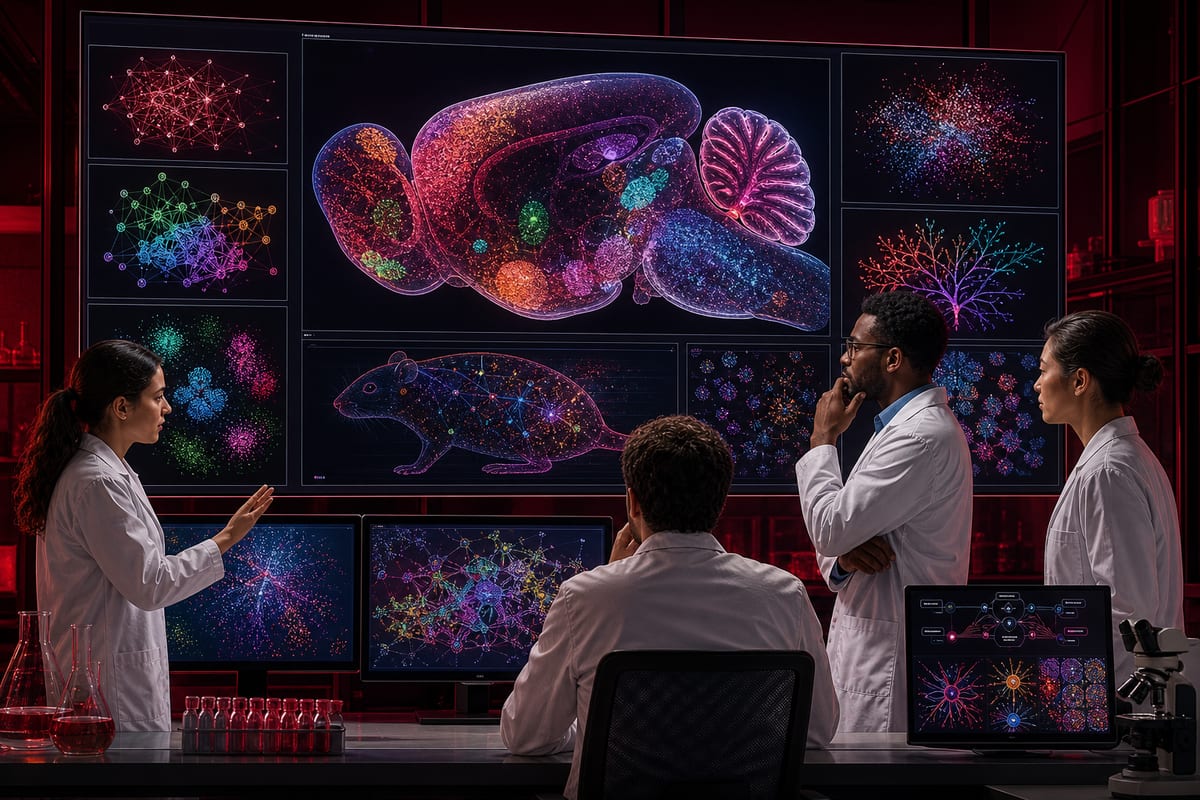
OpenAI, PerturbAI, and Scripps Research have employed thousands of AI agents in parallel to interpret a CRISPR atlas of the mouse brain. In just 32 minutes, their system linked genetic perturbations to the literature, returning results from human analyses and generating new hypotheses deemed promising by experts.
Robust Results and Expert-Followed Hypotheses
In blind comparisons, experts preferred reports generated by distributed agents 75% of the time over those from a single agent. These specialists also considered a hypothesis centered on the DCTN1 gene to be novel, significant, and worthy of further investigation. The agents uncovered unexpected differences between two disease-related genes and a potential connection between cholesterol regulation and neurodegeneration. For the Tsc2/Tsc1 axis, they identified a group of neurons and cellular alterations to explore, while cerebellar anomalies were strongly associated with TSC2 mutations, and learning and behavioral difficulties remain challenging to address despite treatments targeting mTOR for certain tumors and seizures. In the cerebellum, the disruption of Tsc2 altered the activity of dozens of genes involved in neuronal communication, whereas Tsc1 had little effect on these profiles. Regarding DCTN1, mutations of which cause Perry syndrome, the disruption of Dctn1 increased the expression of cholesterol synthesis genes. The agents linked this to research on cholesterol transport, raising follow-up questions about a potential redistribution of cholesterol in neurons and its possible contribution to neurodegeneration, as well as the importance of restoring normal distribution. Tomasz Nowakowski noted that the link between neuronal function and cholesterol metabolism offers a new way to approach disease biology.
A Consultable Atlas for Comparing Genes and Tracking Unexpected Responses
The generated reasoning atlas is available. Researchers can confront related genes, analyze unexpected responses, and identify promising avenues for exploration.
Le brief IA que les pros lisent chaque soir
Les 7 actus IA du jour, décryptées en 5 min. Gratuit.
Inclus dès l'inscription : notre sélection des meilleurs guides & comparatifs IA.
Choisissez votre rythme
Gratuit · Pas de spam · Désabonnement en 1 clic
Agent-by-Agent Distributed Reasoning Backed by GPT-Rosalind
The approach, termed distributed biological reasoning, relies on thousands of agents powered by GPT-Rosalind. The agents analyzed a CRISPR atlas of the entire brain and, for each genetic perturbation, studied cellular responses, queried the literature, and formulated explanations. Their combined reports constitute a reasoning atlas that connects genes, cellular effects, publications, and possible biological mechanisms.
Time Savings, Literature Coverage, and Expert Validation
Data derived from millions of mouse brain cells were interpreted in 32 minutes. It is estimated that a comparable human analysis, conducted perturbation by perturbation, would take several months to a year. The agents replicated results from human analyses while uncovering additional leads, with assessments of novelty and interest aligned with expert judgments in blind evaluations to help prioritize follow-up experiments. A test compared a single agent to distributed agents with constant resources: at maximum load, the single agent cited only 11 references, compared to over 700 for the distributed agents, and experts preferred the interpretations from the distributed framework. The parallel operation broadens the examination of responses, including subtle signals, and facilitates their connection to relevant literature.
Beyond Speed: The Role of AI in Exploring Large Datasets
Modern experiments produce more data than can be analyzed in detail, even as it is possible to perturb thousands of genes and measure their effects on millions of cells. Understanding the impact on human diseases requires linking complex experimental results to scattered knowledge. In datasets covering thousands of perturbations, important clues can be missed. Tsc1 and Tsc2, which together control mTOR, have similar effects in several neuronal groups, illustrating the complexity of large-scale interpretations. AI can connect new data to dispersed knowledge, with a scope that goes beyond accelerating analysis: by combining it with experimental biology, human expertise, and literature, more data can become testable ideas. Scientists remain at the heart of discovery, aiming to transform more information into knowledge that can guide the development of better drugs over time. Sarah Teichmann emphasized that AI could help more researchers explore cellular atlases and formulate new questions for evaluation. The connections identified aim to facilitate the identification of leads for future treatments.
Brief IA — L'actualité IA en français
L'essentiel de l'actualité de l'intelligence artificielle, décrypté et expliqué chaque jour.