OpenAI Reports 49 Exoplanet Candidates Thanks to Astra
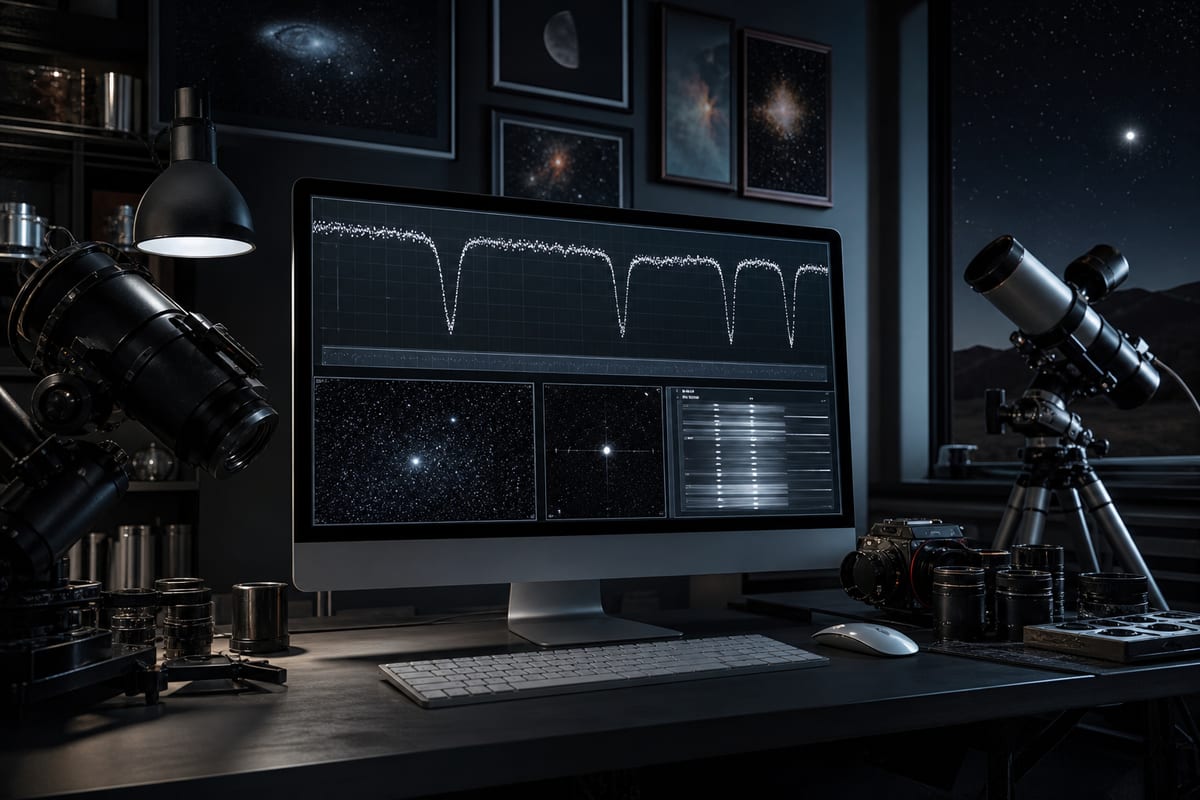
OpenAI announced on November 24 that Ethan Byrd, using Astra, has identified 49 preliminary exoplanet candidates from NASA telescope archives. Another amateur, Kevin Bond, employed Codex and highlighted two signals deemed particularly promising. No new planets have been confirmed.
Stars Can Mimic a Planet
Stars that orbit each other can mimic the dimming caused by a planet. Instruments can also introduce misleading anomalies. And a convincing pattern in a multi-year average can lose its clarity when each observation is examined separately.
In 2026, researchers studied point defects and statistical false detections affecting Kepler observations in the Monthly Notices of the Royal Astronomical Society. They found that the indices associated with several previously reported candidates did not hold up well under complementary checks. An abundance of candidates is not enough to demonstrate the accuracy of a search.
To verify a lead, astronomers may need to check the periodicity of the dimming, look for errors or suspicious gaps in the measurements, and then rule out another star or an instrumental effect. Additional observations may be necessary, particularly to measure the gravitational influence of a planet on its star. This validation can take months or even years when the object is difficult to observe.
Search software must also be evaluated on its ability to recover known planets, avoid false alerts, and distinguish telescope defects from real signals. These checks also apply to programs built with AI assistance.
A SETI Astronomer Recovers Two Signals
An astronomer from the SETI Institute has recovered the signals identified by Bond using a distinct method. This result supports the existence of variations in the observations but does not establish a planetary cause. Byrd's candidates remain less advanced in their verification.
According to OpenAI, KIC 5689121, a relatively cool star in Lyra, appears to lose brightness on a 13.8-day cycle. If a planet is responsible for this variation, its diameter could be about 2.4 times that of Earth. For the dim star KIC 6691030, OpenAI reports a periodicity of 4.8 days, consistent with a potential planet smaller than Neptune.
On Byrd's side, OpenAI indicates that one candidate has been forwarded for further examination to researchers at TESS, NASA's mission known as the Transiting Exoplanet Survey Satellite. Two others are awaiting submission. The search continues.
The AI brief the pros read every evening
The 7 best AI stories, the essentials in 5 min. Free.
Included when you join: our pick of the best AI guides & comparisons.
Choose your rhythm
Free · No spam · Unsubscribe in 1 click
How Codex and Astra Helped Amateurs
Kevin Bond, an engineer at OpenAI and an amateur astrophotographer, worked on transit detection. This phenomenon corresponds to a planet passing in front of its star, temporarily obscuring a small portion of its radiation. Its regular repetition serves as a possible indicator of planetary orbit.
According to OpenAI, Bond utilized Codex to compare already published methods, consolidate them into software, and improve it through testing. His analysis focused on about 100,000 stars observed by NASA's Kepler space telescope. The program identified over 200 signals, of which 10 corresponded to planets whose existence was already established.
Ethan Byrd, founder of Primitive, a startup specializing in email infrastructure, chose a different approach. According to OpenAI, Astra helped him examine observations of about 19 million stars, conducting a general search for possible planets and a targeted exploration of habitable zones. These regions can allow a planet to retain liquid water, provided its atmosphere is conducive.
Byrd asked Astra to review available techniques, produce the software, and then check the initial leads, OpenAI explains. The assistant thus participated in several research stages, without being a model exclusively trained to recognize transits. For amateurs with technical skills, this assistance can facilitate the creation of custom software and provide an additional means to select observations for further investigation.
How to Participate with Exoplanet Watch
According to OpenAI, participants neither sent a telescope into space nor made new observations: they utilized publicly accessible archives that researchers have studied for years. NASA also offers participation without personal equipment through the Exoplanet Watch program. Amateurs can request existing observations there.
The free software EXOTIC allows users to convert these measurements into light curve representations of a star's brightness variations. The results can then be sent to the American Association of Variable Star Observers to contribute to ongoing research. Individuals with suitable telescopes can also make observations and join coordinated campaigns.
The need for independent verification extends beyond astronomy. OpenAI has already mobilized nearly 2,000 AI agents on brain cell data: possible connections to neurological disorders still need to be validated in the lab. Predictions from models dedicated to genetic variants also require independent evidence.
Brief AI — AI news in French
The essentials of artificial intelligence news, decoded and explained every day.