OpenAI Regulates Its Breakthroughs, Community Demands Access
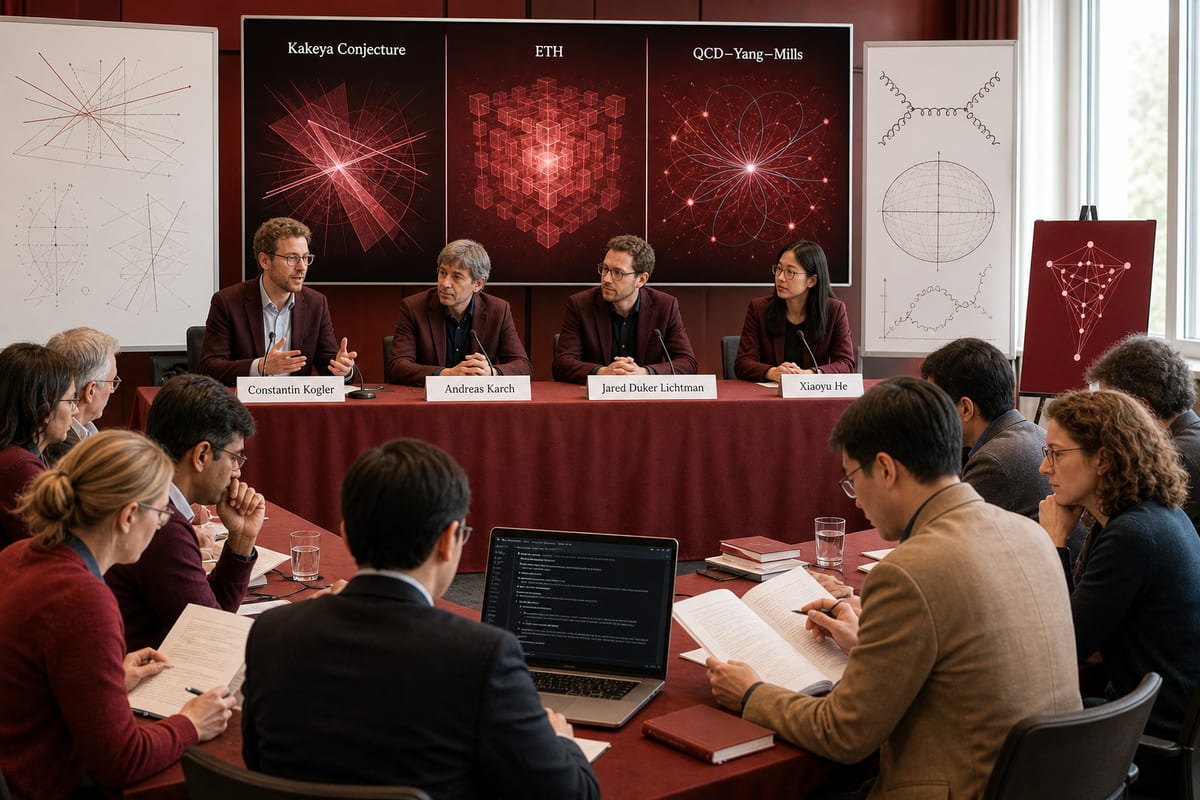
OpenAI claims to have reached a milestone in mathematics, computer science, and physics while testing a publication device supported by external experts. Researchers and the AGMAI welcome the partial openness but demand evidence and accessible releases for all, without delay. The alleged results target the Kakeya conjecture, the exponential time hypothesis, and QCD–Yang-Mills connections, but their examination remains challenging and will take time.
AGMAI Urges Open and Timely Dissemination
The day before the announcement, AGMAI warned against companies controlling dissemination in AI. The body discourages reserving initial access to a chosen circle, denouncing this practice as unnecessary, unfair, biased, and a source of delays, while capitalizing on the reputation of selected researchers. It recommends posting on academic repositories with formalized evidence, clarifications on problem selection, and dedicated support for teams analyzing the work. After the publication of the new results, AGMAI urged OpenAI to publish without delay the natural language and Lean outputs related to physics, reminding that these issues are central in physics and important in mathematics. According to AGMAI, the Lean formalization would be complete, which would remove any scientific reason for further delays, while reaffirming that understanding must progress openly and with equal access.
Researchers Support External Review but Oppose Selection
Several specialists endorse the call for third-party experts, provided that the entire community can access the documents. Constantin Kogler expresses support for the day's publication and appreciates a limited set of three results, while deeming it illogical to grant initial access to a few scientists chosen by OpenAI. Andreas Karch describes the self-selection of the review group as disastrous and suggests a competitive process, which he believes could still produce a similar high-level pool. He also questions the lack of immediate public evidence, which, according to him, would democratize access and facilitate understanding. Hassett argues that broad openness would enhance science and the adoption of tools like AI, noting that rapid breakthroughs without human input complicate reading and verification. Jared Duker Lichtman believes no method will satisfy everyone. Xiaoyu He finds the results impressive but sees OpenAI's staging as a response that does not address the main difficulties of evaluation and readability.
Le brief IA que les pros lisent chaque soir
Les 7 actus IA du jour, décryptées en 5 min. Gratuit.
Inclus dès l'inscription : notre sélection des meilleurs guides & comparatifs IA.
Choisissez votre rythme
Gratuit · Pas de spam · Désabonnement en 1 clic
What OpenAI Plans for Publishing and Explaining
OpenAI states that it relies on "shepherds" to define the dissemination strategy and adopts distinct approaches depending on the fields. In mathematics, the company has published an AI-generated output while allowing the community to organize the explanation of the result. In computer science, it plans to assemble an external group to clarify its implications. In physics, nothing has been made public yet, and OpenAI indicates it will comply with the recommendations of a panel of experts moving forward. The organization claims to be experimenting with different pathways and acknowledges trade-offs, while consulted specialists welcome the idea of external reviews but demand public access to materials.
Three Distinct Scientific Claims
In mathematics, OpenAI claims a resolution of the Kakeya conjecture in all dimensions, a problem related to the minimal space required to rotate a needle; the three-dimensional version earned Hong Wang a Fields Medal earlier this year. In theoretical computer science, the team announces a refutation of the exponential time hypothesis, related to the P vs NP question regarding the ease of solving problems whose solutions can be easily verified. In physics, the claimed result falls within the framework of the Standard Model and touches on quantum chromodynamics and its connection to Yang-Mills theory; it does not address the mass gap, although Yang-Mills is central to a Millennium Prize problem. The Standard Model is presented as a particularly advanced theoretical framework, with the strong force among the four fundamental interactions. Experts describe these announcements as "huge," "major breakthroughs," or "significant," but consider their evaluation difficult and lengthy, given the varying levels of disclosure and complexity.
A Context of Fatigue After Massive Publications in October
Monday's announcement comes amid a sequence marked by tensions with mathematicians since the release of hundreds of preprints in early October. OpenAI highlights three results in areas where major problems remain, indicating that some extend previously opened avenues while others introduce new directions. However, part of the community expresses fatigue with the announcement practices and communication methods adopted by the company.
Brief IA — L'actualité IA en français
L'essentiel de l'actualité de l'intelligence artificielle, décrypté et expliqué chaque jour.