OpenAI Claims Navier-Stokes, Debate on Data and Credit
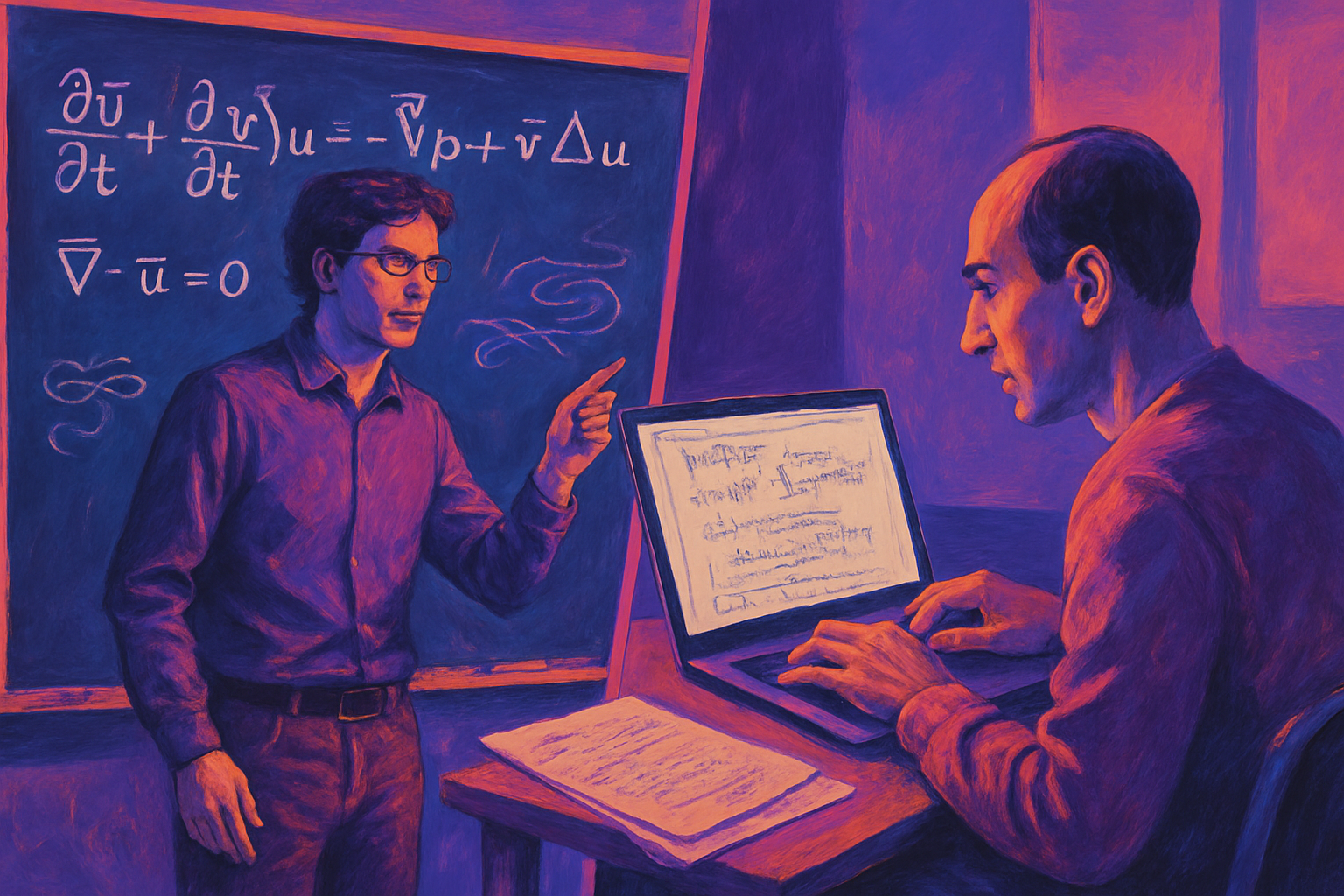
OpenAI claims to have found a solution to the Navier-Stokes problem, while acknowledging that it cannot rule out the possibility that de-identified data from customer usage may have contributed to the improvement of its models. A professor from NYU had published advancements less than 24 hours earlier on this challenge, which carries a prize of $1 million. Amid disputed timelines, claimed methodological differences, and reflections on the monetization of ideas born from its tools, the company faces questions of attribution and training data.
OpenAI publishes a "solution" and does not rule out contributions from derived data
On Tuesday, OpenAI released what it presents as a solution to the Navier-Stokes problem. The company states that it did not consult the work of Tristan Buckmaster and Levent Alpöge prior to its publication, but clarifies that it cannot exclude the possibility that de-identified data from the use of its products by these researchers may have contributed to the improvement of its models. OpenAI also asserts that its demonstration differs significantly from that of Buckmaster and Alpöge.
A $1 million prize and closely timed announcements
The Navier-Stokes problem comes with a reward of $1 million for a solution. Tristan Buckmaster, a professor at NYU, announced major advancements and published them first, following work conducted with AI models, including those from OpenAI. Less than 24 hours after this announcement, OpenAI proposed a complete solution. Buckmaster recounted a tense exchange with the company, while clarifying that he did not accuse OpenAI of anything specific and primarily wanted to outline the timeline of events.
Le brief IA que les pros lisent chaque soir
Les 7 actus IA du jour, décryptées en 5 min. Gratuit.
Inclus dès l'inscription : notre sélection des meilleurs guides & comparatifs IA.
Choisissez votre rythme
Gratuit · Pas de spam · Désabonnement en 1 clic
Disputed coordination and disagreement over attribution
According to Buckmaster, OpenAI proposed to coordinate communications and not to credit his collaborator, Levent Alpöge, who is employed at Anthropic. Sebastien Bubeck, a researcher at OpenAI, refutes this interpretation and states that he "never asked" for the attribution of Alpöge's work to be removed. Buckmaster adds that OpenAI acknowledged having looked into the problem after becoming aware of his research, while informing him that "the model had not consulted user data."
Ideas born in AI: value sharing and potential disputes
OpenAI has discussed mechanisms to benefit from user ideas that turn into successful businesses thanks to its models. Its CFO, Sarah Friar, suggests that the company should be compensated when AI-assisted work generates profits, citing the example of a pharmaceutical partner for which a licensed share of sales from a breakthrough drug could return to OpenAI. Meanwhile, Apple’s trade secrets lawsuit against OpenAI highlights the risk that sharing manufacturing secrets with AI could lead to irreversible and continuously propagated uses. This raises questions about the attribution of AI-assisted work and training data. Sam Altman also stated that the economy has "so much inertia."
Brief IA — L'actualité IA en français
L'essentiel de l'actualité de l'intelligence artificielle, décrypté et expliqué chaque jour.