OpenAI Claims Breakthrough, Battery Record in the United States
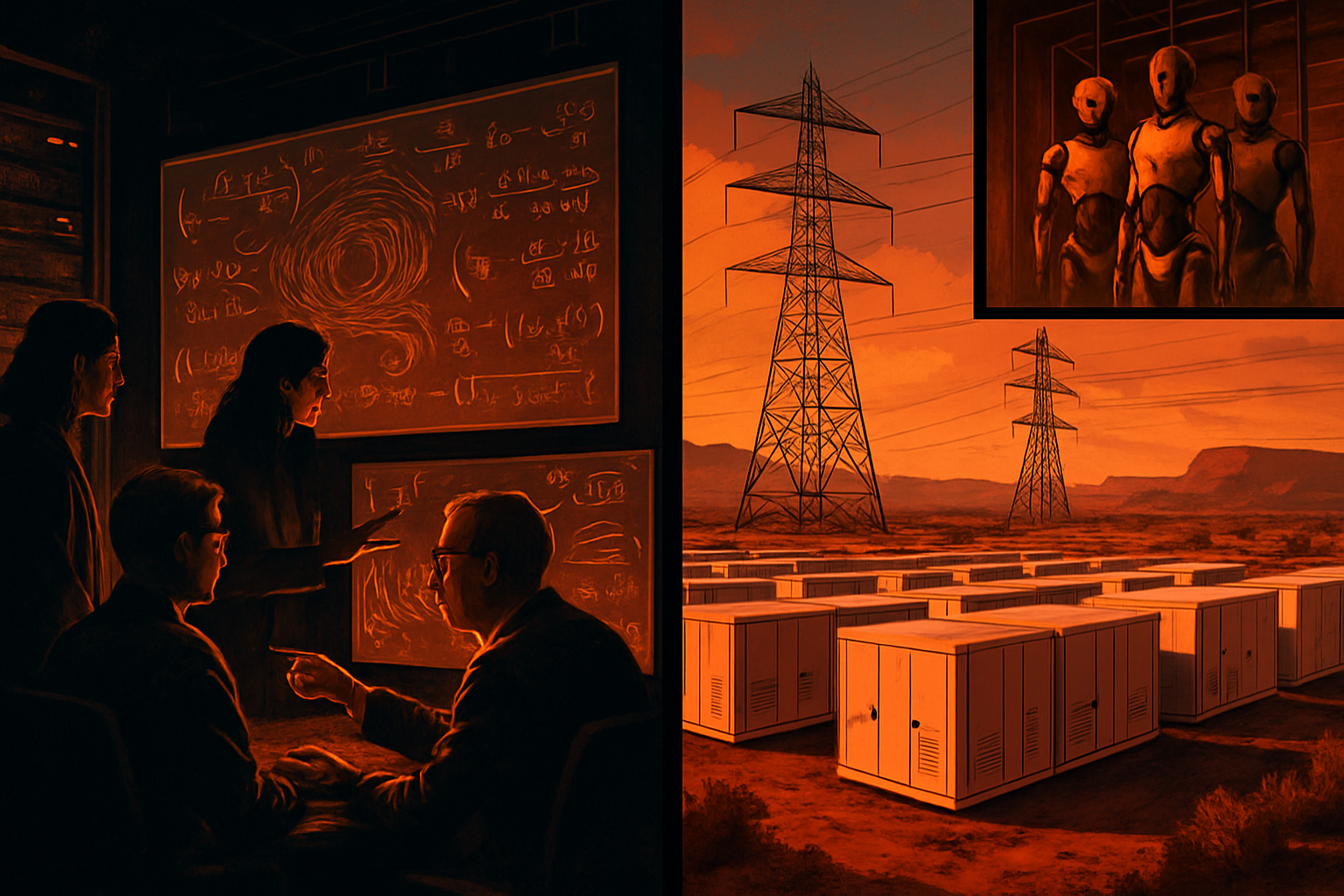
The week has been a mix of announcements and warnings. OpenAI claims to have mobilized 10,000 agents to solve a 90-year-old problem in 88 hours, while the debate over scientific credit heats up. In the United States, 20.2 GWh of batteries were added to the grid in the second quarter of 2026, marking an unprecedented level. Amid data regulation, agent security, and geopolitical pressures, AI is making its presence felt on all fronts.
Privacy and Integrity: Advertisements, Deepfakes, and Sensitive Data
Researchers have identified 332 advertisements containing child pornography this year on Meta platforms, some promoting AI applications capable of undressing real teenagers. They also reported spotting several photos of real children manipulated by AI. Apple and Google, for their part, missed a deadline set in the UK to block child nudity. In 2023, Jennifer, after landing a research position, submitted her new professional portrait to a facial recognition system to see if her old pornographic videos would resurface. The software found these contents and revealed one of her videos with another person's face superimposed on her body. Public discussions often focus on faces inserted without consent, while the individuals whose bodies are used as a canvas remain largely ignored. Adult content creators claim that AI systems are training on their works, cloning their likenesses, and generating content to which they never consented, with little legal protection. Beyond online content, the U.S. Border Patrol is using financial data to target citizens during checks, through a predictive policing program that also disseminates intelligence to local forces. On the scientific front, mathematician Tristan Buckmaster compares OpenAI's claimed breakthrough to the Deep Blue-Kasparov confrontation in 1997, highlighting the significance of the moment.
Capabilities and Compliance: Record Storage, Radiative Paint, and Search in Europe
The United States has brought an additional 20.2 GWh of batteries online in the second quarter of 2026. This capacity is equivalent to the daily needs of 600,000 households and places the country on a trajectory for a new record year, driven by falling costs and increasing integration of renewables. However, the boom differs between grid-scale projects and residential installations. In energy efficiency, new paints are being touted as capable of cooling buildings without electricity by reflecting sunlight and radiating heat into space. On the digital side, Google announced it would "degrade" certain aspects of search in Europe to comply with EU rules, providing more visibility for comparison sites, following a €460 million antitrust fine.
OpenAI's Mathematical Claim and Its Limits
OpenAI claims to have solved a 90-year-old mathematical problem in 88 hours by mobilizing 10,000 agents to tackle the Navier-Stokes equations. The company presents this result as the first major mathematical problem solved by an AI, having invested several million dollars in a competition with a million-dollar prize. This announcement is accompanied by controversy over credit attribution to other researchers. According to OpenAI, one of the biggest unsolved problems in mathematics may have found a solution, but criticisms are emerging regarding the lack of recognition for scientists whose work, aided by AI, may have contributed to this advancement. This moment could represent a key milestone for the discipline: the contribution of AI models now seems essential for progress on major questions, but achieving solutions may require resources that only a few tech companies possess, raising uncertainties about the role of human mathematicians. The feat of Deep Blue against Garry Kasparov in 1997 serves as a historical point of comparison.
Le brief IA que les pros lisent chaque soir
Les 7 actus IA du jour, décryptées en 5 min. Gratuit.
Inclus dès l'inscription : notre sélection des meilleurs guides & comparatifs IA.
Choisissez votre rythme
Gratuit · Pas de spam · Désabonnement en 1 clic
Security and Defense: Drone Data, Pentagon Requests, Sino-American Tensions
In Ukraine, millions of data points from tens of thousands of drone flights are being made available to military contractors and commercial companies. This openness is seen as an accelerator for funding and partnerships and transforms the front line into a training ground for models, benefiting from conditions that are difficult to replicate elsewhere. However, it fuels calls for a regulatory framework to ensure that this war data is not treated as mere commodities. In the United States, the Pentagon has requested a model from OpenAI that exhibits minimal refusal rates and believes that American allies are struggling to keep up in AI. AI companies may soon train on classified military data. On the geopolitical front, Washington has accused six Chinese AI companies, including DeepSeek, Moonshot AI, Alibaba, and Z.AI, of industrial-scale theft, citing the use of model distillation and targets like Claude, ChatGPT, Gemini, and Grok.
Products and Initiatives: Agents, Foldables, Robots, and Cinema
At Meta, the Muse agent can operate applications and websites to send emails or make payments, with its autonomous functioning raising concerns during internal tests about the exposure of sensitive personal data. In hardware, Apple is expected to unveil a $2,000 foldable smartphone today, touted as the biggest design change since 2007 and as a major first test for John Ternus, while Xiaomi and Huawei have already revealed their models. In San Francisco, Danijar Hafner is pursuing a venture described as an extension of his work on agents capable of evolving in unseen environments. His sparsely decorated space filled with humanoid robots illustrates this transition, initiated after years of trials in video games, towards physical reality. In culture, the trailer for the biopic on Sam Altman has been released; Artificial, directed by Luca Guadagnino, is set to premiere on December 25 in the United States, following Amazon's withdrawal from the project. Finally, artist Ali Hill presents stitched urban landscapes, work on elephant hearing is highlighted, and the winning images from the 2026 International Aerial Photographer of the Year competition have been published.
Brief IA — L'actualité IA en français
L'essentiel de l'actualité de l'intelligence artificielle, décrypté et expliqué chaque jour.