OpenAI Claims Breakthrough on Navier-Stokes, Community Expresses Concern
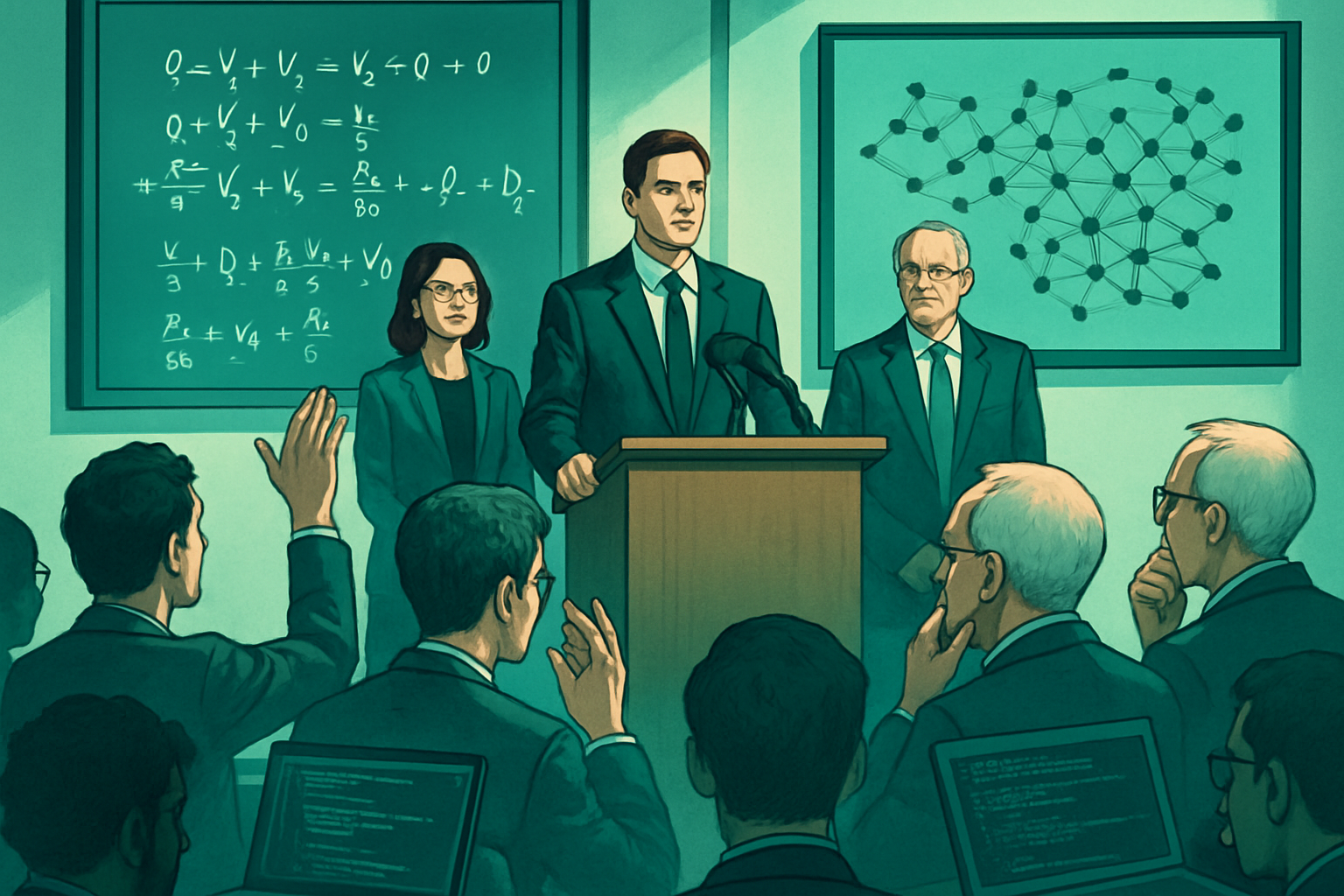
OpenAI claims that an internal model found a solution to the Navier-Stokes problem in 88 hours using around 10,000 agents. This assertion, presented as a milestone, is accompanied by accusations, denials, and calls for guarantees regarding data usage. Mathematicians fear a more secretive climate and self-censorship in exchanges.
Guarantees Required on Data Usage and Transparency
Brendan Hassett finds it concerning that OpenAI cannot specify whether its models were influenced by external work, recalling previous instances where AI companies appropriated protected works without permission or payment. He believes that companies should provide guarantees against using conversation logs to train their models and be able to demonstrate this. OpenAI acknowledges that it cannot rule out the possibility that de-identified data from the use of its products may have contributed to the improvement of its models, while denying having used specific user data. Researchers from the company have relayed these denials on X. The outcome of this controversy remains uncertain. Since a conference in Beijing, Yang-Hui He has expressed concern that mathematical research may become too secretive under the influence of large companies, while remaining optimistic about the potential of AI but worried about a possible return to an era when mathematics was reserved for closed circles.
OpenAI's Version: An Expensive, Accelerated Effort Without a Reward Aim
OpenAI describes its initiative as rushed and very costly, mentioning millions of dollars invested. The company states that it is not seeking to claim the Millennium Prize, which has yet to be awarded by the Clay Mathematics Institute. It asserts that its goal was to demonstrate the progress of its AI models. OpenAI does not appear to have publicly engaged in any notable effort on Navier-Stokes before September.
Disputed Timeline and Tense Exchanges with Academics
The day before OpenAI's announcement, Tristan Buckmaster and Levent Alpöge, the latter not acting on behalf of Anthropic, published results on a related problem. Buckmaster contacted OpenAI to inquire about the timeline and training data. He reports that an OpenAI researcher told him, "Why would you ruin your career?" and "If you don’t want me to be nice, then I don’t have to be," and that the company encouraged him to publish while crediting his model, sidelining Alpöge as a co-author. He also asked if his Codex sessions had been consulted, describing increasingly evasive or hostile responses. OpenAI denies having used specific user data and claims that neither its researchers nor its agents had seen the work of Buckmaster and Alpöge before its publication. The company later indicated that it understood the rumors concerned these two researchers, did not publicly respond to other claims, and referred to its blog when a comment was requested. Sébastien Bubeck contests some elements of Buckmaster's account and denies having requested that Alpöge be sidelined as a co-author.
Le brief IA que les pros lisent chaque soir
Les 7 actus IA du jour, décryptées en 5 min. Gratuit.
Inclus dès l'inscription : notre sélection des meilleurs guides & comparatifs IA.
Choisissez votre rythme
Gratuit · Pas de spam · Désabonnement en 1 clic
The Technical Claim: 88 Hours and About 10,000 AI Agents
OpenAI claims to have solved a Millennium Prize problem related to the Navier-Stokes equations, which concern fluid dynamics, using an internal model and a swarm of about 10,000 AI agents in 88 hours. The reward associated with this challenge is $1 million, and the problem has resisted human researchers for nearly 90 years. The company describes this result as a milestone. The prize has not been awarded by the Clay Mathematics Institute.
Rumors, Rivalries, and Tensioned Norms in the Community
OpenAI states that it launched its work after hearing rumors on Twitter about advancements on Millennium Prize problems, as explained by Sébastien Bubeck during a press conference. The company claims to have later understood that these rumors concerned Buckmaster and Alpöge. Several mathematicians were surprised by how quickly OpenAI mobilized its resources to outpace other teams. Abhishek Saha reminds us that plagiarism exists but remains difficult in cutting-edge research due to the expertise required. Matthew Ballard emphasizes the importance of a norm of trust and non-competitive sharing of unfinished ideas within the discipline. Jeremy Avigad finds it concerning that AI systems could capture ideas through queries, which might make exchanges more cautious. Saha believes that only a few significant questions would justify such expenditures by AI companies. Andras Juhasz views the announcement as a success in terms of visibility for OpenAI, while doubting the sustainability of this approach and noting that AI can amplify behaviors already observed among humans, up to "10,000 virtual mathematicians" on the same problem. The rapid activation of significant resources fuels the impression of increased rivalry over highly publicized topics, with an image effect that could prove to be pyrrhic.
Brief IA — L'actualité IA en français
L'essentiel de l'actualité de l'intelligence artificielle, décrypté et expliqué chaque jour.