OpenAI Relies on AGMAI to Publish Its Results, Distrust Persists
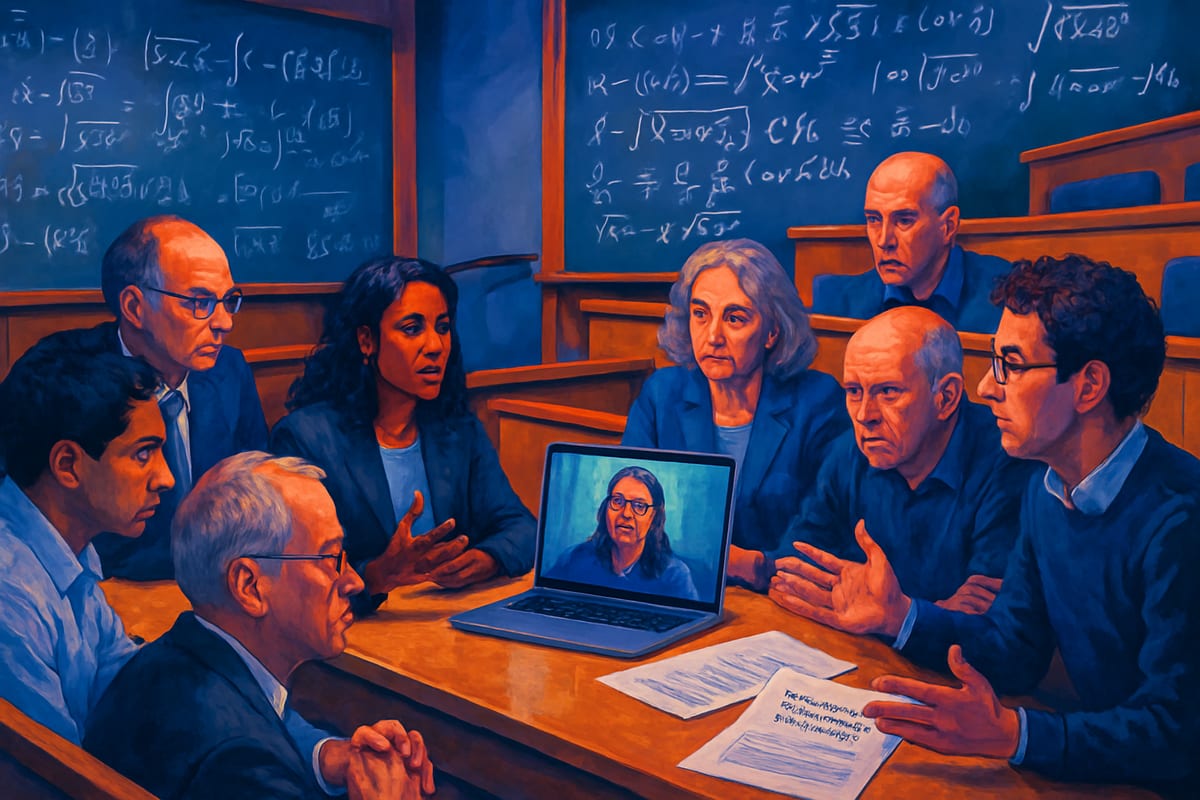
OpenAI relies on a group of nine mathematicians, the AGMAI, to oversee the review and communication of results that its internal model has reportedly already accumulated. Amid confusion regarding the independence of the council, complaints about the quality of manuscripts, and fears of a wave of revelations, researchers describe a tense atmosphere. AGMAI member Martin Hairer emphasizes the group's autonomy and the lack of support from OpenAI.
Tension and Increased Burden for Researchers Amid Vague Announcements
Researchers report poorly written manuscripts and a lack of consideration for existing literature, complicating the assessment of the significance of results and sometimes denying previous work its due credit. Some indicate that OpenAI has already discreetly modified documents after publication without notifying or precisely documenting the changes. Álvaro Lozano-Robledo describes the flood of solutions produced by AI as a burden for the community, arguing that companies do not grasp this cost. He believes that the understanding that accompanies a solution is as important as the solution itself, while AI seems to disrupt this balance. According to him, companies need the expertise of mathematicians to establish the true significance of a result and to support its recognition. For others, the burden has become personal, fueled by uncertainty and a perceived tense atmosphere. Many fear that years, even decades, of work could be overshadowed by corporate announcements seen as geared towards financial communication. Lozano-Robledo asserts that OpenAI fuels paranoia by revealing little concrete information about what has supposedly been resolved.
OpenAI Claims Over 100 Resolutions and Progress on Another Millennium Prize Problem
OpenAI claims that since announcing the resolution of Navier-Stokes, its unpublished internal model has solved over 100 open problems across various branches of mathematics, and has hinted for weeks that another Millennium Prize problem may have been resolved. The company also states it has made substantial progress on another of the seven problems, according to Laurance Fauconnet. These presentations clash with some academics: Álvaro Lozano-Robledo points out that in mathematics, a problem is considered either solved or still under investigation, with no middle ground. For him, claiming substantial progress or a stock of results without detailing their nature is not in line with academic practices.
Le brief IA que les pros lisent chaque soir
Les 7 actus IA du jour, décryptées en 5 min. Gratuit.
Inclus dès l'inscription : notre sélection des meilleurs guides & comparatifs IA.
Choisissez votre rythme
Gratuit · Pas de spam · Désabonnement en 1 clic
AGMAI's Mandate: Review and Communication of Announced Results
The AGMAI consists of nine mathematicians and is tasked with helping to coordinate the publication and communication of emerging results attributed to OpenAI's model. The group states it is open to working with other leading AI laboratories and has begun discussions with some of them. When asked about its plans, Martin Hairer clarified that the structure has just started, with no finalized roadmap at this stage.
Declared Independence of the Council and Guarantees Offered by Its Members
Martin Hairer insists on the independence of AGMAI, while acknowledging that OpenAI initially approached some mathematicians. He states that the group receives no financial, technical, or other support from OpenAI and that no member is bound by restrictive clauses beyond standard confidentiality requirements that provide advanced access to the work. He emphasizes that he does not work for the company and is not compensated by it. Hairer notes that it would be naive to think that no AI company would seek to benefit from this involvement, linking the creation of the group to the controversial history of result announcements. According to him, the primary challenge now is to gain the trust of mathematicians.
OpenAI's Communication and the Chaotic Birth of the Initiative
The creation of AGMAI was announced on September 21 by mathematicians on Terence Tao's blog, while OpenAI published its own communication emphasizing the independence of the council and the freedom of its members to publicly contest it. The company also defined the scope of the body, which is not intended to guide its internal progress in mathematics. Many observers primarily discovered the group through OpenAI's louder communication, which fueled confusion about any potential oversight by the company. The AGMAI website specifies that initial approaches from OpenAI preceded a ultimately independent establishment, without indicating which of the nine members were contacted. Martin Hairer believes that OpenAI's wording did not help, even though, in his view, nothing is factually incorrect and the words were chosen carefully by seasoned professionals. The entire situation appeared rushed, against a backdrop of OpenAI's eagerness to publish a batch of results and a stated desire to avoid another communication mishap, at the risk of reinforcing the image of an entity outside the norms of the academic community.
Brief IA — L'actualité IA en français
L'essentiel de l'actualité de l'intelligence artificielle, décrypté et expliqué chaque jour.