OpenAI Surpasses Anthropic: The AI Model Battle Intensifies
Le brief IA que les pros lisent chaque soir
Les 7 actus IA du jour, décryptées en 5 min. Gratuit.
Inclus dès l'inscription : notre sélection des meilleurs guides & comparatifs IA.
Choisis ton rythme
Gratuit · Pas de spam · Désabonnement en 1 clic
OpenAI Challenges Anthropic with Its AI Model
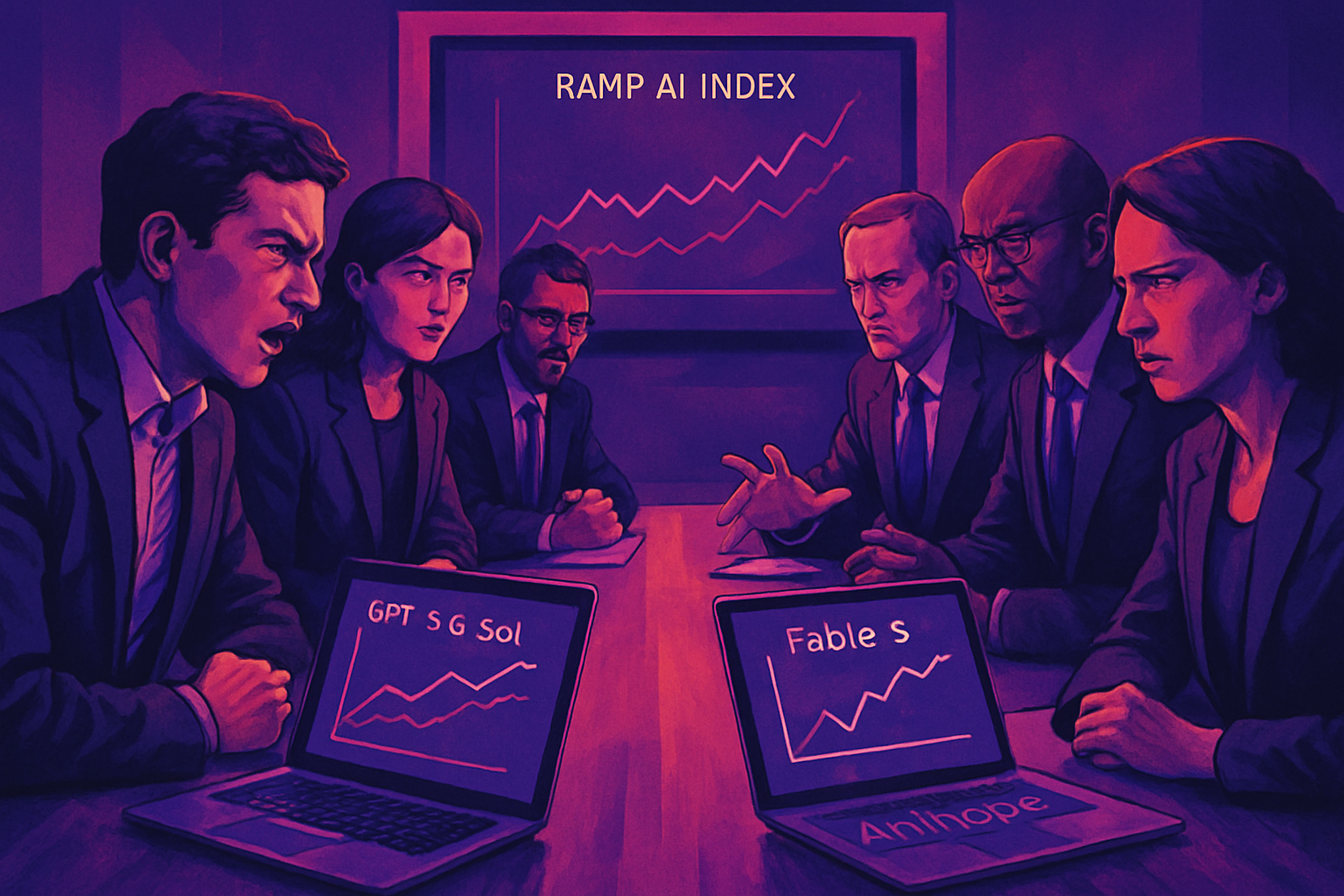
Dario Amodei, the CEO of Anthropic, leads a company that, according to the AI Index by Ramp published in July, remains at the forefront in terms of enterprise adoption. However, OpenAI made a significant mark in July with its GPT-5.6 Sol model, which surpassed the popularity of Anthropic's Fable 5 model, according to data provided by Ramp.
The Competition for Enterprise Adoption
The two AI giants, OpenAI and Anthropic, have invested heavily to attract businesses with their AI agents, which are significant drivers of spending. Although OpenAI still trails behind Anthropic in overall enterprise adoption, a glimmer of hope is emerging for the company led by Sam Altman. New data from Ramp's AI Index shows that OpenAI has gained an edge with its competitor's most expensive and advanced model.
Analysis of AI Spending
The data reveals that Anthropic's Fable 5 model generated 75% of the spending of OpenAI's GPT-5.6 Sol model in July, indicating a lower popularity of Anthropic's flagship model among businesses. While Anthropic maintains its lead in adoption, weaker demand for its high-end models could raise concerns about potential spending pullbacks from clients.
The Role of Ramp in Trend Analysis
Ramp, a financial technology company, tracks billing and spending data from over 70,000 commercial clients in the United States to analyze spending on AI tools and products. Although Ramp's clients represent a subset of businesses, often smaller ones, its AI Index is crucial for helping analysts and companies understand the competitive dynamics among AI providers.
Challenges and Strategies for Anthropic
The launch of Fable has been tumultuous for Anthropic. After being temporarily withdrawn by government order, it was reintroduced on July 1, with price adjustments throughout the month. The success of OpenAI's cheaper GPT-5.6 Sol model poses a threat. As it approaches its IPO, Anthropic is banking on clients' willingness to pay for its cutting-edge technology rather than turning to cheaper options offered by competitors.
Growth and Market Share
Despite these challenges, Anthropic has experienced impressive growth this year and remains ahead of its competitors in terms of adoption. In July, Ramp found that 43.5% of U.S. businesses were paying for AI products from Anthropic, compared to 39.7% for OpenAI. Additionally, xAI has progressed to 4%, while Google has slightly decreased to 6.2% from 6.4% previously. Ara Kharazian, an economist at Ramp, noted that integrations via Google Workspace could indicate that this figure is underestimated.
Influence of Open-Source Models
Kharazian also mentioned the rising popularity of Chinese open-source models, although this does not yet pose a sufficient threat to worry OpenAI and Anthropic.
Evolution of AI Spending
With the gradual increase in the number of businesses using products from OpenAI and Anthropic, Ramp has observed rapid growth in spending. In July, the top 1% of AI spending companies paid a median of $7,400 per employee for AI tools, compared to less than $5,000 in June. On average, a company spent about $12 per employee, up from approximately $11 the previous month.
The Impact of AI Agents
AI agents have been a major driver of revenue growth in the industry this year and have become a central development focus for OpenAI and Anthropic. Kharazian emphasized that a large portion of the AI spending tracked by Ramp came from coding agents, which can generate more tasks and lead to "exponential" costs. "That's why it's increasing so rapidly: it's scalable in a way that typical software is not," he stated.
Brief IA — L'actualité IA en français
L'essentiel de l'actualité de l'intelligence artificielle, décrypté et expliqué chaque jour.