OpenAI Outperforms Humans at the AtCoder World Tour Finals
Le brief IA que les pros lisent chaque soir
Les 7 actus IA du jour, décryptées en 5 min. Gratuit.
Inclus dès l'inscription : notre sélection des meilleurs guides & comparatifs IA.
Choisis ton rythme
Gratuit · Pas de spam · Désabonnement en 1 clic
OpenAI Surpasses Humans at the AtCoder World Tour Finals
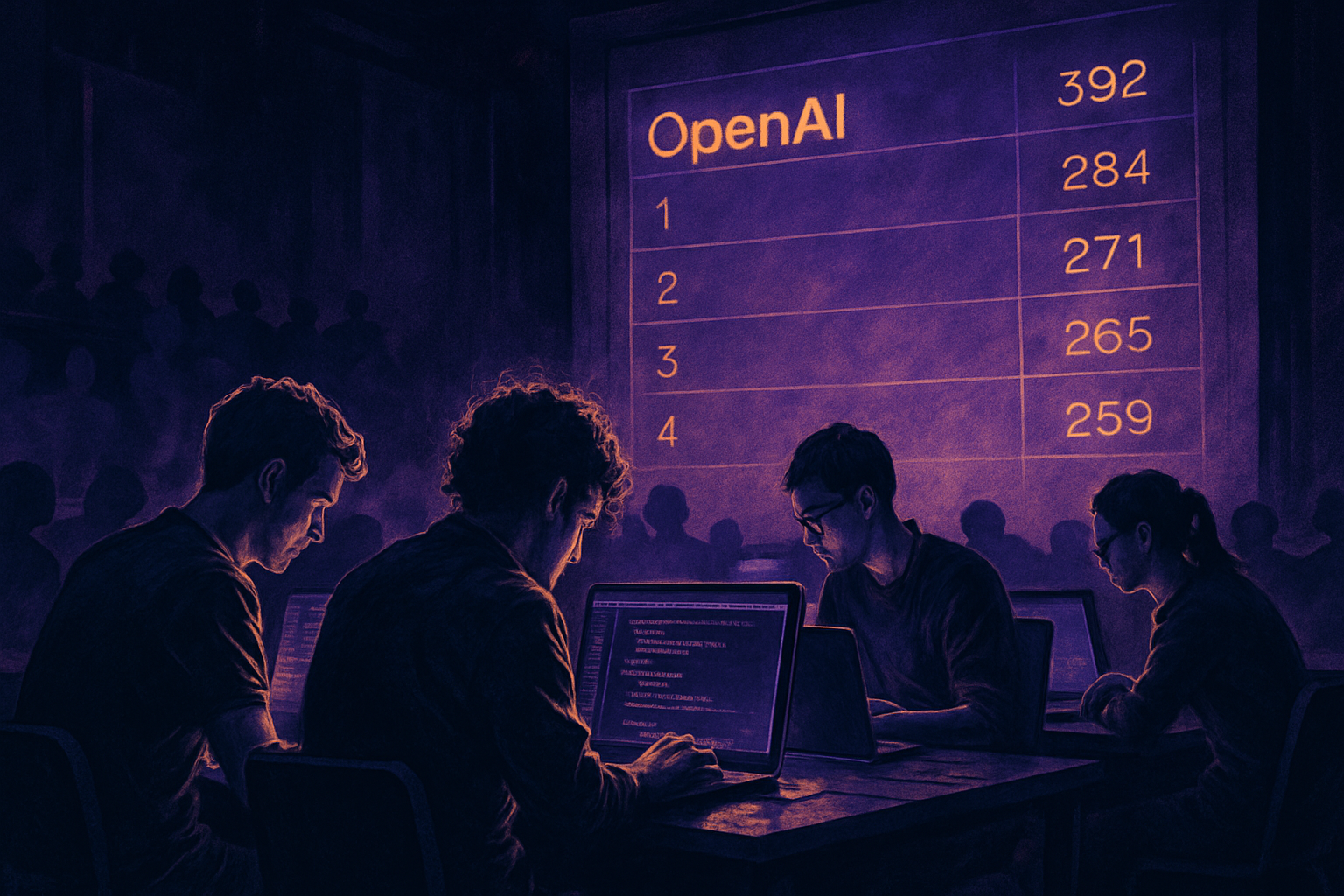
At the AtCoder World Tour Finals 2026, an OpenAI system crushed all human competitors during an exhibition match, solving all five problems in the Algorithm division. Two of these problems were deemed exceptionally difficult by observers.
The annual competition brings together the world's top competitive programmers in Japan. As part of this event sponsored by OpenAI, an exhibition match pitted an OpenAI AI agent against human finalists in a "Human vs. AI" format. A prize of 600,000 yen was offered to any participant capable of defeating the AI and finishing first.
The problems were particularly challenging. Competitive programmer Psyho (FakePsyho) explained on X that the Algorithm track on-site at AtCoder is known for problems that require intense thinking and are relatively easy to implement. This contest included two problems, D and E, which were unusually difficult even by AtCoder standards.
Two Problems Challenged the AI for Hours
Unlike previous editions, not everything went smoothly. Psyho documented the progress on X. Two hours into the competition, problems D and E remained unsolved despite several attempts, and no human competitor had solved more than one problem. The OpenAI system eventually managed to solve problem D after about three hours. According to Psyho, the AI had surpassed the stage where it quickly finds a correct solution or is completely helpless. In the end, all five problems were solved, and the OpenAI system was in first place by a wide margin.
Borys Minaiev, world champion ICPC and working on reasoning models at OpenAI, commented during the Algorithm division livestream that the outcome was actually quite unexpected. He expected the system to solve everything but stated that problems D and E were significantly more difficult than any problem the team had seen before at AtCoder. In tests on previous competitions, the system generally solved everything in under an hour, as it did for problems A, B, and C this time.
Regarding the system's architecture, Minaiev stated that it consisted of a model with a small harness to boost computing power at the time of testing. The model itself is comparable to GPT-5.6, which will be launched this Thursday. The system did not have access to the internet. Minaiev clarified that six months ago, they would not have been able to solve most of these problems.
Shortly after leaving the livestream, the OpenAI system solved the final problem, E.
A Year Ago, OpenAI Finished Second
About a year ago, an OpenAI AI finished second at the AtCoder Heuristics World Finals 2025. This model operated autonomously for ten hours under the same conditions as the human finalists. It lost its initial lead midway and was ultimately surpassed by FakePsyho. OpenAI had described this as the first known placement among the top three by an AI model in a leading programming and mathematics competition.
This time, the OpenAI model took first place with 8,300 points and five problems solved. The second-place competitor, tour1st, scored 4,300 points. No human competitor solved problems C or E.
The Final Step in a Rapid Ascent
This result fits into a pattern that has been building for some time. At the International Olympiad in Informatics (IOI) 2025, an OpenAI system achieved a gold medal level. OpenAI researcher Sheryl Hsu stated that the system ranked sixth, ahead of all but five of the 330 human participants. The leap in just one year is striking: in 2024, the OpenAI system narrowly missed a bronze medal and ranked in the 49th percentile. A year later, it climbed to the 98th percentile. At the ICPC World Finals 2025, the OpenAI system solved all twelve problems and would have taken first place, while Google's Gemini 2.5 Deep Think reached gold level.
In all these competitions, OpenAI emphasized that the systems were not specifically trained for each event. For instance, at the ICPC, the setup was a collection of general reasoning models. GPT-5 solved eleven of the twelve problems, and an experimental model managed to solve the final, most difficult problem after nine submissions, something no human team achieved.
The company's next goal is likely the International Olympiad in Informatics 2026, scheduled for early August.
Brief IA — L'actualité IA en français
L'essentiel de l'actualité de l'intelligence artificielle, décrypté et expliqué chaque jour.