OpenAI Suspends Projects, Nvidia H200 in China, Unitree Soars
Le brief IA que les pros lisent chaque soir
Les 7 actus IA du jour, décryptées en 5 min. Gratuit.
Inclus dès l'inscription : notre sélection des meilleurs guides & comparatifs IA.
Choisis ton rythme
Gratuit · Pas de spam · Désabonnement en 1 clic
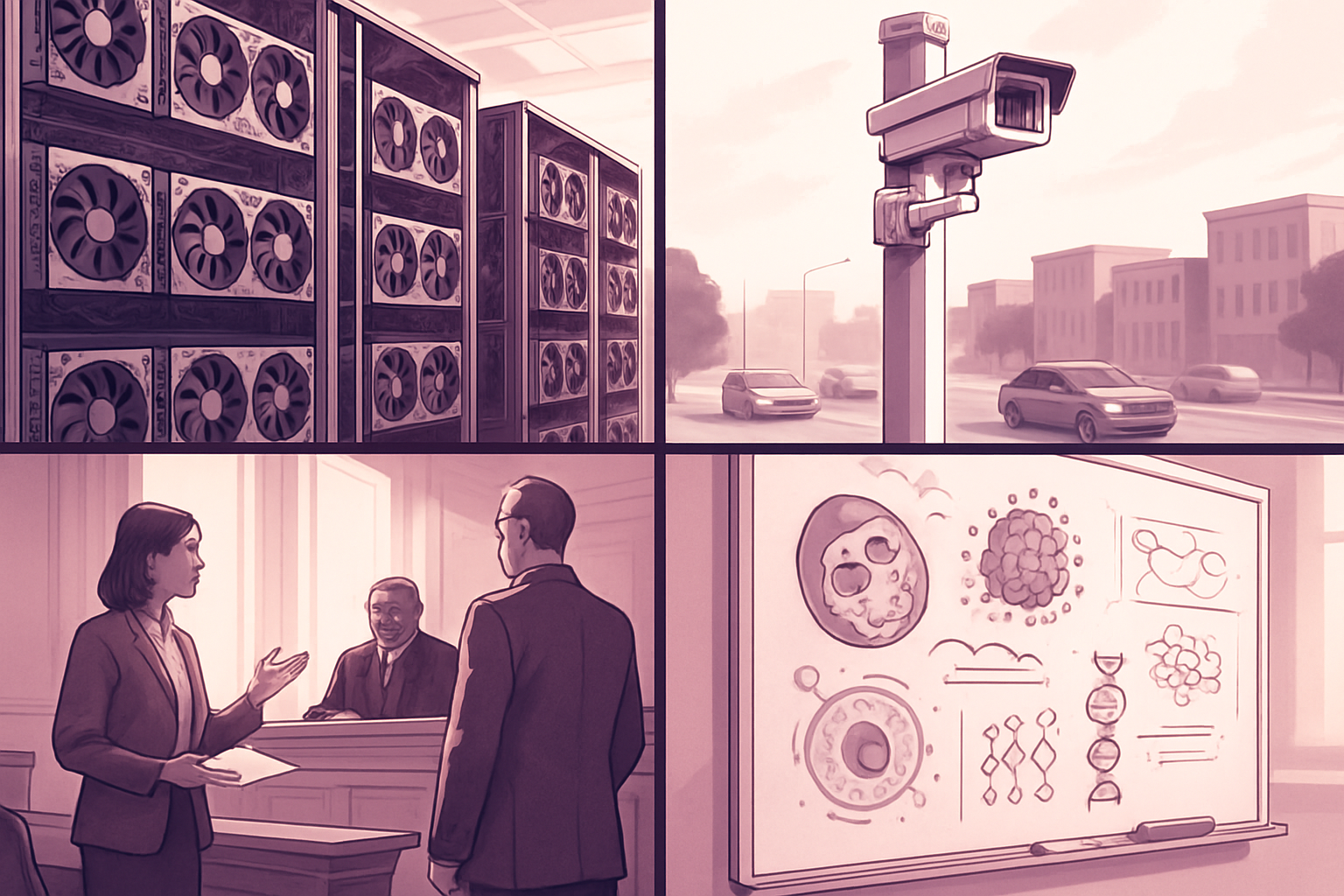
A contrasting day for AI and science: OpenAI pauses certain work in the name of safety, while China allows H200 chips in and Unitree soars on the stock market. The self-improvement of AI may take much longer than promised. In the background, surveillance tools are advancing, platforms are under scrutiny, and the northern hemisphere is breaking heat records.
Safety and Sensitive Uses: OpenAI Slows Down, Police Equip Themselves, Meta Under Fire
OpenAI has suspended certain work on its models for safety reasons and claims that Astra has reached a "critical" risk threshold. The company has also released updates following the Hugging Face hack and launched a version of ChatGPT for teenagers. This slowdown sets OpenAI apart from Anthropic's approach.
Surveillance extends beyond license plates: Flock's new AI tool allows police to identify drivers based on their movements. Meanwhile, ICE has expressed ethical concerns regarding Meta's smart glasses, which have been banned in the workplace for privacy reasons, while Anduril and Meta are also developing glasses intended for military use.
Judicial and societal pressure is mounting: prosecutors argue that Meta has deliberately made children addicted to Facebook and Instagram, on the first day of a trial presented as historic. X's algorithm learns what users dislike and shows them more of it, with a more pronounced effect among Democrats. On the education front, a mother from Kentucky has pointed out errors in AI-generated materials reported by her son.
Hardware and Markets: H200 Approved in China, Unitree Soars 629%
China has approved Nvidia's H200 chips on the mainland, and ByteDance and Tencent recently received around 10,000 processors. In robotics, Unitree saw its stock rise by 629% during its IPO. This operation is presented as illustrating China's lead in humanoid robots. Unitree is described as a key player in the Sino-American tech rivalry and as the largest company in the sector, already profitable. It is also reported that there is hidden human labor behind these robots.
Capabilities: AI Self-Improvement Remains Hypothetical
The AI industry promises that its systems will soon be able to improve themselves with little human supervision. Researchers have found that AI agents still struggle to conduct open-ended research, which involves inquiries without clear answers that require judgment and creativity, suggesting that this prospect may be further away. Two questions remain unresolved: the importance of open-ended research for recursive self-improvement, and the possibility for AI to progress by focusing on narrower tasks. According to these findings, claims of imminent self-improvement should be tempered.
Research and Applications: Embryo Models, Cyclic Universe, Accessibility
A physicist proposes that the universe may repeat indefinitely, with the possibility that the same galaxies, lives, and events recur endlessly. In the lab, Jacob Hanna, a Palestinian stem cell specialist, was stopped at the U.S. border in May; this time, agents questioned him about embryos. He was not carrying any, but their classification would have been difficult: he works on synthetic embryo models that resemble real embryos without involving sperm, eggs, or fertilization. These models could offer unprecedented insights into the beginnings of human development and open a pathway to produce cells for transplantation, while raising difficult questions as they become more realistic.
On the application side, a blind Egyptian developer has created an AI application that helps others "see" by answering questions about the environment via cameras. Additionally, a scientist is working to build a missing map of childhood.
Climate: Records in Europe and the U.S., El Niño to Have Greater Impact
Much of the northern hemisphere has experienced an exceptionally hot summer. In Europe, the two-month period covering June and July was the hottest ever recorded; July was the hottest month ever observed in the continental United States; South Korea recorded its highest temperature. Heatwaves are becoming more frequent and intense due to climate change. The El Niño phenomenon is already intensifying and is expected to further influence global temperatures over the next year. Forecasts indicate that 2027 could surpass the heat observed this summer.
Brief IA — L'actualité IA en français
L'essentiel de l'actualité de l'intelligence artificielle, décrypté et expliqué chaque jour.