Oracle and Google: TPUs Coming to OCI in 2027
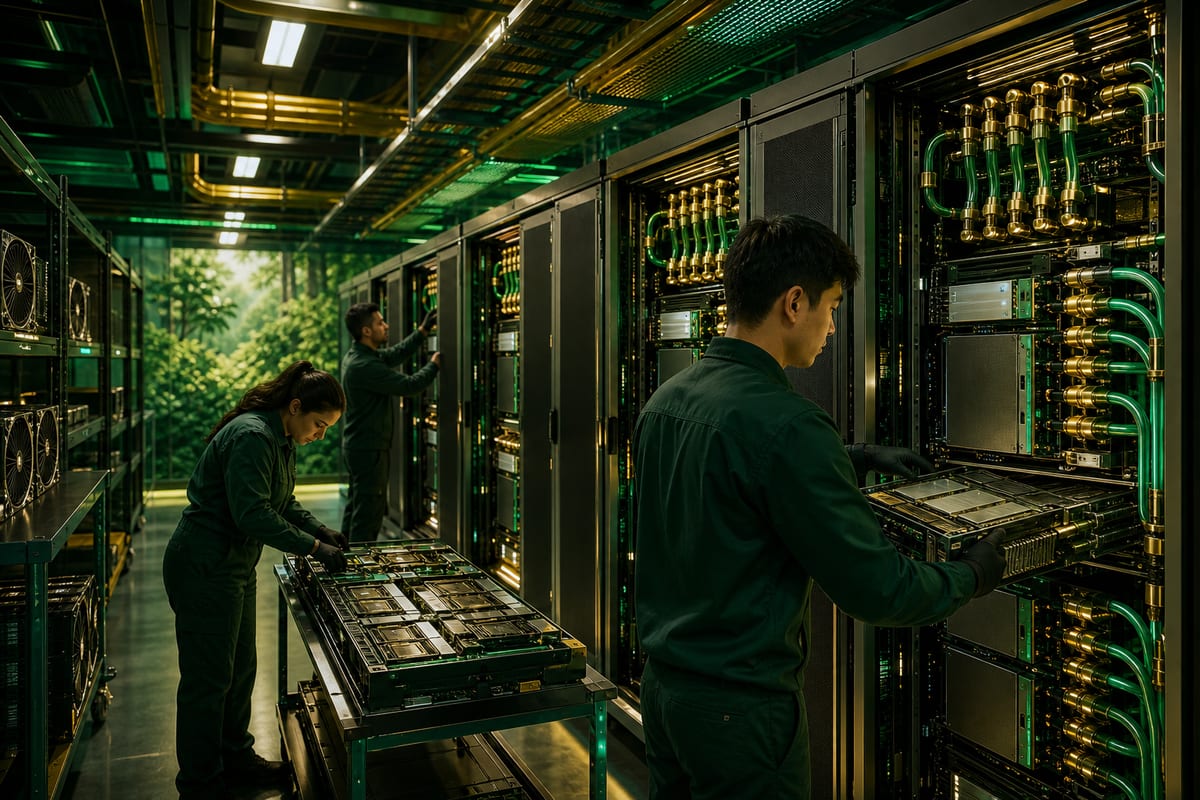
Oracle and Google are preparing for the arrival of TPUs on Oracle Cloud Infrastructure starting in 2027, a deployment that involves significant software adaptation. Microsoft, on the other hand, is reducing its allocations with Oracle and is not renewing its contract related to Bing AI. This reshaping highlights the segmentation of workloads between training and inference and a refocus on energy efficiency.
TPUs Expected in 2027 and Amortization of 18 to 24 Months
TPU processors are set to arrive on Oracle's infrastructure in 2027, with a phased deployment over several fiscal years. To absorb the human costs associated with software migration, an amortization period of 18 to 24 months of continuous operation is deemed necessary. The commissioning will lead to production throughput benchmarks in 2027, which will allow verification of whether the energy savings achieved offset the effort required for code adaptation. Once the systems are in place, it may become possible to automatically route each workload to the most energy-efficient chip.
Migration Away from CUDA and Software Integration Costs
Running models on TPUs while moving away from the CUDA ecosystem requires a software overhaul towards OpenXLA compilers, JAX libraries, or the PyTorch/LAX interface. This migration necessitates specialized skills and represents a significant initial engineering investment for teams accustomed to the Nvidia environment. Furthermore, separate hardware resources must now be allocated for training and inference phases. The technical collaboration between Google Cloud and Oracle emphasizes optimizing energy efficiency per computation operation rather than merely increasing raw power.
Microsoft’s Withdrawal and Reuse of Older GPUs
Microsoft is gradually reducing its server rentals from Oracle Cloud Infrastructure and is not extending the multi-year contract established in 2023 to manage peak activity for Bing AI. This move caused an immediate 4% drop in Oracle's stock price, amid a general decline in the semiconductor index. The machines involved were equipped with older Nvidia processors based on the Ampere architecture, which no longer meet the throughput needs of current models while maintaining energy efficiency. In 2023, the scarcity of accelerators had led to reserving all available computing capacity, including from competing companies. Microsoft has been gradually shutting down these rented server groups from Oracle over the past few months. Foundation models with large contexts and autonomous agents require intensive use of HBM memory bandwidth, leading to internal saturations on previous generations, resulting in increased latency per request and energy consumption. Despite this context, some contracts were extended in September for four-year-old chips, with a 20% markup over their original price. Two types of usage stand out: hyperscalers are bringing complex training tasks back to their own data centers equipped with cutting-edge silicon, while companies with tighter budgets are using these already amortized systems for fine-tuning and batch processing not subject to real-time constraints.
Le brief IA que les pros lisent chaque soir
Les 7 actus IA du jour, décryptées en 5 min. Gratuit.
Inclus dès l'inscription : notre sélection des meilleurs guides & comparatifs IA.
Choisissez votre rythme
Gratuit · Pas de spam · Désabonnement en 1 clic
Oracle-Google Agreement: TPU v8t/v8i and Infrastructure Requirements
The announcement of the arrival of Google TPU processors in Oracle's catalog took place on October 27, 2026, during the Oracle AI World event in Las Vegas. TPUs, which are ASICs optimized for matrix computation, rely on systolic arrays and proprietary inter-chip connections, allowing for very high-speed data transfers without congesting traditional system buses. For the eighth generation, the TPU 8t is dedicated to distributed learning, while the TPU 8i targets iterative inference. Their deployment at Oracle requires high-density power supply, a liquid cooling system for the racks, and a lossless network ensured by the OCI infrastructure in RoCE v2. This technological alliance between Google Cloud and Oracle offers an alternative solution to high-end GPUs, whose acquisition costs and availability timelines weigh on operating budgets.
Architecture Choices: H100, TPU, and A100 Based on Use
Recent Nvidia GPUs from the H100 series are intended for cutting-edge training and dense models, featuring high energy efficiency but significant thermal dissipation, and rely on the CUDA software standard. The TPU v8t and v8i on OCI are suitable for Mixture of Experts models and autonomous agents, with optimization at token per watt and an OpenXLA and JAX ecosystem. The amortized Nvidia A100 series GPUs are suited for fine-tuning and deferred batch inference, with moderate yield on large models.
Brief IA — L'actualité IA en français
L'essentiel de l'actualité de l'intelligence artificielle, décrypté et expliqué chaque jour.