Orbital Avoidance: Transitioning from MDP to POMDP under Uncertainty
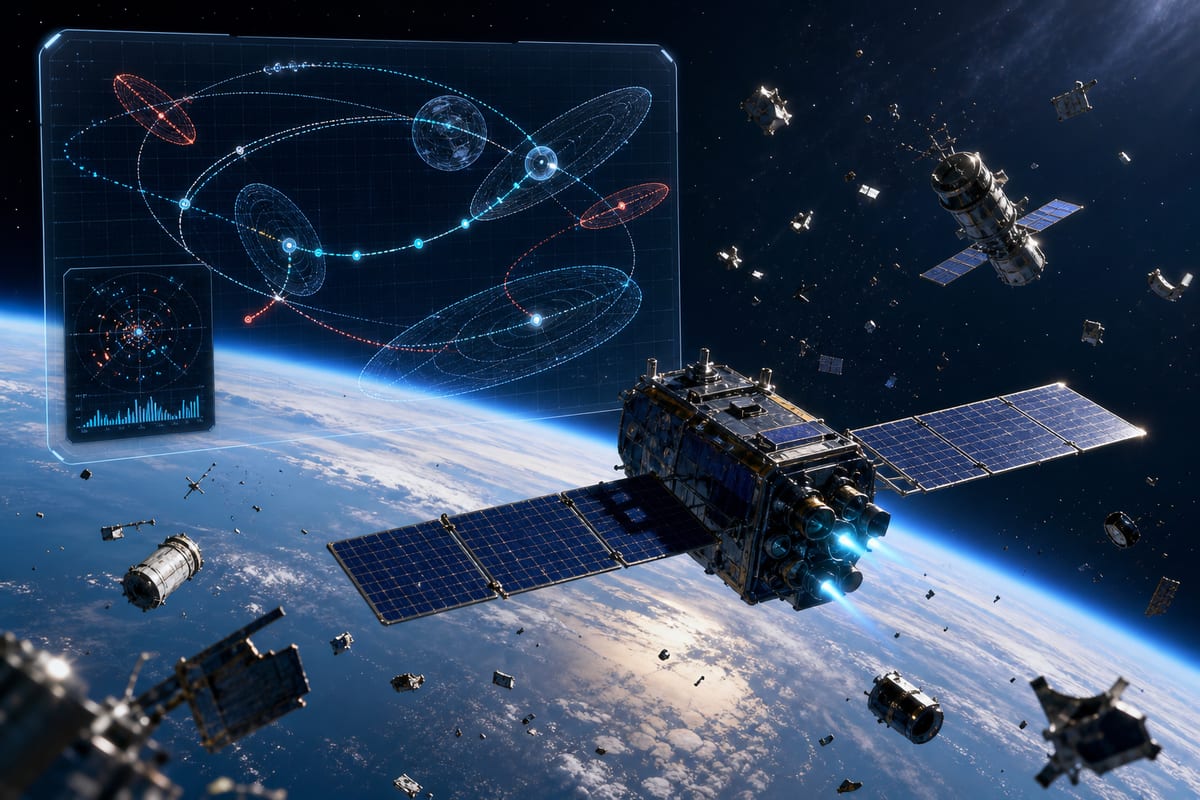
In low Earth orbit, avoidance decisions can no longer rely on perfectly known states. Sensor noise, propagation errors, and the volume of conjunctions necessitate a shift towards embedded policies that incorporate uncertainty. Beyond classical MDPs, POMDP formulations and temporal memory are required as human operations reach their limits.
Under Uncertainty, POMDPs Filter Noise Where MDPs Fail
Spatial situational awareness data combine random and epistemic uncertainty. Measurement noise and fluctuations in the synchronization of radars, telescopes, and onboard sensors produce imperfect observations, and a radar echo results in a probabilistic cloud rather than a single position. To predict the position of debris 24 or 48 hours out, engineers use propagators like SGP4, which rely on approximations of the asymmetric gravitational field, atmospheric drag related to solar activity, and solar radiation pressure. These approximations lead to a nonlinear expansion of uncertainty ellipsoids. Uncertainties are modeled by Gaussian distributions, and in practice, the satellite never knows the true state, only corrupted observations. The analogy of driving at 17,500 mph in dense fog with a GPS tainted by an error of ±100 meters illustrates the problem: an agent taking each snapshot as truth would cause erratic maneuvers. In orbit, such reactions deplete fuel and can send the craft onto a trajectory toward untracked debris. Rather than reacting to isolated measurements, AI must maintain a temporal memory of observations and construct a probabilistic belief state. This necessitates a shift from an MDP to a POMDP, transforming noisy observations into usable belief states for decision-making.
Human Workflows Are Saturated: Hundreds of Alerts and Thousands of Maneuvers
The Space Surveillance Network issues Conjunction Data Messages, of which a low Earth orbit satellite operator receives hundreds per week, with uncertain close approach distances and collision probabilities. Today, the chain relies on humans: radar detection of close approaches, automated dissemination of messages 1 to 7 days before the maximum close approach time, followed by manual analysis of covariance matrices, trajectory propagation, maneuver calculations, and command uploads. With constellations totaling tens of thousands of satellites, this loop reaches a threshold deemed unsustainable. Operators like Starlink perform thousands of avoidance maneuvers each year. If each approach required human oversight, operations would be paralyzed, responsiveness would degrade, and pressure-induced errors would lead to impacts. It thus becomes necessary to transition to autonomous onboard decision-making, with AI systems capable of processing uncertainty.
Le brief IA que les pros lisent chaque soir
Les 7 actus IA du jour, décryptées en 5 min. Gratuit.
Inclus dès l'inscription : notre sélection des meilleurs guides & comparatifs IA.
Choisissez votre rythme
Gratuit · Pas de spam · Désabonnement en 1 clic
The MDP Framework Is Appealing for Its Simplicity but Assumes the Impossible in Orbit
In terrestrial robotics and games, reinforcement learning is often formulated as a Markov Decision Process, which posits complete access to the state. The precise 3D position, velocity, and orientation are known, and the policy associates each exact state with an optimal action. Transposed as is to space traffic, this framework assumes that the flight computer observes the exact positions and velocity vectors of all objects and that a single deterministic maneuver suffices. This assumption of complete observability does not hold in the described orbital environment, which explains the failure of MDP approaches in this context.
A Densified and Energetic Environment: 35,000 Tracked Objects, 900,000 Fragments
At about 2,000 kilometers altitude, low Earth orbit concentrates an increasing number of objects. More than 35,000 residents over 10 centimeters are tracked by the SSN and USSF, associated with a risk of catastrophic impact. Meanwhile, approximately 900,000 fragments between 1 and 10 centimeters, difficult to track consistently, can cause lethal disruptions, while the population of objects from 1 mm to 1 cm is estimated at 128 million, untracked and requiring protection. At speeds of 7.8 km/s, or about 17,500 mph, a collision can destroy an active satellite. Each impact feeds the Kessler syndrome, where debris multiplies and renders certain altitudes unmanageable.
Brief IA — L'actualité IA en français
L'essentiel de l'actualité de l'intelligence artificielle, décrypté et expliqué chaque jour.