Our Brains in Loops, Not in Calculations: What AI Overlooks
Le brief IA que les pros lisent chaque soir
Les 7 actus IA du jour, décryptées en 5 min. Gratuit.
Inclus dès l'inscription : notre sélection des meilleurs guides & comparatifs IA.
Choisis ton rythme
Gratuit · Pas de spam · Désabonnement en 1 clic
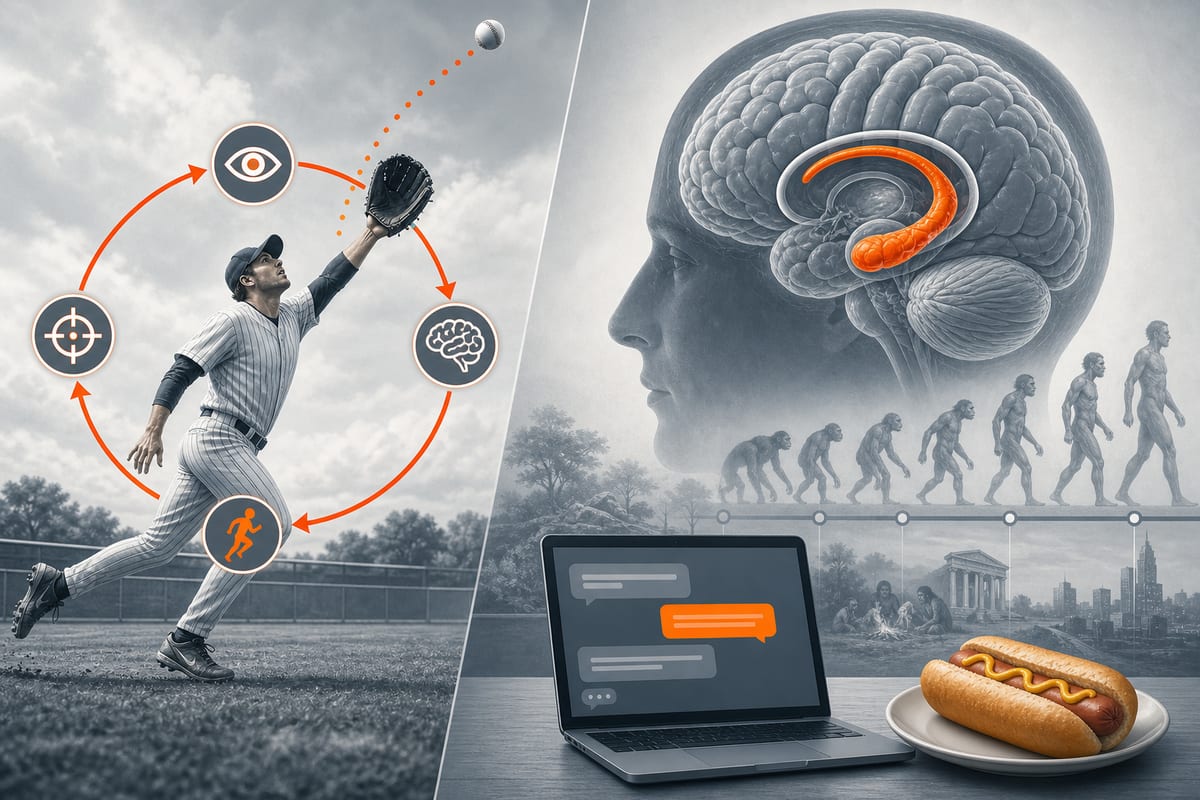
A current in neuroscience describes the brain not as a computer, but as a feedback control system. This perspective, notably advocated by Paul Cisek, is used to characterize AI as a "cognitive hot dog": appealing at first glance, but harmful if it becomes a regular part of the menu. It stands in opposition to narratives that equate the brain with a Turing machine or a biological computer.
The integration of AI into the "mental diet" is presented as harmful
According to this thesis, artificial intelligence products are becoming entrenched in culture, and this progression is put forward as an explanation for the disorders caused by these tools. AI is described as easy and tempting, but ultimately detrimental to the mind. The analogy used is that of the "cognitive hot dog": a product that attracts in the moment but harms the cognitive systems shaped by evolution. It is argued that AI obstructs our ability to develop the knowledge necessary to navigate the world in our minds. Similar to food, occasional use is not identified as the problem; rather, it is the regular incorporation that would be harmful. The alleged risk thus arises from the integration of these tools into our "mental diet." This integration is attributed to the desire of Big Tech hyperscalers to embed AI into our cognitive daily lives.
The brain viewed as a feedback system, not sequential computation
Paul Cisek, a neuroscientist at the University of Montreal, advocates for a model where the brain is a feedback control system rather than an information processor. From this perspective, the organism actively adjusts the inputs it receives based on the available options. John Dewey had already articulated the idea of a circuit where the motor response also determines the stimulus. This view is presented as consistent with the biological architecture resulting from evolution: over time, new behaviors emerge in response to environmental possibilities, extending control over the world. It proposes mapping the emergence of behaviors and overlaying them with brain structures, for example, the emergence of exploration systems with the mobility of vertebrates, linked to the development of the hippocampus and episodic memory. Cisek calls for abandoning algorithmic input-output models in favor of dynamic models. It is also suggested that the computational framework does not align with observable structures and obscures the role of control in interactions with the environment.
The example of baseball illustrates two opposing approaches to action
Catching a ball in mid-air can be interpreted as a calculation problem or as a feedback regulation. In the first interpretation, one would need to estimate speed and gravity and perform implicit mental calculations to predict the trajectory. The second proposes a practical rule: keep the ball in the same position in the visual field and move accordingly. This heuristic avoids separating mind and movement and invoking complex calculations. It is presented as better corresponding to the experience of outfield players.
The computational model and its proponents face historical reservations
The brain-computer analogy, formulated as early as Alan Turing, schematizes thought in sequences of input, computation, and output, where perception leads to cognition and then to action. This representation has fueled advancements in computing, from adding machines to artificial neural networks and generative AI. Public figures have echoed this assimilation: Norbert Wiener linked techniques to the thinking of the time, Demis Hassabis speaks of the brain as a biological counterpart to a Turing machine, and Elon Musk refers to it as a biological computer. In contrast, John von Neumann doubted that this model captures the exceptional complexity of the nervous system. The critique reminds us that these systems have evolved to enable organisms to act within an ecosystem and exert control, which computational reverse engineering tends to overlook.
Millennia-old social feedback loops and their alleged distortions
A decisive part of human feedback loops is social. It is argued that the computational model captures them poorly, just like the AI industry. Norms and institutions for knowledge transmission have been built over millennia: imitation of gestures followed by sounds, the emergence of oral language, sedentarization and the development of agricultural practices, the creation of writing to represent languages and ideas, and to transmit complex concepts across generations. Formal education has been established to ensure the sharing of knowledge, and collective decision-making mechanisms such as markets, law, and democracy have emerged. This cultural dynamic is described as continuous with biological evolution, aiming for increased control over the environment, but susceptible to undesirable effects. The food example illustrates these deviations: the ancient scarcity of fats has shaped our attraction and storage, while agriculture has made these foods abundant, with hot dogs as an example. Meanwhile, it is argued that, for less than a decade, Big Tech companies have been working to dismantle the norms and institutions of communication and learning.
Brief IA — L'actualité IA en français
L'essentiel de l'actualité de l'intelligence artificielle, décrypté et expliqué chaque jour.