Pangram Expands Its Detection to Image and Video
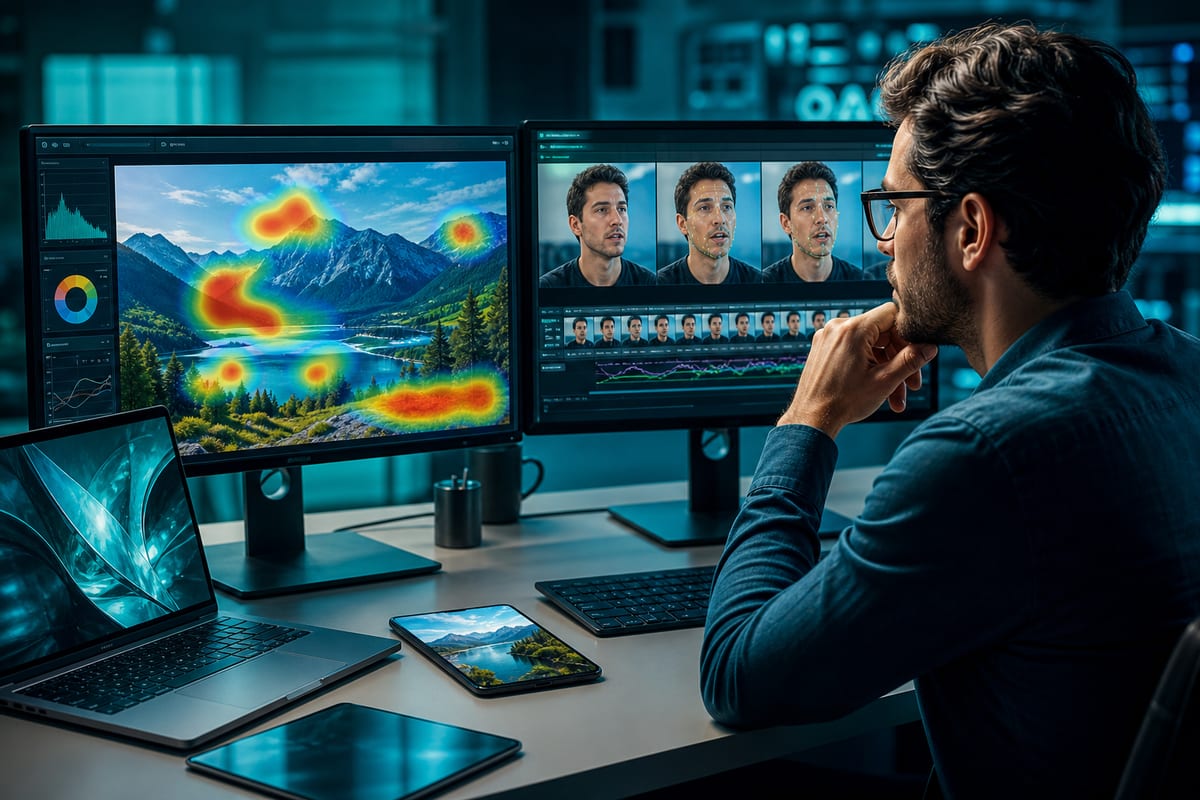
The start-up Pangram Labs now offers tools to detect AI-generated images and videos, in addition to text. The performance claims are high according to the company, without independent verification, and the models have been trained to withstand compression and edits from smartphones.
Claimed scores without audit and existing competition
Pangram Labs states that its Flash 1.0 model achieves a score of 98.7% on the DF26 corpus, which is 29 points ahead of the next detector, but these performances have not been validated by an independent team. The company also claims to outperform its rivals in detecting images and videos, without specifying which ones, while companies like Hive, Reality Defender, and Sightengine already offer their detectors to platforms and newsrooms. Pangram also offers a browser extension and an API for businesses, but its performance remains to be confirmed by external validations.
Access to new tools and terms of use
Two models are now available: Pangram Image 1.0 for images and Flash 1.0 for videos. They are accessible on the company’s website and via an extension compatible with Chrome and Firefox. Without a subscription, it is possible to submit five images per day to Image 1.0, while Flash 1.0 is reserved for paid accounts.
Analysis method: heat map and frame-by-frame processing
Image 1.0 provides a detailed analysis that goes beyond a simple binary verdict and generates a heat map locating areas suspected of being AI-generated. The model can distinguish entirely synthetic content from those modified by generative editing tools. For video, Flash 1.0 conducts a frame-by-frame analysis.
Le brief IA que les pros lisent chaque soir
Les 7 actus IA du jour, décryptées en 5 min. Gratuit.
Inclus dès l'inscription : notre sélection des meilleurs guides & comparatifs IA.
Choisissez votre rythme
Gratuit · Pas de spam · Désabonnement en 1 clic
Training to withstand compression and resizing
Visual content often circulates in compressed or resized forms, complicating the task for detectors due to artifacts. Pangram Labs indicates that it has trained its models on blurred, reduced, compressed, or noisy images to avoid confusing these artifacts with generation traces.
Claimed figures for images and DF26 protocol for video
To evaluate Image 1.0, Pangram Labs created a dataset of 100 real photos and asked 12 generators to each produce a duplicate, totaling 1,200 imitations. From this corpus, the company claims to have achieved 99.96% correct responses. In other tests, it specifies that its model detects over 99% of artificially generated images with a false positive rate of 0.27%, which corresponds to about one real photo out of 370 being incorrectly flagged. For video, Pangram Labs mentions tests conducted with the DF26 benchmark, which includes 271 authentic videos of people facing the camera and 2,420 copies produced by seven models, including Veo 3.1 and Grok Imagine. Human participants correctly identified only 52.6% of the fake videos during an experiment conducted by the creators of DF26, and the other tested detectors did not achieve better results.
Smartphones and delayed launch, a tricky case for detection
Max Spero explains that most smartphones, including iPhones, apply AI post-processing that adds detail to photos, which forces detection models to tolerate these edits without letting entirely generated images pass through. According to Pirate Wires, Pangram Labs delayed the launch after finding that photos taken with the iPhone 18 Pro were classified as artificial, then tested the detector on several units of this phone before making it public.
Brief IA — L'actualité IA en français
L'essentiel de l'actualité de l'intelligence artificielle, décrypté et expliqué chaque jour.