Perplexity Releases Decider v1.3 and Flash with Text Extraction
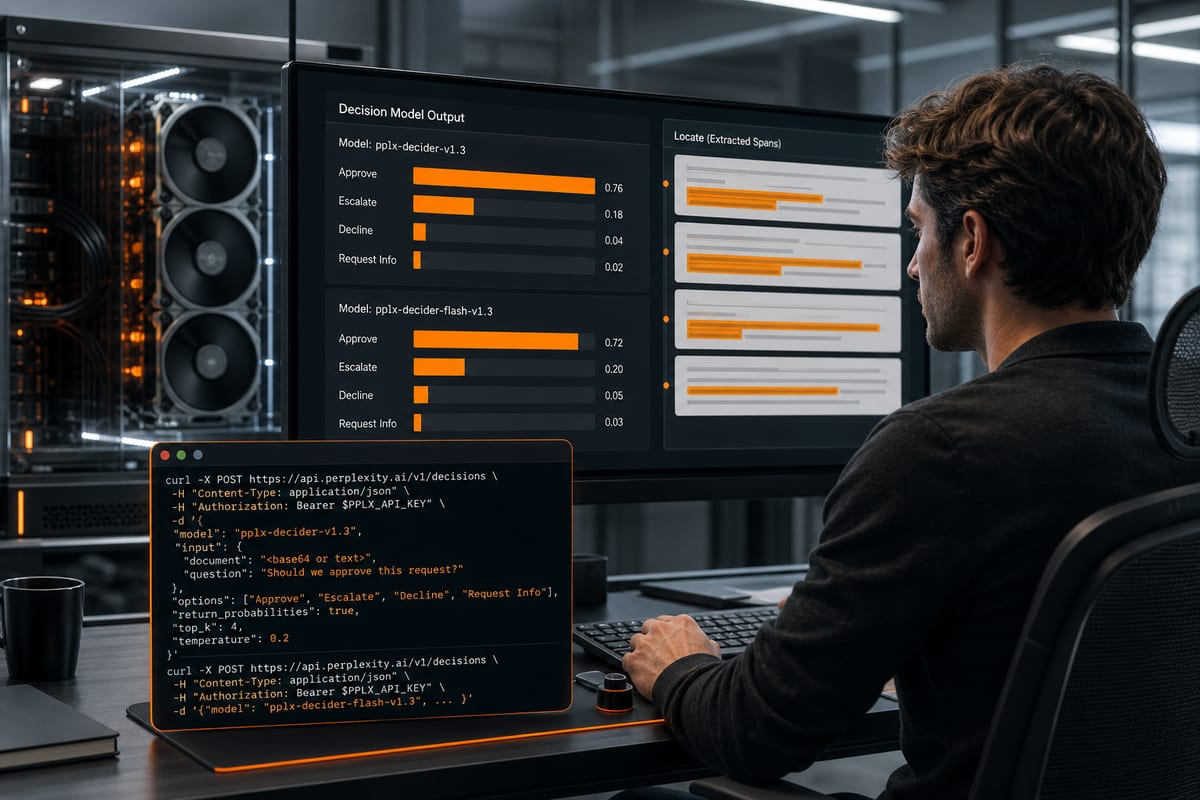
Perplexity releases two open-weight decision models, Decider v1.3 and Flash, and introduces Locate for extracting text spans. The publisher communicates self-reported cost and robustness metrics, offers low API pricing, and provides local deployment options under the Apache 2.0 license.
Announced Costs and Robustness by Perplexity
Perplexity reports a response change rate of 0.27% and a cost of $26.47 per million production queries for Decider v1.3. Over 1 million queries and 2,318,887 questions, the publisher reports a 93.98% agreement with leading LLM judges, compared to 93.35% for Jev 1.14. Robustness is said to be measured at 0.27% changes during reordering or relabeling transformations, whereas Jev 1.14 varies between 2.69% and 4.84%. The costs per million queries are also reported at $13.24 for Flash and $68.10 for Jev 1.14. In retrieval and reevaluation, Perplexity announces an nDCG@10 of 83.99 over 72 tasks, surpassing Qwen3-Reranker-8B and Jev 1.14 according to published discrepancies.
Locate Extracts Spans and Targets NER, PII, and Extractive QA
Locate allows for the extraction of exact text segments, with character offsets and fields formatted as labels or instructions. This capability pertains to named entity recognition, personal information identification, and answer extraction from text. Technically, a token <|locate|> is inserted for each field, a segment head equipped with a LoRA adapter is trained, while the main structure and decision head remain unchanged; the adapter is not merged to maintain decision accuracy. For 17 out-of-domain tasks, Perplexity indicates an average of 69.0 for v1.3 and 63.6 for Flash; Liquid d1 and GLiNER large v2.5 are reported at 43.3 and 33.6, respectively. Perplexity notes that Flash lags behind Jev 1.14 in finance, programming, and law, and that Locate queries accept up to 128 questions.
Architecture: A Generative LLM Converted to a Classifier
Decider adapts a generative language model architecture into a classifier: the output head, derived from the language head, is reduced to option tokens, and a linear head reads the hidden state at the token <|marker|> to produce probabilities. Perplexity reports that transitioning from full attention layers to bidirectional has proven beneficial in its ablations. In v1.3, attention management between questions evolves: the state has access to all questions, while each question can only consult the state and itself, all in a single pass. Learning occurs in three phases: first, a complete fine-tuning on several hundred public datasets, followed by training a LoRA adapter for specialization, and then another for vision; weights are then averaged over three seeds, and Flash is distilled by minimizing KL divergence from the main model. This family, modeled after Jev from TypeSafe, structures each query around a shared state and choice questions, with v1.3 succeeding versions 1.2, including Flash.
Le brief IA que les pros lisent chaque soir
Les 7 actus IA du jour, décryptées en 5 min. Gratuit.
Inclus dès l'inscription : notre sélection des meilleurs guides & comparatifs IA.
Choisissez votre rythme
Gratuit · Pas de spam · Désabonnement en 1 clic
Specifications, Hardware Constraints, and Latencies
Decider v1.3 relies on Qwen3.8-27B and Flash on Qwen3.5-4B, with Hugging Face indicating 26B and 5B parameters, respectively. The API input is less than 256K tokens, with a default local value of 32,768. On the hardware side, v1.3 requires about 49 GiB of weights in BF16 compared to 8.5 GiB for Flash, with no quantized variants offered. Perplexity measures a query of about 243K tokens at 16 seconds for v1.3 and 5 seconds for Flash. Locally, loading goes through Decider.from_pretrained() in the pplx_decider package, with full attention layers in non-causal mode; Perplexity recommends v1.3 for nuanced topics and Flash for high-volume routing.
Pricing, API Access, and Positioning Against Peers
The Decisions API is accessible via POST https://api.perplexity.ai/v1/decisions with the identifiers pplx-decider-v1.3 and pplx-decider-flash-v1.3, and aliases -latest; input is charged at $0.02 for v1.3 and $0.01 for Flash, with output being free. The models are also available on OpenRouter, and their weights under the Apache 2.0 license on Hugging Face. In terms of self-reported performance, Perplexity claims 91.6% over 63 query classification tasks, 6.54 points above production classifiers, and announces leading Jev 1.14 in 7 domains, up to 12.9 points in finance. In multilingual (19 tasks, 8 languages), Perplexity indicates 88.16% for v1.3 and 86.50% for Flash, compared to 85.41% for Jev 1.14; in image classification (5 tasks), 76.99% for v1.3, 1.47 points above Jev 1.14, and 72.77% for Flash. Regarding context and licenses, Jev 1.14 is given at 262,144 tokens of context, undisclosed license, and hosted access only, while Qwen3-Reranker-8B remains open-weight and self-hosted; Decider handles text, images, and Locate (text only), Jev 1.14 handles text and image, and Qwen3-Reranker-8B handles text. In retrieval, Perplexity publishes 83.99 in nDCG@10, with announced derived values of 81.75 for Jev 1.14 and 82.18 for Qwen3-Reranker-8B based on provided discrepancies.
Brief IA — L'actualité IA en français
L'essentiel de l'actualité de l'intelligence artificielle, décrypté et expliqué chaque jour.