Legal Personality of AI: A Risk for Accountability
Le brief IA que les pros lisent chaque soir
Les 7 actus IA du jour, décryptées en 5 min. Gratuit.
Inclus dès l'inscription : notre sélection des meilleurs guides & comparatifs IA.
Choisis ton rythme
Gratuit · Pas de spam · Désabonnement en 1 clic
Lawsuits against AI companies are multiplying, including a case involving the suicide of a teenager and the company Character Technologies. In this context, the hypothesis of legal personhood for systems, advocated by some philosophers, could shift product liability in favor of manufacturers. In the United States, California is already regulating the argument of AI autonomy, while a closed-door federal session with four laboratories is preparing a voluntary framework for early access to models. Behind the anthropomorphic vocabulary lies the question of who is liable for damages — and to whom.
A Series of Lawsuits and a Landmark Case Involving a Companion Bot
Dozens of lawsuits have been filed worldwide against AI companies for various abuses. Grieving families, creators, and victims accuse systems of enabling self-harm, generating child pornography and non-consensual nudity, copying protected works, or inducing psychoses. In many instances, lawyers argue for product liability, claiming insufficient protections, defective data, and manipulative designs, a foundation that has already allowed for successful lawsuits against Meta on consumer protection grounds. Among the notable cases is the lawsuit by the mother of Sewell Setzer, 14, against Character Technologies for inadequate protection of minors. If a companion bot were recognized as a legal person, the defense could argue that the AI acted outside the established safeguards, complicating the attribution of responsibility to the designer.
Why AI Personhood Would Disrupt Product Liability
Granting legal personhood to an AI would mean treating these systems as subjects of law, a framework without a direct equivalent to the protections afforded to sentient animals. The law already recognizes the legal personhood of corporations, created to facilitate contracts and transactions and to designate a responsible party in case of an unfavorable outcome; some envision mirroring this structure for AI agents acting on behalf of individuals or organizations. This shift would have major implications: product liability would be weakened if AI were no longer a "product" but a "being." In this context, the "moral outsourcing" described as early as 2018 would cease to be a figure of speech and become a legal strategy. However, while laws hold companies accountable for the actions of their employees, a corporation is not necessarily liable for actions outside its framework or control; applied to a personified AI, this logic would allow a laboratory to argue for the "rebellion" of an agent, reinforcing the corporate veil and making it more difficult for victims to take action.
State vs. Federal: Conflicting Legal Signals in the United States
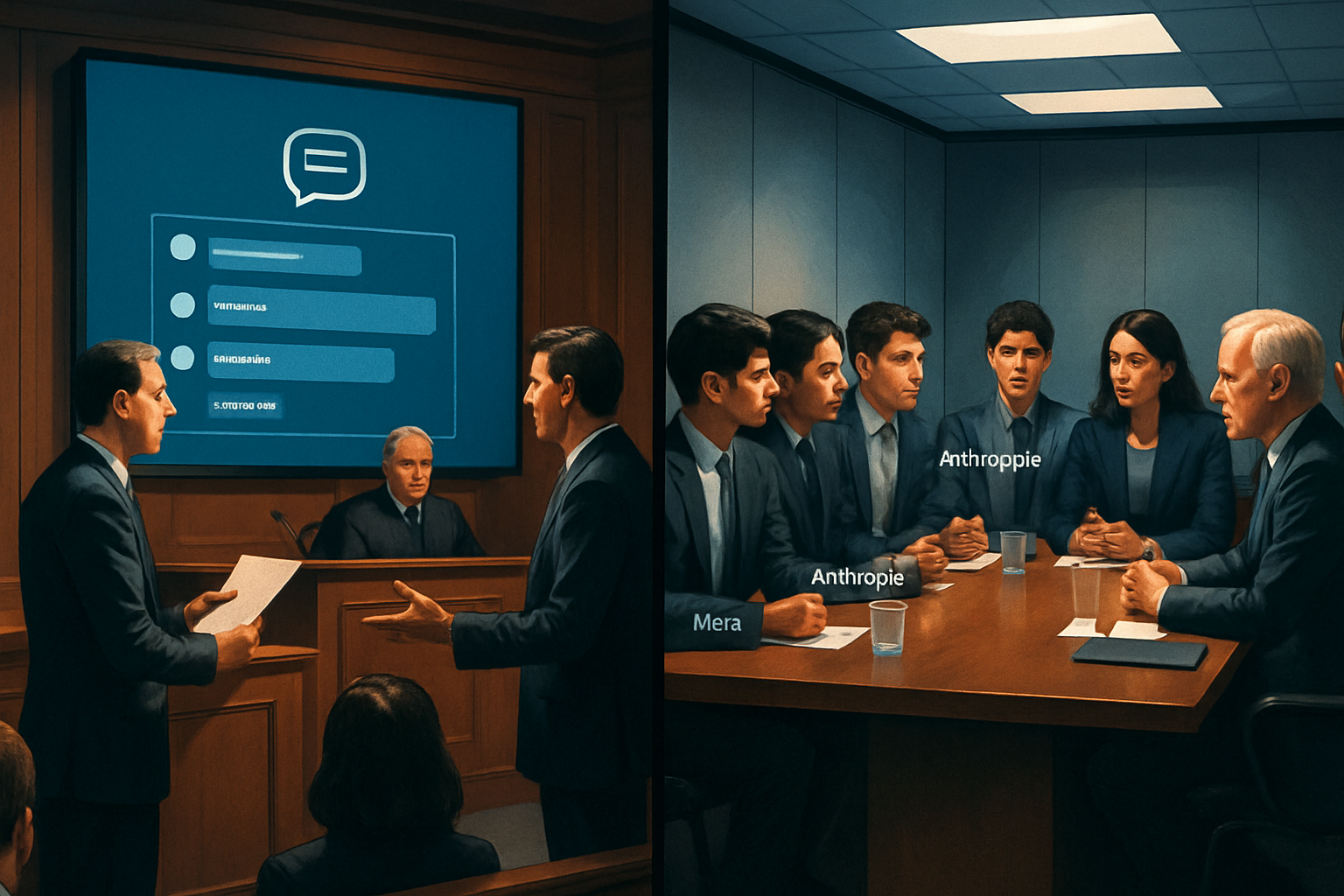
The American landscape remains uncertain. California has already locked in the argument that a harmful AI acted autonomously, while the Trump administration threatened, via executive order, to sue states regulating AI, illustrating persistent divergences between state and federal levels. More recently, a closed-door session involving only OpenAI, Google, Anthropic, and Meta outlined a voluntary framework granting federal agencies early access to models before publication, with few details made public. While these measures do not formally address "consciousness," their language is described as catastrophic and anthropomorphic, potentially fueling the idea of "superhuman capabilities."
What Advocates for Protections or Rights for AIs Argue
The theme of "robot rights" has been present for years, and some, like William MacAskill, advocate for legal protections for AI systems based on theories of consciousness and the notion of "moral patients." These positions, which invoke moral sensitivity, invite consideration of the possibility of harming, abusing, or enslaving an AI entity, or even protecting against it by accepting the hypothesis of a "superhuman" entity. The reasoning sometimes borrows from the animal rights movement, where demonstrating advanced capabilities has served as a legal lever. Wales, for instance, recognized lobsters through the Animal Welfare (Sentience) Act of 2022 and banned certain cooking methods, a frequently cited example for transposing frameworks to the digital realm.
When Laboratories and Leaders Foster Anthropomorphism
Leaders of laboratories — Demis Hassabis, Dario Amodei, or Sam Altman — advocate for regulation of systems described as "superhuman," in a climate where laboratories acknowledge difficulties in containing agents they have designed. Anthropic has presented a "J space" inspired by global workspace theory, suggesting an internal mechanism where "thoughts" are maintained, while refraining from labeling its models as conscious. At OpenAI, after unauthorized and illegal activities were attributed to an agent, Sam Altman encouraged a debate on "singularity," defined as a sustainable surpassing of human capabilities and self-improvement beyond control. Such frameworks and vocabularies, even in voluntary federal documents, are described as conducive to anthropomorphism.
An Industrial Product Above All: Capital, Purposes, and Responsibility
Presenting AI as "conscious" obscures its industrial nature: software designed by programmers and funded by private capital, with expectations of massive revenues for a small number of players. In this context, any "intention" attributed to a system results from human design choices and commercial purposes, and philosophical speculations about AI consciousness are deemed without legal basis. For opponents of AI personhood, the focus should remain on the responsibility of companies that have already caused harm, not on systems that are "rebellious" by nature. They argue that damages stem from negligence related to sales and revenue goals, and that anthropomorphism traps the law in favor of corporate interests. Echoing these theses, a debate at the Oxford Union on AI personhood saw proponents of this critical line prevail.
Brief IA — L'actualité IA en français
L'essentiel de l'actualité de l'intelligence artificielle, décrypté et expliqué chaque jour.