Small Language Models: The Future of AI in Business by 2026
Le brief IA que les pros lisent chaque soir
Les 7 actus IA du jour, décryptées en 5 min. Gratuit.
Inclus dès l'inscription : notre sélection des meilleurs guides & comparatifs IA.
Choisis ton rythme
Gratuit · Pas de spam · Désabonnement en 1 clic
The Rise of Small Language Models in 2026
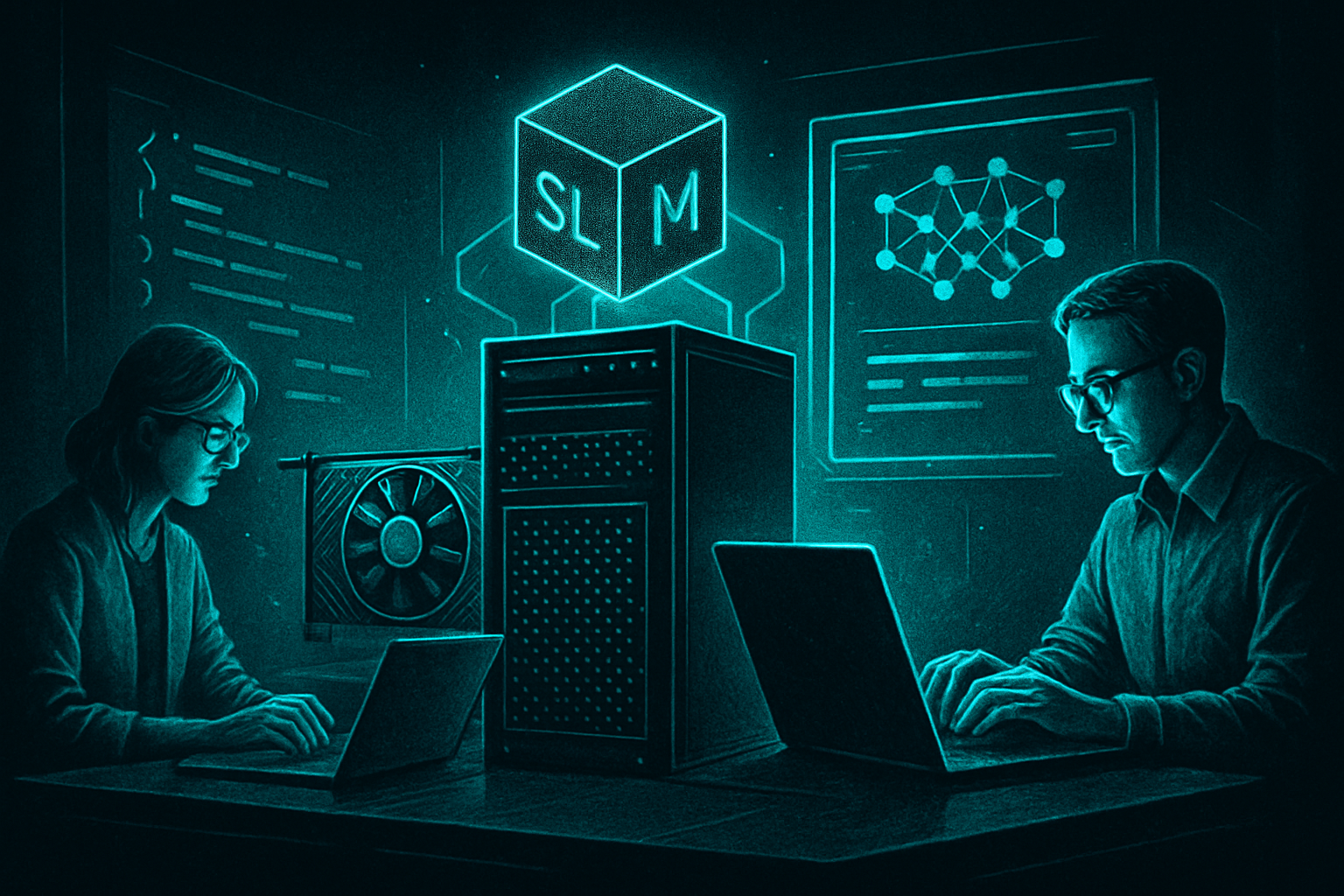
In 2026, the landscape of artificial intelligence in business is undergoing a significant transformation. While large models continue to capture media attention, companies are increasingly turning to more compact and pragmatic solutions. Small Language Models (SLMs), ranging from 1 to 10 billion parameters, are becoming essential to meet budget constraints, latency requirements, and growing data privacy concerns. These lighter models can be effectively deployed on local infrastructures or edge devices, utilizing affordable GPUs.
For data professionals, mastering the art of selecting, fine-tuning, and deploying these compact models has become an indispensable skill. Why invest substantial amounts in cloud API calls for specific tasks when an optimized model of 3 billion parameters can accomplish the same task locally and instantly? Here are five essential resources that cover the entire SLM ecosystem, from their architecture to their production deployment.
Diving into Architecture and Source Code
To understand a complex system, there’s nothing like diving in directly. The first two resources in our selection take this in-depth approach: one guides you through training a compact model from scratch, while the other immerses you in the theoretical principles underlying the construction of modern SLMs.
1. Building a Small Language Model from Scratch (GitHub)
Creating state-of-the-art language models typically requires considerable resources, such as supercomputer clusters. However, building a functional SLM from scratch is now possible with just a consumer GPU. The open-source Jupyter Notebook repository by ChaitanyaK77 offers a detailed guide to training a compact model using the lightweight TinyStories dataset. This guide removes the complexities of modern frameworks, encouraging you to interact directly with the fundamental mechanisms of model training.
Key features of this repository:
-
End-to-end pipeline: The guide walks you through preprocessing raw text to a fully trained transformer model, all within a single executable notebook.
-
Memory management: It presents practical techniques for managing GPU memory, thus avoiding fragmentation on limited hardware.
-
Custom architecture: The repository provides a minimalist PyTorch implementation of multi-head attention and feed-forward blocks, making the flow of information through the network concrete and visible.
For engineers eager to understand the underlying mechanisms of APIs, the GitHub repository "Building-a-Small-Language-Model-SLM" by ChaitanyaK77 is an excellent weekend project.
2. A Comprehensive Survey of Small Language Models in the Era of Large Language Models (arXiv)
After building a model from scratch, the next question is: how are production-quality SLMs actually assembled? This survey article explains that most modern SLMs are not built from the ground up. They are often distilled or pruned from large models. Understanding this process changes how one approaches their selection and optimization.
Here’s what the survey covers:
-
Advanced compression: The article explains the mathematics behind knowledge distillation, quantization, and low-rank factorization, enabling SLMs to maintain high performance with fewer parameters.
-
Domain-specific deployment: It details how specialized SLMs are used in regulated sectors such as healthcare, finance, and scientific research.
-
Edge deployment: The article breaks down the memory efficiency optimizations necessary to run generative text models on mobile and IoT devices.
For a rigorous, peer-reviewed literature review, check out "A Comprehensive Survey of Small Language Models in the Era of Large Language Models" on arXiv.
Strategy and Agentic Workflows
With a solid architectural foundation, the next question is how SLMs integrate into larger AI systems and how to make them work reliably in practice. The next two resources shift the focus from building SLMs to their deployment, as components in agentic pipelines and as refined solutions for specific business problems.
3. Small Language Models Are the Future of Agentic AI (NVIDIA Research)
There is a widespread assumption in the industry that autonomous AI agents require massive foundational models to operate reliably. This position paper from NVIDIA Research argues that SLMs are not only viable for agentic workflows; in many cases, they are the best choice when properly specialized.
Why this paper is worth reading:
-
Modular orchestration: The paper advocates for a heterogeneous model approach where specialized SLMs handle routine, narrow subtasks, reserving costly calls to LLMs only for complex cases.
-
Task-specific benchmarks: It shows that a well-tuned SLM, trained on as few as 10,000 quality examples, can achieve parity with large models on specialized routing tasks.
-
Economic viability: The paper explores how SLMs significantly reduce inference costs, allowing teams to run high-volume agentic workloads on less expensive hardware with reduced energy consumption.
Read "Small Language Models Are the Future of Agentic AI" via the NVIDIA Research portal to understand how enterprise automation is evolving.
4. A Guide to Small Language Models (Pioneer AI)
Understanding the relevance of SLMs in agentic systems is one thing; actually executing fine-tuning against a real business problem is another. This gap is precisely what the guide from Fastino Labs addresses. It offers one of the clearest practical roadmaps available for deciding when, why, and how to fine-tune an SLM for a specific task.
What makes this guide useful:
-
Precise task definition: The guide teaches you how to narrow down a vague objective, such as "improve support," into a precise classification task, reducing the amount of labeled data you actually need.
-
Guidelines on data volume: It provides realistic practical rules on the amount of labeled data needed based on the task. Simple classification can work with 200 to 500 examples; instruction-following typically requires nearly 10,000.
-
LoRA optimization: The guide covers recommendations for low-rank adaptation (LoRA) parameters, including optimal learning rates and batch sizes for training on standard 24 GB VRAM GPUs.
Read "A Guide to Small Language Models" on the Pioneer AI blog before provisioning your first cloud GPU for fine-tuning.
Overview of the Ecosystem
Architecture, theory, agentic strategy, fine-tuning practice: at this stage, you have the foundations to work seriously with SLMs. What remains is to know which models are truly worth your time. This is where the final resource comes into play.
5. Small Language Models: A Comprehensive Overview (Hugging Face)
Hugging Face remains the nerve center of the open-source AI community, and their overview of SLMs is the best starting point for developers looking to understand the current state of compact open-weight models. With new models released every week, this resource provides the categorization and context needed to make informed choices.
Key points from the overview:
-
Model directory: The overview provides a breakdown and comparison of widely used edge-ready models, including Llama-3.2-1B, Qwen2.5-1.5B, Phi-3.5-Mini, and Gemma-3-4B.
-
Trade-offs: The overview explains the limitations of SLMs, including reduced zero-shot generalization capability and the risk of amplified bias from smaller training datasets.
-
Local deployment tools: It highlights open-source tools like Ollama, showing developers how to run models locally with minimal configuration on consumer GPUs.
Check out "Small Language Models (SLM): A Comprehensive Overview" on the Hugging Face blog to identify your next base model.
Where to Go from Here
These five resources outline a complete arc: from training a transformer from scratch and understanding the theory of compression, to designing agentic workflows, executing your first fine-tuning, and selecting the right base model for local deployment. Together, they provide both a conceptual foundation and practical direction for working seriously with SLMs.
Where you start depends on your current situation. If you are new to the field, the GitHub notebook and the Hugging Face overview will quickly guide you without overwhelming you. If you already understand the theory and want to build something concrete, the Pioneer AI guide and the NVIDIA Research paper will deepen your thinking. And if you want to explore the underlying mechanisms in depth, the arXiv survey is the most rigorous place to begin.
The shift towards compact and specialized models is already shaping how engineering teams build and deliver AI products. These resources will help you respond to this change and contribute effectively.
Brief IA — L'actualité IA en français
L'essentiel de l'actualité de l'intelligence artificielle, décrypté et expliqué chaque jour.