Platforms: Restrictions on AI Agents, Service by Service
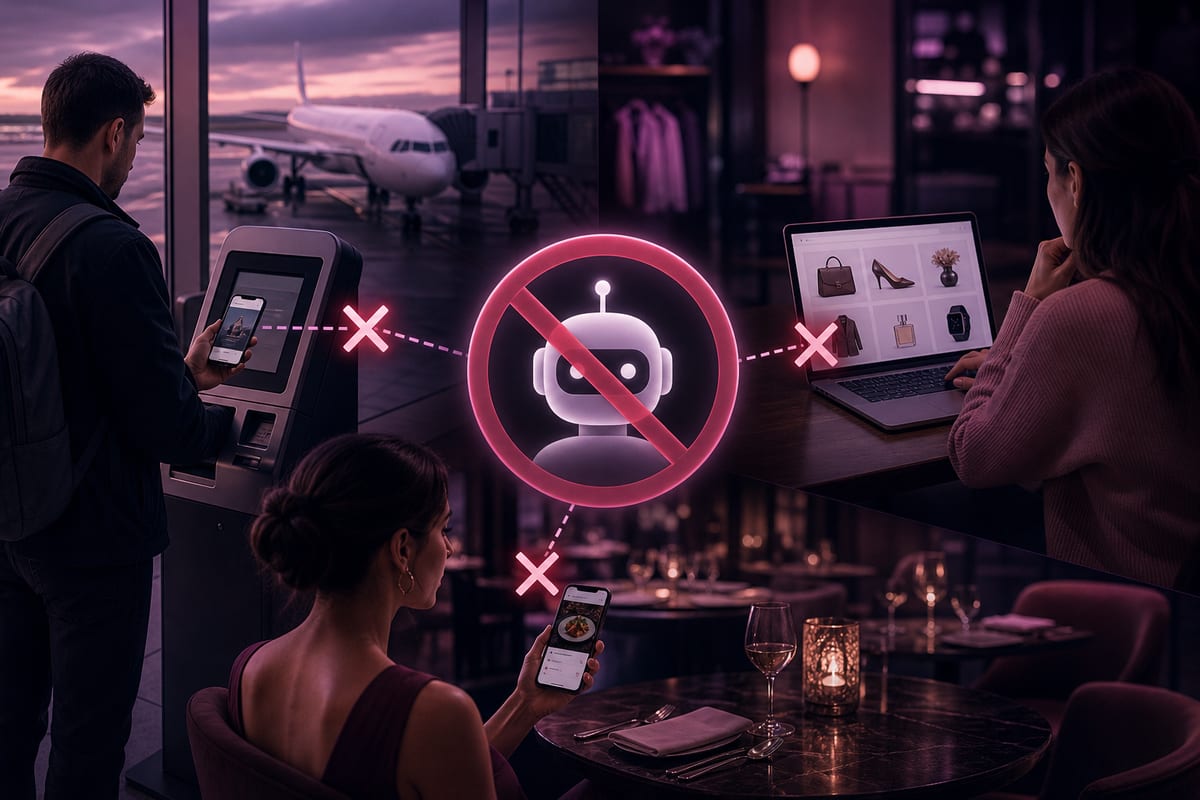
Public services are locking out AI agents. Several players are banning automated purchases and, at times, any non-human browsing, citing security, privacy, and regulatory constraints. Policies vary: total bans, prior authorizations, whitelists, or paid licenses.
United bans unauthorized agents and cites regulatory risks
United Airlines has announced a ban on AI agents and restricted access for third-party agents. The company cites security risks, regulatory risks, and the possibility of unintended purchases. It specifies that a booking made by an agent on behalf of a passenger could violate federal rules requiring human declaration on baggage contents, particularly the absence of explosives. Its policy prohibits unauthorized AI agents from searching, booking, purchasing, or managing travel on its platforms. United is the latest to adopt such a ban.
Booking.com and eBay set the framework: prior permission or prohibition
Booking.com states that it reserves the right to block individuals suspected of using AI assistants to access its platform. Automated bots are not allowed to make bookings without explicit consent, and according to its terms, any AI-based assistant must obtain prior permission before accessing the service. eBay has updated its user agreement to prohibit any automated access without the company's green light. "Shop for me" agents, LLM-powered bots, and end-to-end flows attempting to place orders without human review are explicitly targeted.
Whitelists and at-risk accounts: Target, Resy, and Yelp frame access
Target prohibits AI purchasing agents from accessing or collecting data without explicit authorization and maintains an approved list that includes its own assistant, OAI, Google, and Microsoft. Approved agents can log in, create carts, place orders, and initiate returns with customer consent, but the company can modify this list or restrict access at any time. Resy limits access to approved agents and supports discovery and booking via ChatGPT and Claude; it may block unauthorized AI activity, citing platform security issues and excessive demand, and plans to terminate accounts in case of violations. Yelp does not allow non-human traffic without explicit consent and offers a paid data licensing program that enables certain actions through approved integrations, including allowing ChatGPT users to make reservations.
Le brief IA que les pros lisent chaque soir
Les 7 actus IA du jour, décryptées en 5 min. Gratuit.
Inclus dès l'inscription : notre sélection des meilleurs guides & comparatifs IA.
Choisissez votre rythme
Gratuit · Pas de spam · Désabonnement en 1 clic
Amazon flags unauthorized agents and maintains control over access
In September, users attempting to use Muse to shop on Amazon saw a message indicating that continued access by an unauthorized AI agent violated the Terms of Use. The terms do not prohibit all AI agents, but Amazon reserves the right to limit, including through technical means, how an agent accesses, uses, and interacts with its services.
Popularity of agents and reasons cited for blockages
Companies cite privacy and security to restrict AI agents. These measures often prevent automated purchases and sometimes even simple browsing. The rise of agents, bolstered since the September release of Meta's Muse and similar tools like Instinct, has been accompanied by agent capabilities added by public systems such as ChatGPT and Claude. Sectors ranging from retail to travel are closely interested, while some fear a loss of traffic if users no longer visit sites directly. Amazon, eBay, and Target are among the companies that have already adopted restrictions.
Brief IA — L'actualité IA en français
L'essentiel de l'actualité de l'intelligence artificielle, décrypté et expliqué chaque jour.