U.S. Ports: AI Tackles Complex Logistical Challenges
Le brief IA que les pros lisent chaque soir
Les 7 actus IA du jour, décryptées en 5 min. Gratuit.
Inclus dès l'inscription : notre sélection des meilleurs guides & comparatifs IA.
Choisis ton rythme
Gratuit · Pas de spam · Désabonnement en 1 clic
The Port of New Orleans: A Pioneer of AI in Logistics
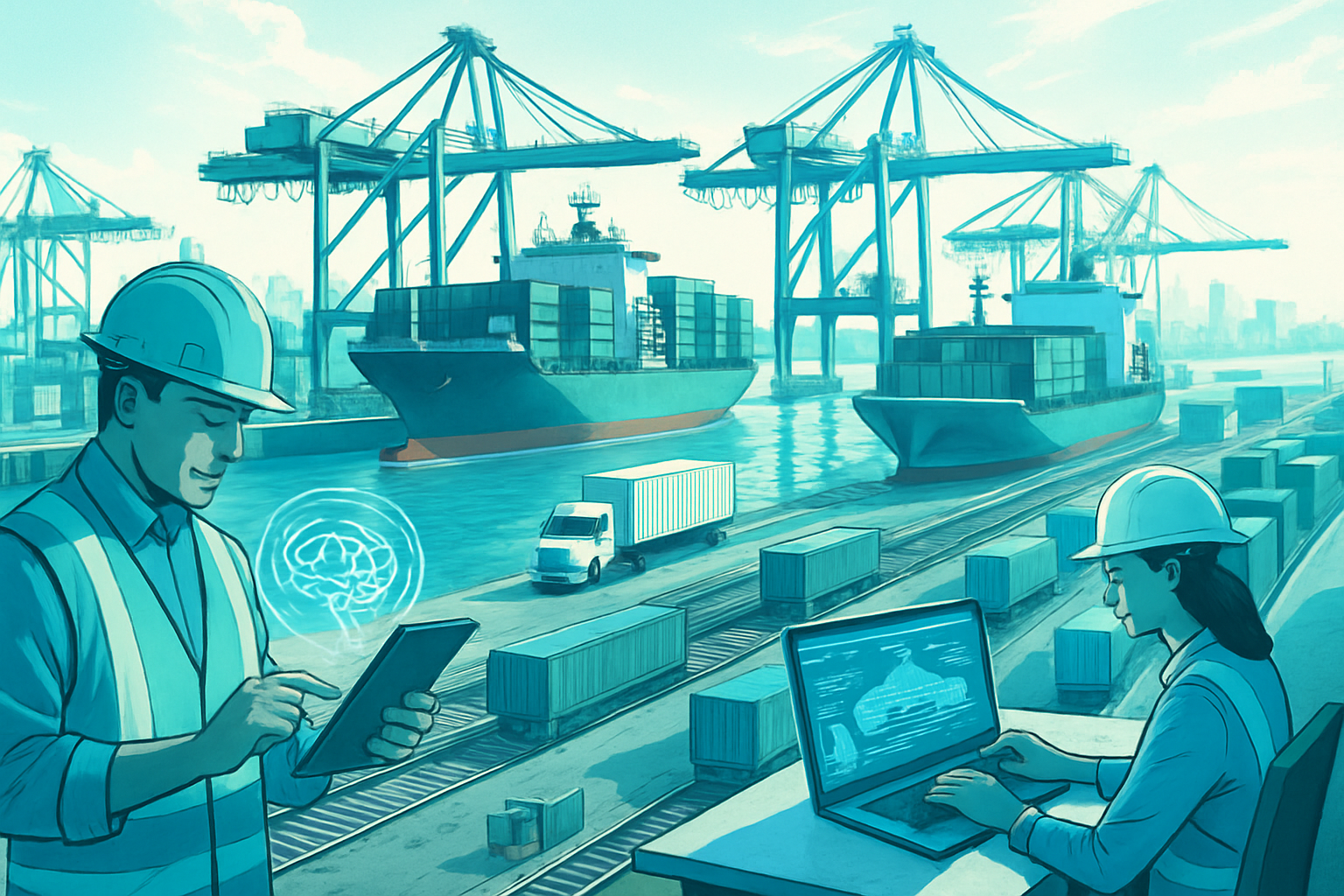
In May, the Port of New Orleans initiated a strategic partnership with the New Orleans Public Belt Railroad and the new logistics company UTC Transoceanic. The goal is to leverage artificial intelligence to optimize cargo management. By utilizing digital twins and real-time data, the port hopes to enhance the efficiency of its logistics operations.
The adoption of AI in American ports is progressing slowly, hindered by risk aversion and significant cybersecurity concerns. AI has the potential to quickly provide solutions for cargo logistics and administrative tasks. For example, at the Port of New Orleans, a ship regularly docks carrying electrical transformers, wind turbine components, and industrial generators. These pieces of equipment are essential for the construction of data centers in the United States.
Transporting these bulky items inland poses a significant logistical challenge. Often too heavy to be transported by road, the cargo must be carefully planned to ensure it can navigate through rail infrastructure. It is in this context that the port has decided to deploy AI to facilitate the planning of movements for these heavy loads.
Traditionally, workers rely on static drawings and manually input data into spreadsheets. Now, the AI being deployed uses digital twins and predictive models to assess the feasibility of transporting cargo. It also integrates real-time data, as rail tracks can shift slightly with temperature variations, according to the Federal Railroad Administration.
Kimberly Curth, spokesperson for Port NOLA, emphasized that the main advantage lies in the speed and certainty offered by AI. Once the application is fully operational, an importer will be able to enter the dimensions and weight of their cargo. The AI will compare these specifications with the digital model of the rail network to determine if the cargo can be transported safely. If issues are detected, such as clearance heights under bridges or maximum weights, the AI can recommend an alternative route.
AI Experiments in Other American Ports
The Port of New Orleans is not alone in this endeavor. Other maritime ports in the United States are also exploring the use of AI. For example, the Port of Corpus Christi in Texas has implemented digital twins to track ships, while the Port of Los Angeles has improved its truck appointment system using AI. The Georgia Port Authority, which oversees the ports of Savannah and Brunswick, has introduced AI-based facial recognition for truck drivers arriving at terminal gates. Additionally, PortCity, a logistics provider near Savannah, recently adopted EAIGLE technology to automate truck check-ins and exits.
However, AI in ports is still in its infancy, with few concrete examples in the United States. Ports are "quietly testing" AI, but the technology has not yet been "deployed at the level of adoption by the entire port community," according to Lauren Beagen, founder and CEO of The Maritime Professor and former project manager at the Massachusetts Port Authority.
An Industry Reluctant to Change
One reason for the slow adoption of AI is that ports and terminals have historically been reluctant to take risks, as explained by Rene Alvarenga, vice president of products, AI, and execution visibility at Kaleris. This company provides operating systems for terminals to 80% of global terminals.
Cybersecurity is a major concern, and most terminals prefer to keep sensitive data locally on on-site networks. This slows the integration of cloud-based AI or third-party solutions. Moreover, maritime transport is a critical infrastructure sector, and any disruption to terminals for software updates could disrupt the supply chain. As a result, terminals lag about five years behind other industries in adopting AI.
Many operators are still using systems dating back to the late 2010s, well before the advent of generative AI. "If you go to any maritime terminal today, you will not find any AI in the terminal operating system," says Alvarenga.
The transition points between the various stakeholders in the port are also constant sources of friction, according to Amir Hoss, founder and CEO of the software company EAIGLE. Different entities own and operate cargo ships, maritime terminals, railroads, trucking companies, and chassis that secure containers on trucks or rail, each with its own technological systems and data practices.
"This is undoubtedly a more significant barrier than the technology itself," adds Hoss.
The Promises of AI for the Future of Ports
Despite these obstacles, AI offers numerous potential use cases in ports. Traditionally, coordinating a large industrial shipment, such as those arriving at the Port of New Orleans, would require weeks or months of engineering studies, communication with multiple railroads, and the collection of fragmented data. With AI assessing cargo dimensions and a digital twin of the rail network, the Port of New Orleans can provide clients with an almost immediate response and more accurately determine if a route is feasible for a specific piece of freight.
Some port and terminal employees are also using AI models like ChatGPT or Claude for daily administrative tasks, such as sending emails, billing, or accounting. Terminals have added chatbots to their websites for customer support, allowing a cargo owner to inquire about the status of their container and receive an AI-generated response.
"The internal productivity gains from generative AI are real in maritime terminals, just as in any other industry," states Alvarenga.
Towards a Co-Pilot Role for AI?
Alvarenga often discusses with terminal operators the possibility of AI acting as a co-pilot for workers. Someone in a terminal's control room could pose problem-solving questions to an AI in natural language, such as: "There is a long line at the gate. How can I reduce it?" Or if they are unsure how to do something technical, they can ask the AI instead of sifting through hundreds of pages of manuals. The AI would respond in natural language with step-by-step solutions.
Although this application is not yet in place in American terminals, operators are showing increasing interest in AI as a co-pilot. Alvarenga predicts that real use cases will emerge in about three years as ports begin to implement the technology.
The Port of New Orleans also views its AI project as a means to assist humans. Curth stated that the technology will quickly provide insights, but rail staff, terminal operators, and logistics professionals will continue to use their judgment to plan how a large piece of cargo moves through the supply chain.
"The strongest applications combine advanced technology and human expertise," concludes Curth.
Brief IA — L'actualité IA en français
L'essentiel de l'actualité de l'intelligence artificielle, décrypté et expliqué chaque jour.