PSI Claims AI Breakthrough on Quantum Conjecture
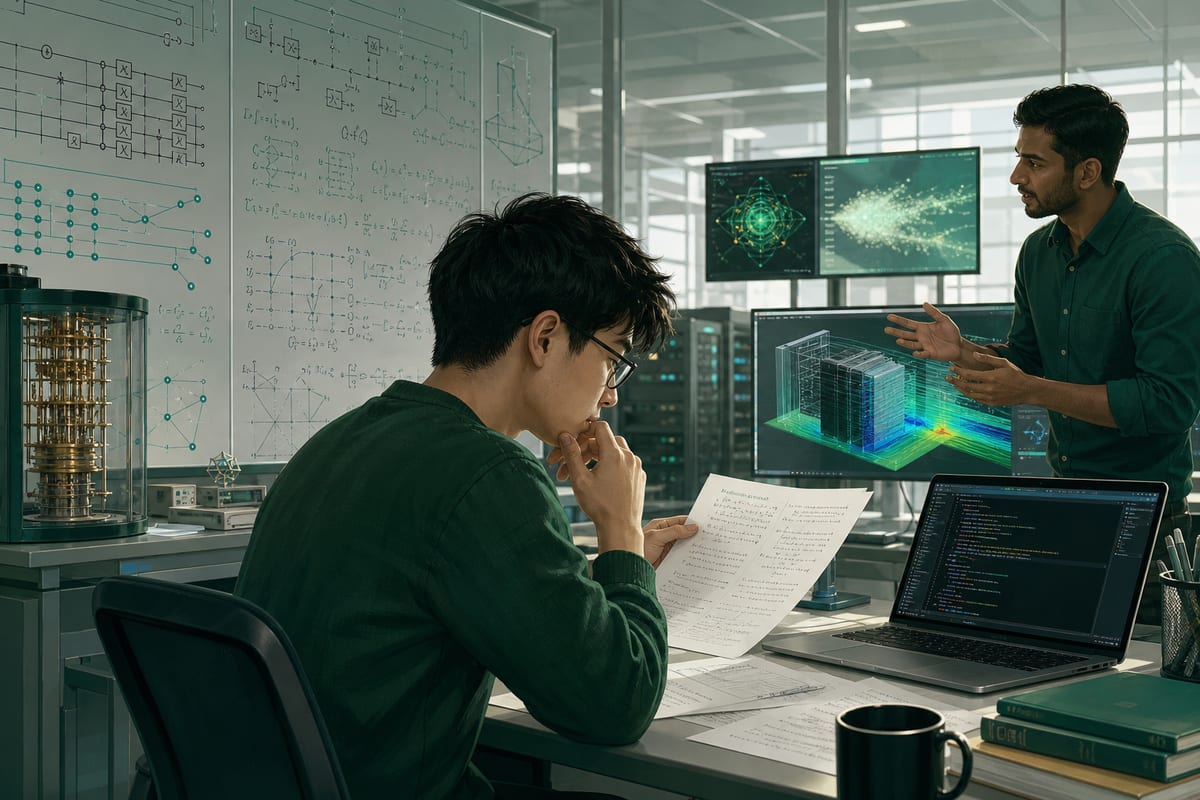
A PSI team claims to have obtained proof of the Aaronson-Ambainis conjecture using an Anthropic model and dedicated software tools. The startup is already funding its activities through data center optimization and aims to transform formal results into lab-validated technologies as the community refines its standards.
PSI is already monetizing its tools and aims for technologies derived from theory
PSI's current revenue comes from applying its tools to data center optimization by simulating variables such as heat, energy, water, and sound. The company states it is focused on the most efficient way to experimentally validate computational results. According to Matt Pines, a proven fact in nature can be leveraged to create a device, and AI can suggest ideas that enable previously impossible tasks. The long-term goal is to convert breakthroughs in theoretical physics into concrete technologies by linking suggestion, validation, and exploitation.
Emerging safeguards and a debate on scientific pace
PSI waited until the Anthropic model was nearly ready for publication before sharing its result with concerned researchers to enhance understanding. Jim Halverson, a professor at Northeastern and advisor to PSI, emphasizes the commitment to adhering to academic practices and believes that best practices are still being developed. He will participate in a summit at MIT next week where leading physicists will seek to define an appropriate response to the new pace of science, valuing transparency and expert consultation.
A proof that would close a path in quantum computing
Scott Aaronson, co-author of the conjecture, writes that he does not fully understand the proof but considers it likely correct, particularly because it was self-formalized in Lean and explained by a team of researchers to whom PSI submitted the solution. The proposed demonstration seems to close a pathway through which quantum computers could quickly solve certain problems. David Turturean refers to a negative result that redirects efforts. Aaronson presents this proof as one of the last major open problems in the complexity of quantum queries and expresses mixed feelings, noting his surprise at not having seen it appear in a recent delivery of results from OpenAI.
Le brief IA que les pros lisent chaque soir
Les 7 actus IA du jour, décryptées en 5 min. Gratuit.
Inclus dès l'inscription : notre sélection des meilleurs guides & comparatifs IA.
Choisissez votre rythme
Gratuit · Pas de spam · Désabonnement en 1 clic
PSI's industrial bet on "scaffolds" and dedicated tools
PSI is betting on harnesses and specialized scaffolds to tackle scientific problems. Matt Pines describes a research system equipped with tools, memory systems, and a simulation infrastructure capable of exploring a vast space of alternatives both broadly and deeply. He notes that six to nine months ago, he had to convince investors that theoretical physics would primarily become the domain of machines. According to him, this has not yet been realized, but the trajectory is moving in that direction.
An achievement attributed to an Anthropic model and a PSI team
David Turturean, a MIT graduate and member of PSI's technical team, indicates that he used early access to Anthropic's Fable 5.2 model to tackle the Aaronson-Ambainis conjecture, posed 18 years ago regarding the computational advantage of quantum machines over classical ones. He paused his master's projects within the MIT Computer Science and AI Lab to join PSI and even considers that the article resulting from this work might be the last he publishes. He explains that he reread a solution generated by AI on paper for the first time to make it more natural to read, as the academic community expects him to be able to explain it, which made him realize the weight of what AI can accomplish. More broadly, advancements claimed by AI are easier to validate in mathematics and computer science than in life sciences or physics, according to PSI. Discovered Materials has even launched a $1 million challenge on issues of superconductivity and heat dissipation, while Matt Pines reminds that physics engages the real world and the role of nature in models. PSI presents itself as a startup lab dedicated to physical superintelligence and AI-driven scientific discovery.
Brief IA — L'actualité IA en français
L'essentiel de l'actualité de l'intelligence artificielle, décrypté et expliqué chaque jour.