PuppyGraph 1.0 Automates Diagram Creation for AI in Business
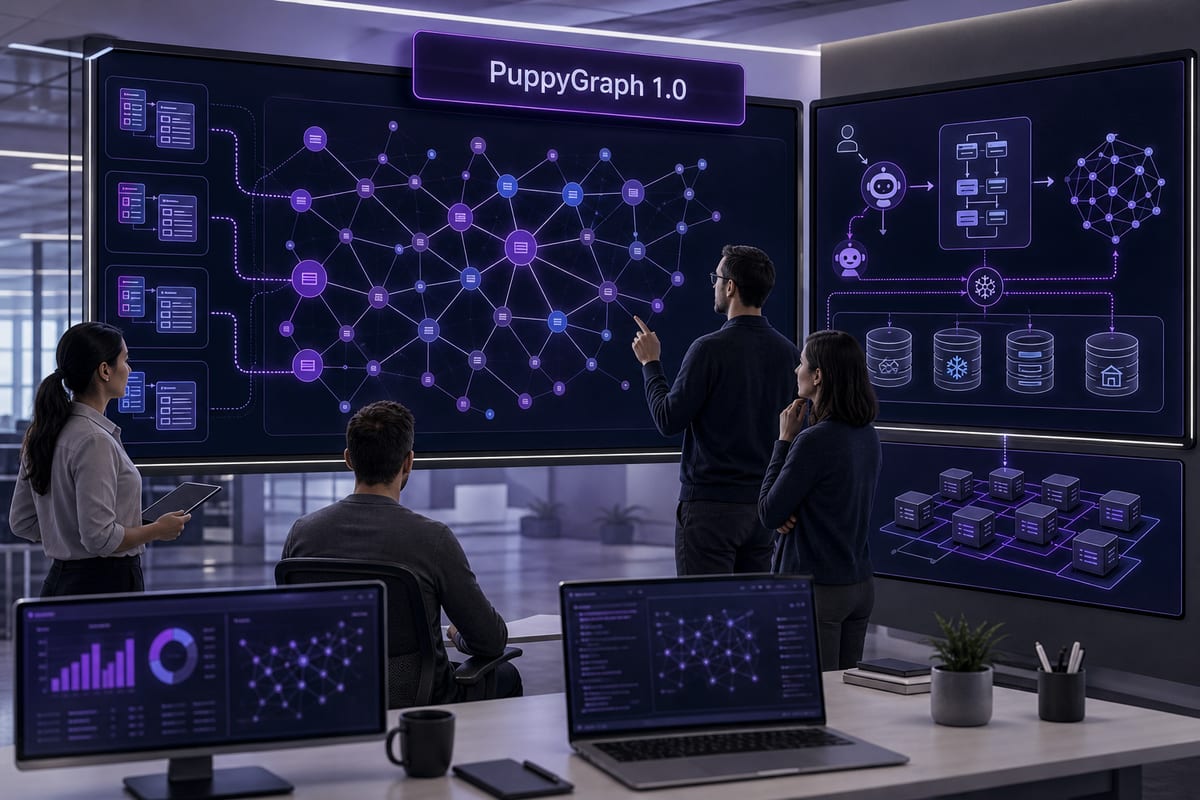
The new version of the PuppyGraph graphics engine promises to frame AI agent queries through an automatically generated schema and support for the MCP protocol. Analysts see potential savings and fewer errors, while also pointing out modeling, cost, and load management choices that need to be addressed.
Primarily Analytical Uses and Costs to Anticipate
Analysts believe that the PuppyGraph engine primarily targets analytical queries. Applications requiring low-latency writes or high volumes of transactional updates may be better served by native graph databases. Performance and costs will partly depend on the underlying platforms being queried, including warehouses and lakehouses, leading to a recommendation for cost modeling before generalizing deployments. CIOs are encouraged to assess the maturity and support capabilities of PuppyGraph before making it a critical component. The quality of results will also depend on the consistency of schemas and the quality of source data.
Query Framing for Agents via Ontology
The engine validates agent queries against a graphical schema and rejects undefined relationships, providing feedback for correction. This "imposed ontology," as described by HFS Research, tends to constrain agents to the entities and relationships recognized by the company. According to this analyst, it reduces the generation of invalid joins and the pursuit of non-existent relationships, thereby limiting the risk of unreliable results associated with faulty joins.
Targeted Gains in Complexity, Latency, and Costs
The update announces reductions in complexity, latency, and costs for AI agent queries covering thousands of tables. Distributed execution fragments queries and runs them in parallel across multiple nodes, a mechanism presented as accelerating multi-relation traversals. Computational savings are mentioned if the schema information processed and generation attempts are limited. Avoiding duplicate storage and synchronization pipelines can also reduce management and keep graph analysis within the existing regulated environment. These directions are set against a backdrop where 96% of organizations aim to consolidate their data capabilities, many managing over 10 technologies, with preparation, storage, and service costs frequently cited as barriers to scaling generative and agent-based AI.
Le brief IA que les pros lisent chaque soir
Les 7 actus IA du jour, décryptées en 5 min. Gratuit.
Inclus dès l'inscription : notre sélection des meilleurs guides & comparatifs IA.
Choisissez votre rythme
Gratuit · Pas de spam · Désabonnement en 1 clic
For Developers: Model Once, Query in Graph
The AI-assisted schema builder automatically transforms tables into entities, relationships, and properties, which teams can review and approve. Agents then leverage these schemas to query without having to identify the tables themselves or construct complex SQL joins. Analysts believe this approach can reduce engineering effort and make multi-hop questions more natural, while freeing developers from pipelines to a separate graph store. However, complexity does not disappear; it shifts towards design, table and key selection, and model governance.
Product: Unified LPG Engine, SQL, and MCP
Launched in 2024, the engine queries relational databases, warehouses, and lakehouses as a single graph without data duplication. It maps tables into a Labeled Property Graph with nodes, edges, and properties, then executes queries via a distributed computing cluster. The current version also accepts traditional SQL queries. MCP integrations connect PuppyGraph to compatible agents and tools, allowing them to access query capabilities within their workflows without requiring specific agent integration.
Adoption: Clients, Compatibility, and Deployment
PuppyGraph reports usage at AMD, Palo Alto Networks, Datadog, Netskope, Coinbase, Trend Micro, Baker Hughes, Sola Security, HighStreet Insurance Partners, and Prevalent AI. The version supports Apache Iceberg, Databricks, Snowflake, ClickHouse, DuckDB, PostgreSQL, Microsoft Fabric, and Apache Hudi. Deployment can be done via Docker, Kubernetes, or the marketplaces of AWS, Microsoft Azure, and Google Cloud. Based in Santa Clara, the company delivers with PuppyGraph 1.0 a distributed graphics engine designed for enterprise data and scenarios with AI agents.
Brief IA — L'actualité IA en français
L'essentiel de l'actualité de l'intelligence artificielle, décrypté et expliqué chaque jour.