Q.ANT Tests Its Photonic Chips at IONOS
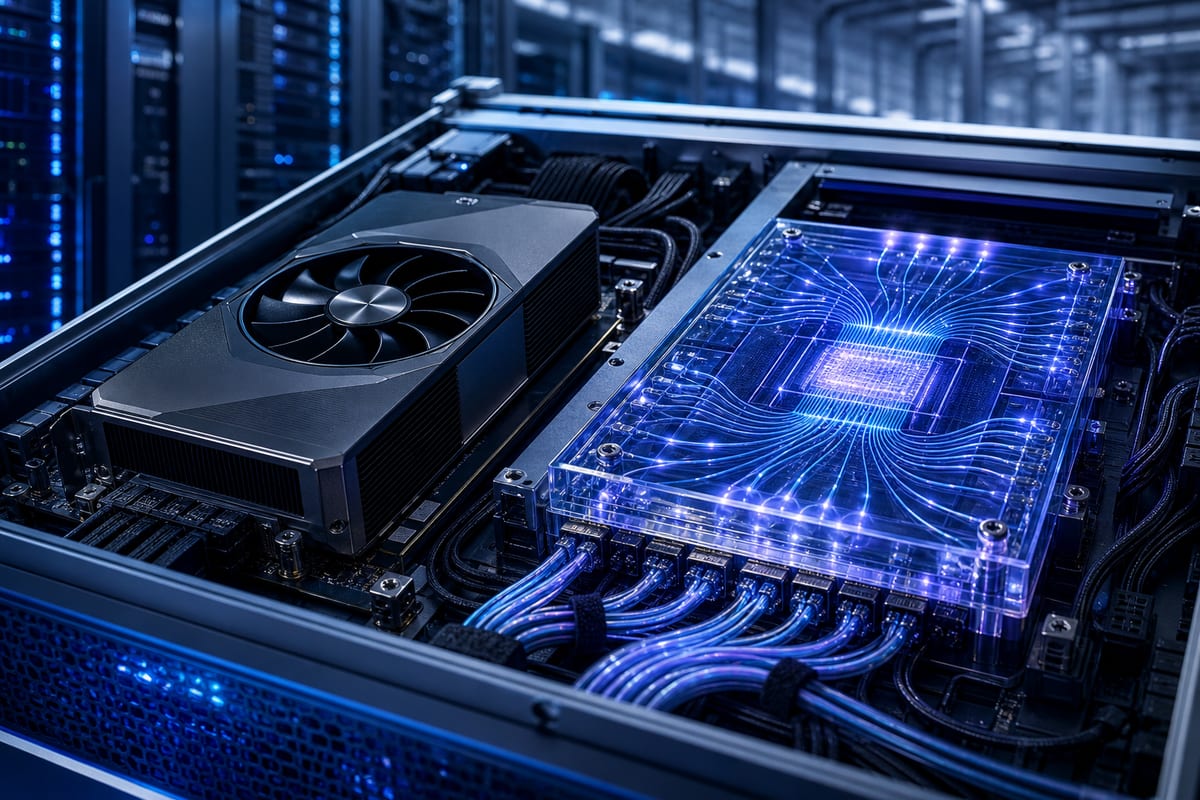
Q.ANT has recently deployed its photonic processors at the cloud provider IONOS as part of a pilot program. The German company aims to combine these chips with GPUs to reduce the energy expenditure of AI. However, the announced savings in simulation have yet to be demonstrated on its machines.
Savings Yet to Be Proven on the Chips
A consumption reduction of about four to five times: this is the gain announced in simulation by Michael Förtsch, founder and CEO of Q.ANT. The executive clarifies that this reduction still needs to be proven with actual hardware. He envisions a combination of photonic processors, CPUs, and GPUs that would offer greater AI capabilities for less energy, without promising free computation.
According to Michael Förtsch, a program exclusively optimized for GPUs will not automatically benefit from acceleration: adaptations will be necessary. Q.ANT has chosen to introduce experimental systems in data centers to test their robustness. The executive believes that a group like Google will need time before it can sufficiently trust a new technology to build an infrastructure around it.
The Suppliers' Capacity in Question
In the event of an order for 100,000 photonic processors, Michael Förtsch claims that Q.ANT would be ready. However, he expresses doubts about his suppliers' ability to keep up. In his view, assembly will still take time before it can provide a supply as solid as that of traditional semiconductors.
According to the executive, Q.ANT's chips require only a 90-nanometer node, a technology from the 2000s. Many foundries are already utilizing these capabilities for components sold at very low prices, he indicates. He believes that these lines could manufacture high-performance chips sold at higher prices without massive hardware investments, and asserts that this proposal is well-received by the industry.
Light Would Handle Non-Linear Calculations
GPUs transport and process information using electrons; the photonic processor works with light waves. Light propagation does not generate heat and allows for more simultaneous processing. These properties raise hopes for lower consumption and very limited cooling needs, as the latter represents a major expense for data centers.
The distribution envisioned by Q.ANT retains GPUs for large numbers of additions and multiplications, for which they are particularly suited. The photonic coprocessor would handle heavy, complex, or non-linear operations. Michael Förtsch finds it particularly challenging to compete with the Nvidia H200 in its favored applications.
The AI brief the pros read every evening
The 7 best AI stories, the essentials in 5 min. Free.
Included when you join: our pick of the best AI guides & comparisons.
Choose your rhythm
Free · No spam · Unsubscribe in 1 click
His explanation is based on the wave nature of light: the sine function describes a regular oscillation. To illustrate this property, he contrasts the description of a circle by an infinite number of points and lines with linear functions to a representation using two points with a sine function. He presents the latter as an illustration of light's ability to process complex equations.
The executive primarily identifies the current cost in memory accesses. He claims that Q.ANT can accomplish in one step operations that would require thousands from traditional components, thereby reducing the necessary data or memory requests. According to him, limiting the data mobilized for a task improves both efficiency and performance.
Models to Adapt and Intended Uses
Photonic installations remain rare in data centers. However, Q.ANT claims that more than 30 teams of engineers are already developing models suited for this form of computation. According to Michael Förtsch, the machines accept existing code, and developers can retain C++ or Python without learning an additional language.
The executive acknowledges a mutual dependency: convincing cloud providers requires adapted models, but their development necessitates access to processors. Q.ANT aims to welcome users onto its systems. The company anticipates particular advantages for image and video, with intended applications in recognition, segmentation, and image generation, as well as in robotics and physical AI.
According to Michael Förtsch, the chips are not tied to any GPU brand, whether Nvidia or AMD; Q.ANT wishes to collaborate with all manufacturers. He does not rule out competing with GPUs if an opportunity arises in five years, while acknowledging that he is unaware of the computational loads that will exist then. The future role of photonics, he admits, will depend on the architecture of the models. The company envisions models optimized for data that would maintain task quality with less energy and reduced operating costs.
Data Centers Facing Energy Costs
Q.ANT's approach is part of a hardware development movement driven by a growing number of startups. Michael Förtsch identifies the bill from considerable energy consumption as the problem to solve. The sophistication of AI models indeed comes with a significant increase in energy costs.
Meanwhile, laboratories and cloud providers are seeking sites with abundant and inexpensive renewable electricity, particularly in Scandinavia. These projects face logistical difficulties, shortages of essential components, and a rise in protests against data centers.
Brief AI — AI news in French
The essentials of artificial intelligence news, decoded and explained every day.