Speaker Recognition: An Internal App in Just a Few Hours
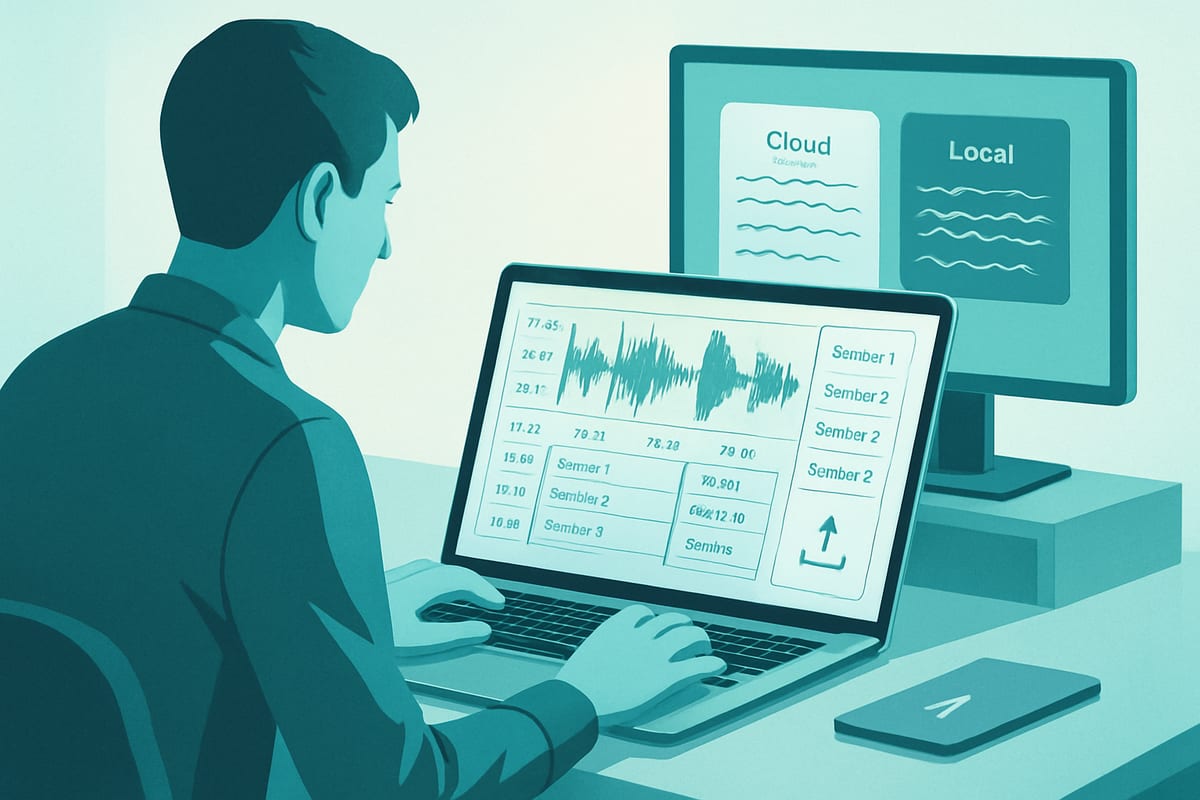
An internal system allows for the association of real names with speakers in meetings. It relies on anonymous transcription with Soniox, audio embeddings compared using cosine similarity, and an 80% threshold for automatic labeling. Nvidia models can operate locally for comparison, and coding agents accelerate implementation to just a few hours.
Audio embeddings and an 80% threshold for naming voices
The system begins by isolating the time segments corresponding to each unique speaker in order to extract an audio sample per person. Each sample is then compared to a database of already recorded samples. This comparison is conducted using audio embeddings and a cosine similarity measure. If the confidence score exceeds 80%, the speaker is automatically identified as likely already known. Below this threshold, the sample undergoes manual labeling and is added to the reference database. The initial anonymous transcription is obtained with Soniox, which, according to the described experience, yields better results than the local model in this context and provides accuracy deemed sufficient in most cases.
Implementation choices: Soniox, Nvidia models, and conversion to names
The system combines an online service for anonymous transcription and local models for comparison. Soniox is used for anonymous transcription, valued for its accuracy and ability to operate in multiple languages. Meanwhile, Nvidia models, already employed in the FluidVoice application, can be downloaded to run locally and serve as a point of comparison. The process aims to convert the anonymous transcription into a named transcription. After a few reference labels, the system displays its predictions, allowing the user to assess the accuracy achieved.
Le brief IA que les pros lisent chaque soir
Les 7 actus IA du jour, décryptées en 5 min. Gratuit.
Inclus dès l'inscription : notre sélection des meilleurs guides & comparatifs IA.
Choisissez votre rythme
Gratuit · Pas de spam · Désabonnement en 1 clic
Role of coding agents: from a single brief to application in hours
Coding agents enable the creation of internal tools much more quickly than before, reducing timelines from several weeks or months to just a few minutes or hours. Providing a detailed vision in a single prompt, while anticipating technical choices such as the transcription model and labeling method, avoids unnecessary back-and-forth. It is estimated that in 2019, without coding agents, a solid implementation would have required about two days, depending on the capabilities of the models at the time. Today, the same goal can be achieved in just a few hours with high accuracy. This speed also alters the traditional trade-off between purchasing and developing, which previously relied on a detailed assessment of cost and time savings.
An unmet business need and the appeal of do-it-yourself
The use case concerns the review of internal meetings with speakers identified by their names, rather than by anonymous labels as is often the case with market tools. The use of Soniox highlights this limitation when only a single recording is provided and no prior reference exists to name the voices. Having not found a service deemed robust enough to associate audio samples with identities, the decision was made to develop the tool internally. This solution offers complete control, precise customization, and appropriate data management. Overall, it enables more efficient speaker recognition and smoother transcription, thanks to the support of coding agents to tailor the tool to exact needs.
Brief IA — L'actualité IA en français
L'essentiel de l'actualité de l'intelligence artificielle, décrypté et expliqué chaque jour.