Recruitment: AI Transforms the Market into a Technological Duel
Le brief IA que les pros lisent chaque soir
Les 7 actus IA du jour, décryptées en 5 min. Gratuit.
Inclus dès l'inscription : notre sélection des meilleurs guides & comparatifs IA.
Choisis ton rythme
Gratuit · Pas de spam · Désabonnement en 1 clic
AI Redefines the Recruitment Process
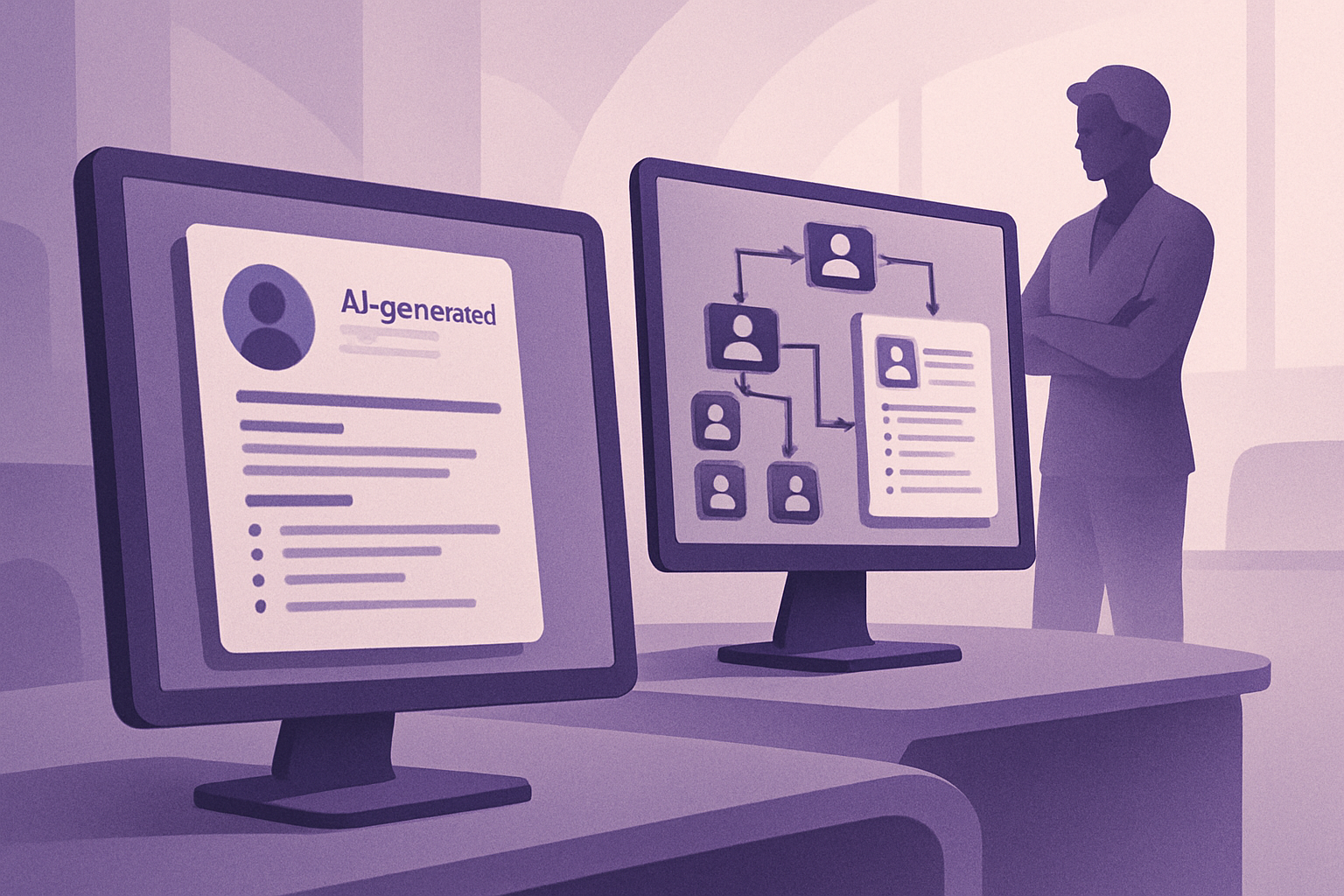
The recruitment landscape is undergoing a significant transformation with the increasing integration of artificial intelligence. Candidates are now using automated tools to create their resumes, while recruiters rely on algorithms to filter these documents. This evolution is turning the job market into a kind of automated dialogue, where human interactions tend to fade away.
In the United States, a study reveals that 22% of candidates are already using AI agents to apply automatically. This phenomenon is documented in the Greenhouse report on the job market for 2025. To cope with this avalanche of automatically generated applications, Greenhouse launched a tool in mid-2025 dedicated to automatically detecting fraudulent applications and bot patterns, precisely because its recruiting clients were overwhelmed by candidate pipelines that were impossible to sort manually. Both parties in the recruitment process, candidates and recruiters, are increasingly relying on technology, thereby reducing human intervention.
Global Impact and the French Example
While this trend is particularly visible in the United States, it is rapidly spreading to other regions, including France. Local startups are adapting these tools into French, facilitating their adoption. For example, AIApply claims over one million users for its self-application service, which sends hundreds of identical resumes on autopilot. Despite its apparent success, AIApply has an F rating, the worst possible score, from the Better Business Bureau, the American organization that assesses business reliability, which does not accredit it. The demand for these solutions is indeed present, but their quality often leaves much to be desired.
Towards a Future of Automated Applications
According to Gartner, by 2028, a quarter of global applications could be entirely false, generated by technologies like deepfake or voice cloning. Although this may seem futuristic, the market is already heading in this direction. A study conducted by Ashby in May 2026, covering over 100 million applications and 200,000 positions, shows a significant increase in the number of applications per position since 2021. In fact, the number of applications received per position has tripled, now averaging over 300 applications per job offer. This increase has halved the chances of getting an interview compared to five years ago, for equivalent profiles, despite all the time saved in sending applications.
This race towards automation does not seem to benefit anyone. Applications sent in the blink of an eye by AI agents are often filtered by other automated systems before even being read by a human. Candidates often interpret the ensuing silence as a lack of skills, when in reality it is an algorithmic sorting between machines.
Rethinking the Use of AI in Recruitment
For candidates, AI should be a tool for better targeting and preparation, rather than for multiplying applications. At Personal Job Coach, experience shows that what makes a difference in a saturated market is not the volume of applications, but their relevance and personalization. An effective AI helps to understand a position, prepare for an interview, and clearly articulate what the candidate can bring to the company.
Using AI to apply blindly only fuels an endless race, with no real winner. The day candidates and recruiters stop opposing each other with the same tools to achieve the same goal—finding the right person for the right position—this arms race may finally come to an end. In the meantime, the best application remains the one that piques the interest of a human recruiter, an aspect that machines cannot yet replace.
Brief IA — L'actualité IA en français
L'essentiel de l'actualité de l'intelligence artificielle, décrypté et expliqué chaque jour.