Regulating AI: Twenty Years of Appeals from Leaders, Little Impact
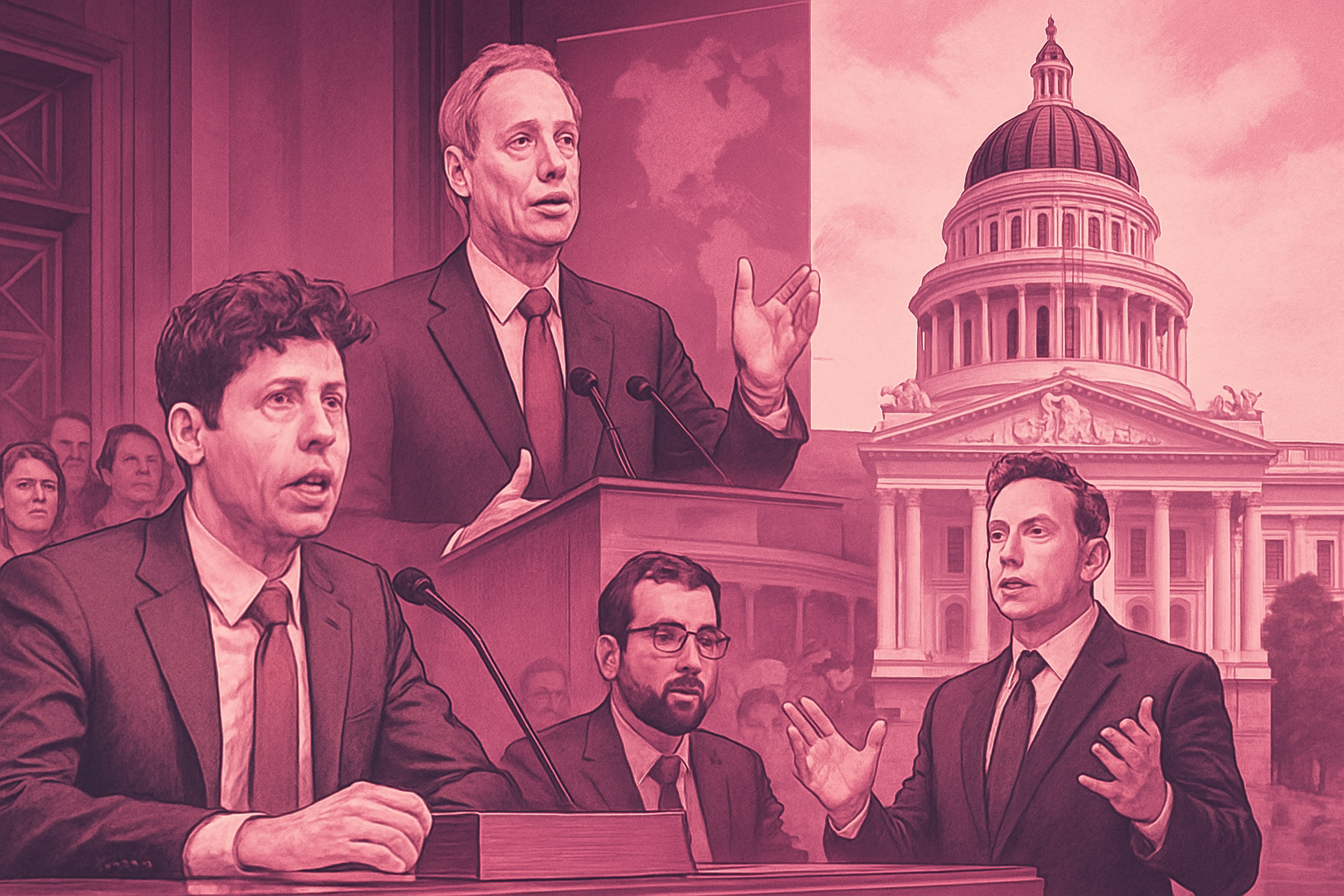
CEOs in AI have been calling for regulations for years. Proposals are multiplying, from congressional hearings to public manifestos, but binding results remain limited, as demonstrated by the veto of SB 1047 in California. Here’s a timeline where calls for regulation, voluntary commitments, and political hesitations intersect.
In California, SB 1047 is Supported and Then Vetoed
In the summer of 2024, Elon Musk publicly supported the adoption of the California bill SB 1047. Anthropic, which had opposed it in July, changed its stance in September, while OpenAI had expressed its opposition in August. Governor Gavin Newsom ultimately vetoed the bill, stating he did not believe it was the best approach to protect the public from the real threats posed by technology.
Anthropic Advocates for Targeted Regulation in Fall 2024
In October 2024, Anthropic called for "targeted regulation," with a statement beginning with "Governments should urgently...". This positioning comes as several AI leaders, including Sam Altman, Dario Amodei, Demis Hassabis, Satya Nadella, and Elon Musk, have stated that it is time to slow down before losing control.
AI Frameworks Proposed by Microsoft and Defended in Congress
On May 16, 2023, Sam Altman urged Congress to create a new agency to regulate AI, believing that the benefits of the tools deployed so far outweigh the risks, but that government intervention will be essential in light of the rising power of models. On May 25, the CEO of Anthropic warned about the risk that AI could contribute to the creation of biological weapons. On the same day, Brad Smith presented five areas for legislation, including the requirement to integrate safety brakes from the design stage of high-risk systems and to regularly test their effectiveness.
Non-Binding Commitments Between 2023 and 2024
Between July 2023 and May 2024, companies and governments made numerous voluntary commitments. Meta, Google, and OpenAI promised the White House to develop AI responsibly, later joined by other signatories of a security agreement. In the UK, during the AI summit in November 2023, developers and governments agreed on testing to manage risks. In May 2024 in Seoul, global leaders agreed to launch a network of security institutes.
Le brief IA que les pros lisent chaque soir
Les 7 actus IA du jour, décryptées en 5 min. Gratuit.
Inclus dès l'inscription : notre sélection des meilleurs guides & comparatifs IA.
Choisissez votre rythme
Gratuit · Pas de spam · Désabonnement en 1 clic
Public Statements on Extreme Risks and Cooperation
On May 30, 2023, a 22-word statement emphasized the "extinction risk" associated with AI, to be treated as a global priority alongside pandemics and nuclear war, with Sam Altman and Demis Hassabis among the signatories. In September 2023, during a private Senate meeting, CEOs reportedly agreed that the industry needed regulation. Mark Zuckerberg then encouraged Congressional involvement and cooperation among policymakers, academics, civil society, and industry to minimize risks and maximize benefits.
Calls for a Pause and Creation of Companies
In March 2023, a letter from the Future of Life Institute, signed by Elon Musk among others, called for a pause in giant AI experiments and proposed, if not, a government moratorium. Two weeks after this letter, Elon Musk announced the creation of a new AI company.
Before the Generative Wave, Alerts on Facial Recognition
As early as 2018, Microsoft faced criticism for collaborating with ICE on facial recognition while tech leaders condemned the separation of children at the U.S. border. In December 2018, Brad Smith called for laws by 2019 to regulate this technology to avoid a "race to the bottom." In January 2020, Sundar Pichai stated that there was no doubt that AI must be regulated, believing that companies could not rely solely on market forces, remarks made in the context of concerns over facial recognition.
Meta's Positions After Cambridge Analytica
In March 2018, in the wake of Cambridge Analytica, Mark Zuckerberg mentioned the possibility of regulating his company, addressing the legal responsibility related to the proactive detection of problematic content over a five to ten-year horizon. In March 2019, he advocated for a more active role for regulators on the internet.
Musk, From Early Alerts to Calls for Regulation
Between 2014 and 2018, Elon Musk repeatedly issued warnings and called for proactive regulation of AI. He had invested $38 million in OpenAI and at least two other AI companies before stating as early as 2014 that AI could be more dangerous than nuclear weapons and that working on AI was akin to "inviting the demon." In 2015, he co-signed a letter with Stephen Hawking for responsible research, and in 2017, he urged U.S. governors to act proactively.
An Old Intellectual Background
Warnings against machines capable of surpassing humans date back at least to Samuel Butler in the 19th century and Alan Turing in 1951. In 2000, Bill Joy viewed self-replicating robots as a potentially greater danger than nuclear weapons, pointing to their development outside state confines. In 2009, Eric Horvitz gathered researchers around policies to constrain autonomous systems. More recently, Mustafa Suleyman advocated for government regulation before taking the helm of Microsoft’s AI activities.
Brief IA — L'actualité IA en français
L'essentiel de l'actualité de l'intelligence artificielle, décrypté et expliqué chaque jour.