US-China Rivalry: Slow Down AI or Maintain American Edge
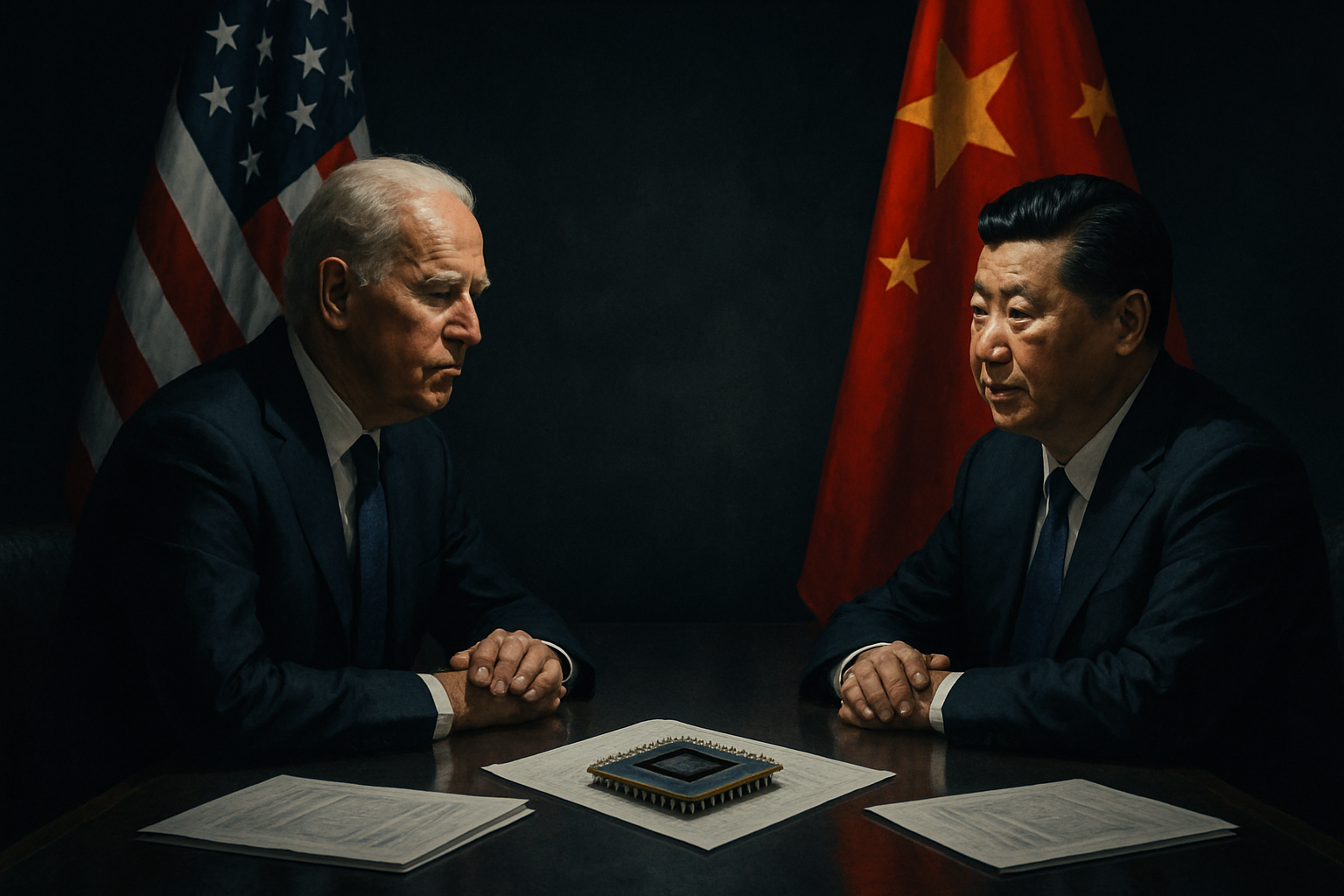
A rare essay from a Chinese intelligence official on the risks of AI, along with Dario Amodei's renewed call to slow down the most powerful models, brings China back to the center of the debate. Amid tightening controls, minimal cooperation, and skepticism about global coordination, experts and analysts are drawing incompatible lines as a Trump-Xi meeting approaches.
Washington Faces a Choice Between Export Controls or Fewer Constraints
According to Chris McGuire, the United States now faces two realistic choices: either tighten export restrictions to slow the progress of AI in China, or allow American labs to advance more quickly by easing national security constraints to maintain their lead. He asserts that there is no longer any room for compromise between these two directions, in response to a comment from the Global Times that interpreted Dario Amodei's proposal as a tool to ensure American technological supremacy. Analysts at Mizuho, led by Vijay Rakesh, believe that slowing down cutting-edge AI cannot succeed without global coordination and that unilateral safeguards could risk losing ground to Chinese competitors capable of closing the gap and enhancing their computing capabilities. They also argue that effective coordination between cloud providers and governments would be nearly impossible. Ryan Fedasiuk suggests that Anthropic's report will likely influence the future behaviors of Chinese AI labs and predicts consequences for companies that submitted queries to Claude without disclosure, suspecting that Anthropic anticipated this effect as a deterrent against distillation. He describes this report as one of the best pieces of intelligence he has seen and considers it to have exposed a failure of Chinese counterintelligence, creating a major embarrassment. He believes that the hostility of Chinese state media towards coordination on AI security could be explained by this report, although he considers this a low-confidence hypothesis.
Minimal Cooperation Considered, Major Agreement Seen as Unlikely
For Kenton Thibaut, a general agreement between Washington and Beijing aimed at curbing cutting-edge AI is unlikely to materialize, even as both governments become increasingly aware of the dangers associated with this technology. She notes that China fears that the issue of AI security will be used by the United States to maintain its technological superiority, making significant progress on this front very improbable. Thibaut instead proposes limited cooperation focused on preventing abuses by non-state actors and establishing technical systems to monitor risks and respond to emergencies, provided that AI security does not become a new front in technological competition. Yishan Wong believes that "pacing the frontier" is a sensible approach and attributes American skepticism towards cooperation to a difficulty in viewing the Chinese and their government as full-fledged interlocutors. He draws a parallel with the Cold War, arguing that the leading country should slow down first, and calls on the United States to take the first step to establish a bridge. Arnaud Bertrand contests the idea that China has rejected collaboration on AI security, arguing that Beijing primarily refuses a definition of security that would involve American leadership aimed at containing China.
Le brief IA que les pros lisent chaque soir
Les 7 actus IA du jour, décryptées en 5 min. Gratuit.
Inclus dès l'inscription : notre sélection des meilleurs guides & comparatifs IA.
Choisissez votre rythme
Gratuit · Pas de spam · Désabonnement en 1 clic
Perceived Chinese Capabilities: Distillation and Lack of Advanced Chips
Yishan Wong questions the notion that China is at the technological frontier, citing its dependence on the distillation of American models and its lack of advanced chips. Despite this, Mizuho believes that unilateral safeguards in the United States could allow Chinese competitors to close the gap while developing their own computing capabilities. In this context, Dario Amodei proposes to maintain an American advantage over China through export controls and enhanced AI security.
Recent Triggers and the Sino-American Political Timeline
A high-ranking Chinese intelligence official recently indicated that advanced AI poses significant dangers and requires increased oversight, as Beijing aims to establish itself as a global leader in this sector. Just days earlier, Dario Amodei had reignited the discussion by stating that leading AI labs should slow down the development of the most advanced models to give security time to catch up. This debate occurs ahead of a scheduled meeting at the White House between Donald Trump and Xi Jinping, where artificial intelligence is among the key topics. More broadly, China has made leadership in artificial intelligence a national priority, and the desire to slow the pace clashes with the competitive dynamics between Washington and Beijing.
Brief IA — L'actualité IA en français
L'essentiel de l'actualité de l'intelligence artificielle, décrypté et expliqué chaque jour.