Robotics to Attract $97.3 Billion by 2026
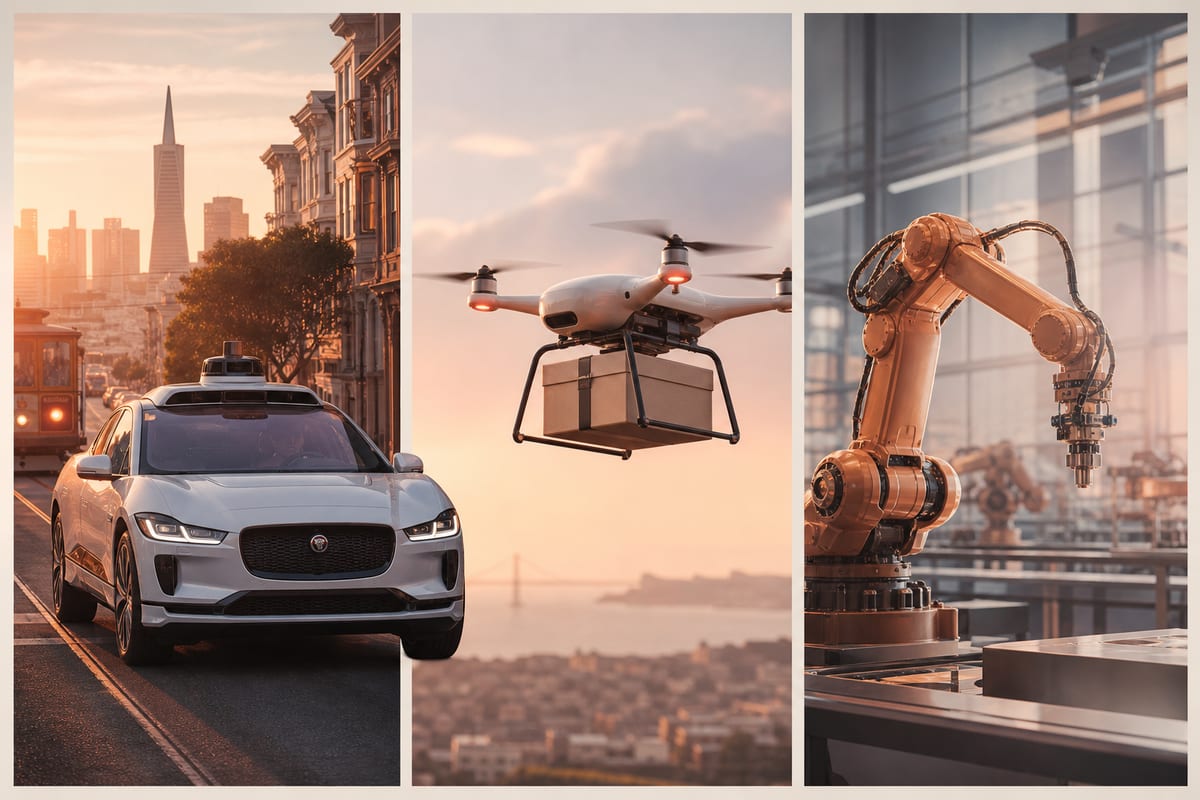
Robotics and physical AI companies have raised $97.3 billion globally in 2026 at this point in the year, according to Crunchbase, more than double the amount from 2025. Waymo leads the pack, followed by Prometheus, co-led by Jeff Bezos. The funding covers both operational services and machines still in development.
Skild, Neura, and Atoms Develop Robots
In Pittsburgh, Skild AI is developing command AI for articulated arms as well as humanoids, aiming to enable them to learn tasks without dedicated programming for each. Founded by Carnegie Mellon researchers Deepak Pathak and Abhinav Gupta, the company claims to have reached $100 million in annual recurring revenue as of September, with over 60 clients. It is conducting assembly projects with Nvidia and Foxconn, as well as culinary experiments with Mitsui. Its Series C, announced on January 14 and led by SoftBank Group, brought in $1.4 billion, achieving a valuation exceeding $14 billion, placing it ninth in the Crunchbase ranking.
In Germany, Neura Robotics produces articulated arms and mobile carts while developing humanoids. Its clients can rent training spaces equipped with simulators and tracking systems: the machines learn tasks whose skills can then be transferred to other robots. Tenth in the ranking with $1.4 billion, Neura announced its Series C in June, led by Tether Investments, with participation from Amazon, Nvidia, and Bosch.
In Los Angeles, Atoms remains tight-lipped about its activities but claims to manufacture robots intended for mining, transportation, and food. Uber co-founder Travis Kalanick publicly introduced it this year after several years of discretion. Atoms has integrated CloudKitchens, its ghost kitchen company, as a subsidiary. Announced on July 22, its $1.7 billion funding round, led by Andreessen Horowitz, places it in eighth position. Kalanick describes its ambition as the digitization of the physical world.
Military Drone Manufacturers Attract Capital
Defense companies Anduril, Shield AI, Helsing, and Saronic are among the main beneficiaries of the reported capital. According to Gené Teare, head of research at Crunchbase, the appeal of drones lies in their technical maturity, which is more advanced than that of robotics fields still in the experimental stage. Anduril, co-founded by Palmer Luckey nearly a decade ago to equip the battlefield, has surveillance towers at the border between Mexico and the United States and claims to have supplied hundreds of Altius drones to Ukrainian forces. With $5 billion, the company ranks third; in May, it announced a Series H led by Andreessen Horowitz and Thrive Capital, which doubled its valuation to $61 billion. For the previous year, it reported $2.2 billion in revenue, more than double that of 2024.
Crunchbase ranks Shield AI fourth with $4 billion, but the company only announced a $2 billion fundraising project in November to finance the acquisition of radar manufacturer Echodyne. It previously raised $2 billion in March during a Series G led by Advent International and JPMorgan Chase. Co-founded by Brandon Tseng, a former Navy SEAL, Shield AI produces military drones as well as Hivemind, an AI piloting system. Its V-BAT surveillance device can take off vertically and fly under jamming. It participated last year in a cocaine seizure valued at $362 million by the U.S. Coast Guard and completed over 200 missions in Ukraine in 2025.
The AI brief the pros read every evening
The 7 best AI stories, the essentials in 5 min. Free.
Included when you join: our pick of the best AI guides & comparisons.
Choose your rhythm
Free · No spam · Unsubscribe in 1 click
Sixth, Helsing announced a Series E of $1.8 billion in July, bringing its valuation to $18 billion, with investors including Dragoneer Investment Group, Lightspeed Venture Partners, and ICONIQ Capital. Based in Munich, it designs AI software and equipment for defense and national security, including drones and autonomous underwater vehicles. Its HX-2 can navigate and recognize targets using AI despite GPS jamming. Helsing claims that thousands of drones have been deployed to Ukrainian forces in the first half of 2026.
In Austin, Saronic builds unmanned boats for the U.S. military and its allies. In June, one of its vessels, operated by the U.S. Navy, assisted in the rescue of two American soldiers after Iran shot down their helicopter off the coast of Oman. Its Series D announced in March, led by Kleiner Perkins, brought in $1.75 billion for a valuation of $9.25 billion, placing it seventh.
Waymo and Zipline Fund Their Services
Waymo's Jaguar robotaxis and new Ojai vehicles are operating in Phoenix, San Francisco, and Los Angeles. The company operates in 15 cities across the U.S. and plans to add more in 2027. Its Series D announced in February, totaling $16 billion, is the highest sector funding in the ranking and brings its valuation to $126 billion. Dragoneer Investment Group, DST Global, and Sequoia Capital led the round, supported by Alphabet, its primary investor.
Zipline, which started by delivering blood in Rwanda in 2016, now also transports medical supplies and meals. It claims to have completed over a million deliveries in the Dallas-Fort Worth area this year and is working with Walmart to add 300 delivery sites in the U.S. Fifth with $2.3 billion, it closed an $800 million Series H in March and announced this month a $1.5 billion Series I. This latest round, led by Paradigm, WCM Investment Management, and Layer Global, values the company at $21.5 billion.
Bezos Co-Leads Prometheus, Valued at $41 Billion
Amazon founder Jeff Bezos shares leadership of Prometheus with Vik Bajaj, a former executive at Google X. This is his first CEO position since leaving Amazon in 2021. Prometheus is developing engineering AI intended to assist in designing and testing products in simulations before manufacturing, with applications ranging from smartphones to aircraft engines.
Its $12 billion Series B, announced in June, places it behind Waymo in the funding ranking. The round assigns it a valuation of approximately $41 billion. Bezos himself, JPMorgan, BlackRock, and Goldman Sachs are among the investors.
Funding Drivers and Outlook for 2027
Crunchbase's global tally is based on over 1,200 transactions. The amount reported for 2025 was $47.4 billion. The capital is distributed among established companies, military equipment manufacturers, and early-stage humanoid projects.
Sanjay Aggarwal, a partner at F-Prime, identifies several drivers: the rise of autonomous vehicles and defense, efforts to revive domestic production, bets on founders like Bezos or Kalanick, and futuristic technologies, including humanoids. He expects the top three categories to continue receiving significant investments in 2027. For the last category, he anticipates more demanding investors, believing that a company cannot indefinitely secure funding solely on the promise of future revenues.
Brief AI — AI news in French
The essentials of artificial intelligence news, decoded and explained every day.