Runware Aims to Industrialize AI Pod Production in Romania
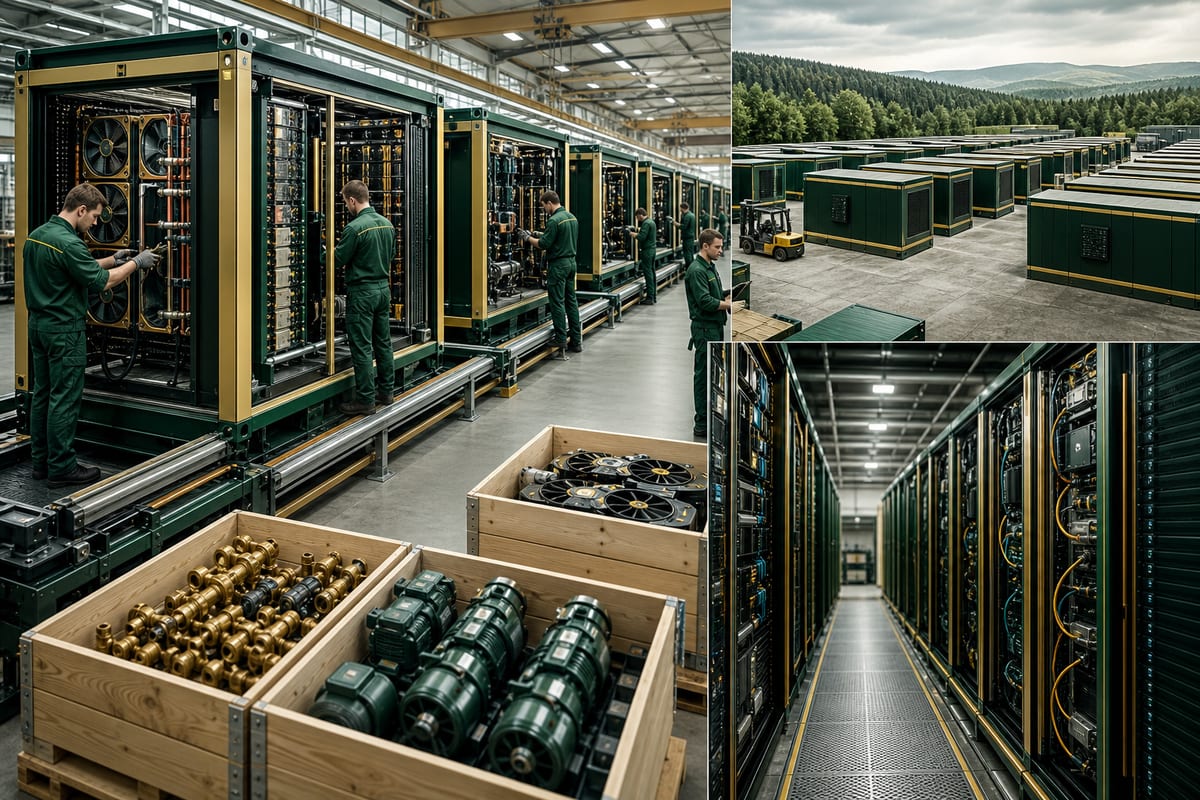
Runware promises to manufacture AI data centers like assembling cars, with a factory in Romania and a planned ramp-up to 30 MW per day by 2028. The company highlights a $1 billion interest book and installation timelines of 48 hours, while acknowledging constraints related to labor, logistics, and supply chain.
Costs, financing, and industrial risks are explicitly addressed
Runware admits that establishing its factory will involve significant needs in labor, inventory, supply chain logistics, and financial resources. The case of Arrival, which was valued at over $13 billion and faced challenges in industrializing profitable production with a "reinvented" manufacturing method, highlights this type of risk. To date, Runware claims to have raised over $60 million and is planning a Series B. The company indicates it will complete and launch the factory with the $50 million from its Series A raised in December. Flaviu Fadulescu asserts that Runware's cost structure differs, relying on personnel and material costs, with factory staff deemed profitable in light of the value of compute deployment. He adds that designing its own systems and purchasing widely available parts helps contain costs. Runware also claims to have recruited an experienced factory director from the automotive industry to support its materials manager.
Target capacity and industrialization timeline are precise
Flaviu Fadulescu aims for daily data center production reaching 30 megawatts by 2028, which corresponds to about 1 gigawatt each month. At this level, the annual output would be comparable to the 10 gigawatts that the United States plans to add this year. The increase in production pace is scheduled to begin next year. Runware claims to have two factories: the first has been operational for several years, and the second, under construction since the beginning of the year, is expected to be completed in a few months to start early next year. These modular data centers will be manufactured on an assembly line.
Turnkey offer, installation in 48 hours, and business options
Clients can provide their own site or entrust the search to Runware. The company aims to have the pods online within 48 hours, covering installation and setup. It states that a pod previously required three weeks of construction, and this time should decrease to one day with the ramp-up. Runware plans to provide spare parts in case of failure. Regarding the business model, clients can rent compute from Runware or bring their own GPUs, with monthly fees for the pods and operations, while power and internet are billed separately.
Le brief IA que les pros lisent chaque soir
Les 7 actus IA du jour, décryptées en 5 min. Gratuit.
Inclus dès l'inscription : notre sélection des meilleurs guides & comparatifs IA.
Choisissez votre rythme
Gratuit · Pas de spam · Désabonnement en 1 clic
Customization, cadence against GPUs, and technical dependencies
The pods have a standard base but can be configured according to client preferences and the latest generations of GPUs. Fadulescu claims that the delivery times for the pods are shorter than the current lead times for GPUs, allowing time to adapt the infrastructure to the ordered hardware. For new GPUs, the internal hardware team can design, build, and test components in-house. In the supply chain, some parts like pumps and fans come from Germany, and Runware states it relies on Nvidia for the network.
Declared demand and pipeline of energy sites in development
Runware reports having recorded $1 billion in commitments for its Sonic pods over the past month, corresponding to over 20 megawatts currently being delivered. The company specifies it is collaborating with energy suppliers on a set of sites totaling 397 megawatts, with the potential to reach 1.2 gigawatts. It is deploying its modules on smaller sites than those of hyperscalers like Amazon, Microsoft, and Google. According to Fadulescu, these sites generally already have electricity, which should not further overload the grid or disrupt the community.
Cooling, noise, and announced energy sources
The pods require electrical power as well as internet access. They will operate with a closed-loop liquid cooling system using air-cooled radiators, eliminating the need for water connections. Fadulescu specifies that they remain completely silent as long as the temperature does not exceed 30 °C. Runware claims to use renewable energy whenever possible and aims to make it its primary source.
Competition and positioning against industry giants
Other players like Crusoe and Schneider Electric are already marketing prefabricated pods. However, Runware asserts it can ship faster. Nvidia has introduced its Vera Rubin AI factories and the DSX POD to accelerate the construction of AI infrastructure. Runware insists it has built a factory, beyond just a simple reproducible architecture design.
International roadmap and vision for modularity
After commissioning its new factory early next year, Runware plans to expand to the United States and other regions. Flaviu Fadulescu believes that modular systems will quickly become the norm for large-scale AI deployments. He asserts that clients should be able to plan a hyperscale around factory-made pods and have it operational in a few months rather than several years. The Sonic Inference Pod, already presented as a factory-built module delivered ready to install, serves as the foundation for this strategy, which the company aims to push towards mass production.
Brief IA — L'actualité IA en français
L'essentiel de l'actualité de l'intelligence artificielle, décrypté et expliqué chaque jour.