Safran Speeds Up Inspection with Loopr's AI and Synthetic Data
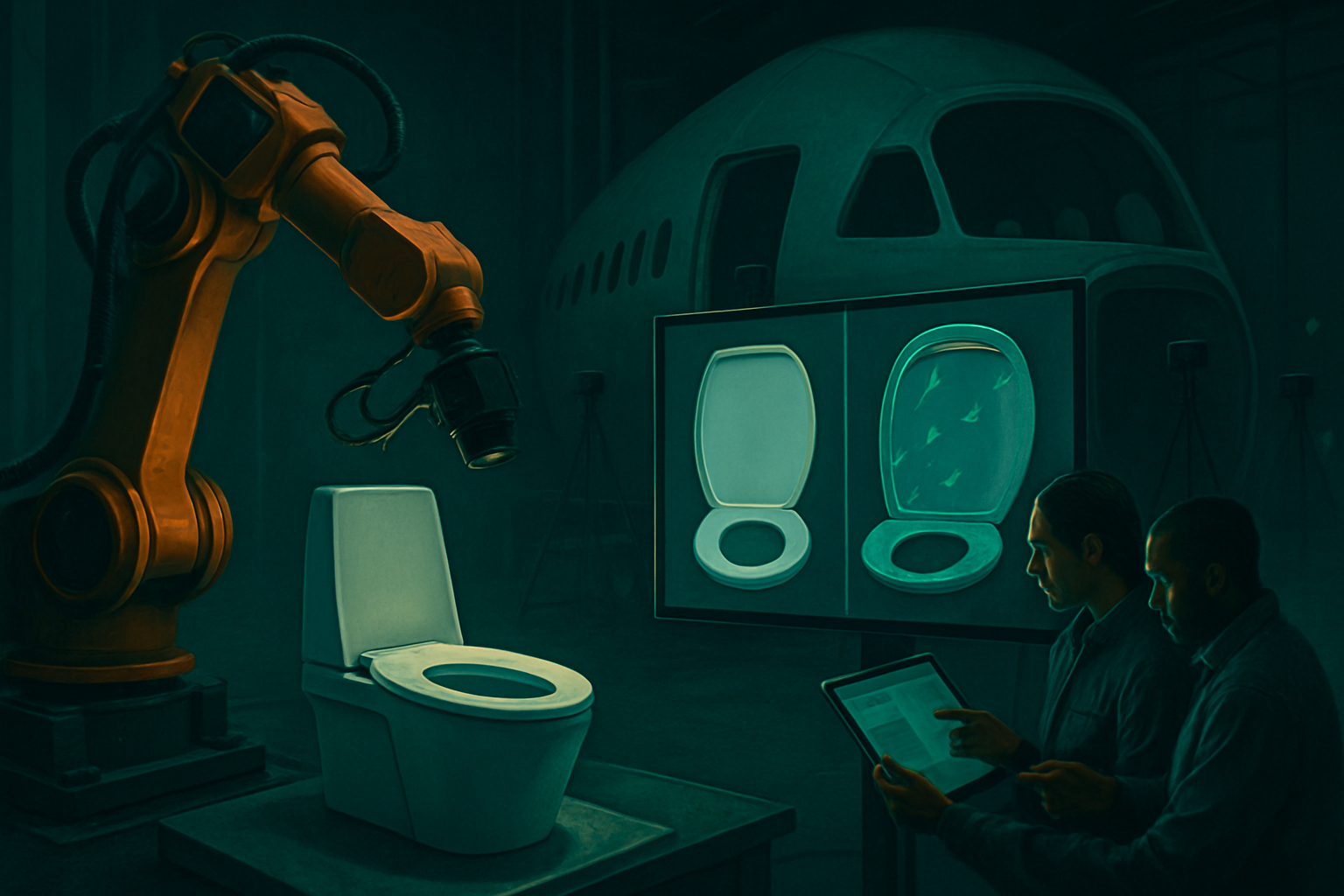
Safran has conducted pilots with Loopr AI to partially automate the inspection of cabin parts using models fed with synthetic data. The group reports faster inspections, a recall rate of 90.9% on the project, and increased throughput, and is beginning to deploy the tool at two U.S. sites.
Quantifiable Gains and Deployment at Two U.S. Sites
For toilet seats, inspection time is now between five and ten minutes, with a defect and inspection report generated automatically before moving on to the next step, a task previously handled by the inspector. In this project, Loopr's technology achieved a recall rate of 90.9%, covering defects such as scratches, discoloration, or paint bubbles. Safran indicates that it is producing 10% to 15% more parts than before, with throughput increasing towards final assembly. Following these pilots, the company is introducing Loopr's technology at its sites in Marysville (Washington) and Santa Maria (California).
Synthetic Data to Address the Scarcity of Training Sets
Two years ago, Safran launched pilots with Loopr to accelerate defect identification and reduce inspection and documentation time. In a context where the company manufactures a wide variety of parts but in low volumes for each, it is challenging to quickly obtain thousands of data sets. Loopr artificially increases the number of samples by generating synthetic data from existing and modified images, allowing for the simulation of different scenarios while validating results with real data. The software is deemed effective for detecting cosmetic defects in cabin assemblies by comparing results to production drawings and intended parts.
Le brief IA que les pros lisent chaque soir
Les 7 actus IA du jour, décryptées en 5 min. Gratuit.
Inclus dès l'inscription : notre sélection des meilleurs guides & comparatifs IA.
Choisissez votre rythme
Gratuit · Pas de spam · Désabonnement en 1 clic
Two Inspection Modes: Automated for Painting, Hybrid for Assemblies
The inspection process can be fully automated or combine automation with human intervention, depending on the chosen configuration. Regarding paint inspection, Safran was already using visualization equipment: image capture and processing by artificial intelligence are performed automatically, while the platform allows an operator to validate, adjust, or correct the obtained results, with this feedback used to refine the model. Loopr is compatible with several camera and tablet models; for this project, a robotic arm takes pictures of the parts before and after paint application, then sends these images for processing. In hybrid mode, typical for large cabin assemblies, inspectors take photos from multiple angles and upload them into Safran's system; the algorithm identifies potential issues and generates an inspection report.
How AI Learns Defects and Its Limitations
The collaboration between Safran and Loopr relies on trained models, including those with synthetic data, to improve the accuracy and efficiency of inspections, with reported reductions in control time and costly recalls by the manufacturer. Historically, examining a toilet cover took 20 to 30 minutes and focused on specific cosmetic criteria. Some inspectors, who have been in their positions for over ten years, detect up to 90% of defects in cabin kitchens, passenger seats, and other parts. AI is presented as a means to eliminate subjectivity, preserve operator knowledge, automate repetitive tasks, and standardize processes. For paint analysis, the model learns the visual characteristics of defects and the parts on which they may appear, integrating data specific to each component and lighting conditions similar to those in installation areas. However, fatigue can affect human detection rates, and AI is only effective if companies have sufficient data sets; otherwise, synthetic sets can supplement training.
Brief IA — L'actualité IA en français
L'essentiel de l'actualité de l'intelligence artificielle, décrypté et expliqué chaque jour.