Sakana AI Challenges Vendor Lock-In with Fugu
Le brief IA que les pros lisent chaque soir
Les 7 actus IA du jour, décryptées en 5 min. Gratuit.
Inclus dès l'inscription : notre sélection des meilleurs guides & comparatifs IA.
Choisis ton rythme
Gratuit · Pas de spam · Désabonnement en 1 clic
Sakana AI Innovates with Fugu to Counter Vendor Lock-In
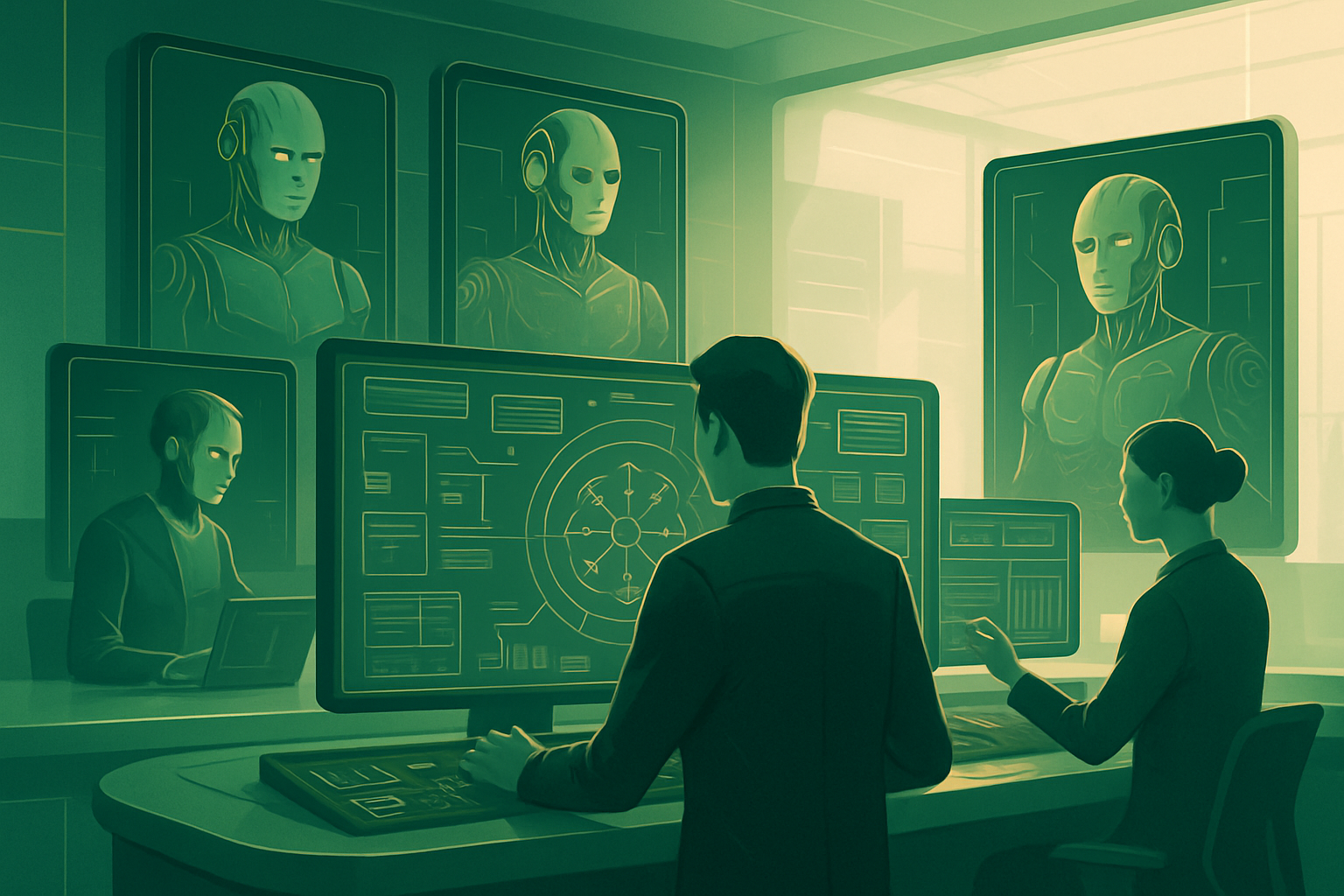
The Japanese company Sakana AI has recently introduced Fugu, an innovative model designed to orchestrate multi-agent operations. This development aims to mitigate the risks associated with reliance on a single vendor in enterprise deployments. Indeed, companies that depend solely on monolithic AI APIs can find themselves vulnerable to service interruptions. To address this issue, Sakana AI has developed Fugu, a language orchestration model that utilizes a variety of models to execute complex multi-step tasks.
Users can interact with this ecosystem through a single access point compatible with OpenAI. Fugu has the capability to process requests internally, determining whether to resolve a request directly or to mobilize a team of expert models for deeper analysis. The system supports model selection, task delegation, result verification, and data synthesis. Thus, engineering teams benefit from a simplified interaction, akin to working with a single model, while a network of specialists executes the required computations in the background.
Addressing Geopolitical and Regulatory Risks
Sakana AI designed Fugu to respond to geopolitical and regulatory risks related to AI sourcing. Recent export restrictions that have affected models such as Fable and Mythos have illustrated the fragility of access to certain essential architectures based on international political decisions.
Fugu presents itself as a backup solution against these unexpected supply chain disruptions. The platform relies on a fully interchangeable pool of agents, allowing Fugu to dynamically reroute traffic around any restricted or degraded vendor, thereby ensuring service continuity. Sakana AI claims that this flexibility provides the resilient architecture necessary to guarantee sovereignty in AI.
Different Deployment Levels of Fugu
Fugu is available in two distinct levels to meet varying operational latency requirements.
-
The standard Fugu model is optimized for low latency, ideal for everyday tasks. It integrates seamlessly with standard development tools such as Codex for live coding and code review. Organizations subject to strict data governance or privacy requirements can choose to manually exclude certain models from Fugu's standard routing pool.
-
Fugu Ultra is designed to handle complex analytical problems requiring maximum precision. This version coordinates a broader set of expert agents for intensive tasks such as reproducing academic articles, conducting literary surveys, and analyzing patents.
According to Sakana AI, Fugu Ultra competes with leading closed models like Fable 5 and Mythos Preview in scientific, engineering, and reasoning benchmarks. Through its orchestration method, companies can access cutting-edge computational capabilities without facing the risks of vendor concentration or export restrictions associated with these closed models.
Application in Cybersecurity
Nearly 500 early users participated in an extended beta program to test the system, focusing on long, multi-step computational workflows. Cybersecurity, being a key area for models like those used in Fugu, has seen engineering teams deploy Fugu Ultra to automate complete security assessment cycles.
Human operators issued targeted instructions, and the orchestration engine handled the entire reconnaissance phase. The model successfully performed checks for cross-site scripting and SQL injection, as well as thorough authentication reviews.
A participating cybersecurity engineer confirmed that the model strictly adhered to its operational parameters, avoiding any destructive actions against the target infrastructure. Fugu concluded the automated engagement by generating a clear vulnerability report, complete with verifiable evidence and precise retest steps for human remediation teams.
This implementation demonstrated that multi-agent routing maintains strict compliance boundaries while executing complex penetration testing sequences.
Software development teams have also integrated Fugu Ultra into their main code review pipelines to compare defect detection rates with established monolithic tools. The orchestration engine consistently outperformed benchmark models in identifying logical defects and security vulnerabilities within complex enterprise codebases.
“For code review, Fugu Ultra is significantly better than GPT-5.5. It provides comprehensive responses and finds bugs that others miss,” reported a software engineer involved in the beta deployment. “Where other tools report about three issues, Fugu highlighted over twenty. It has become the model I use for all my reviews.”
Automated Research and Persona Stability
Data science units have deployed the system in a nearly fully automated research mode. Fugu Ultra has successfully explored mathematical hypotheses, executed experimental code runs, interpreted failure states, and revised its own approaches to maintain progress over long periods with minimal human intervention. This capability directly addresses the operational limitations of single-call models that require constant human incentives to recover from logical errors.
The leadership of an unnamed platform company identified long-term persona stability as a key advantage during these extended sessions. Conventional monolithic architectures often suffer from context degradation and identity drift when processing lengthy conversational narratives.
“The quality of the raw output is comparable to that of the best cutting-edge models, but Fugu has shown exceptionally strong persona stability over long sessions, maintaining its identity where other models drift,” said the executive. “For agent products, this may matter more than raw benchmark scores.”
Extensive Benchmark Validation
Sakana AI built the internal routing logic based on thorough research into model orchestration. The technical foundation of the product stems from results published in the company's papers, particularly the Trinity and Conductor frameworks.
These academic foundations enable Fugu to process requests by precisely understanding when a task requires delegation versus direct resolution. The internal language model dictates the communication protocols between individual agents and structures the final synthesis of their separate computational outputs.
Validation tests against leading AI competitors covered complex and open disciplines ranging from financial time series forecasting to mechanical design. Fugu also demonstrated high competence in niche physical logic tests and visual interpretation tasks, including solving the Rubik's Cube and analyzing Japanese writing. The ability to excel in both quantitative financial modeling and qualitative image processing confirms the effectiveness of the multi-agent orchestration approach.
Sakana AI designed the system to evolve organically as the broader AI hardware and software market matures. Since the product relies entirely on learned orchestration logic rather than fixed operational rule sets, it automatically benefits from third-party innovations. Sakana AI plans to continuously expand the pool of available expert agents.
The engineering team will integrate newly released open-source tools and proprietary models from Sakana AI into the routing pool as soon as they become available. The standard Fugu and Fugu Ultra models are available to enterprise customers today.
Brief IA — L'actualité IA en français
L'essentiel de l'actualité de l'intelligence artificielle, décrypté et expliqué chaque jour.