Sam Altman of OpenAI: AI Will Transform Our Material Reality
Le brief IA que les pros lisent chaque soir
Les 7 actus IA du jour, décryptées en 5 min. Gratuit.
Inclus dès l'inscription : notre sélection des meilleurs guides & comparatifs IA.
Choisis ton rythme
Gratuit · Pas de spam · Désabonnement en 1 clic
Sam Altman and His Vision for the Future of AI
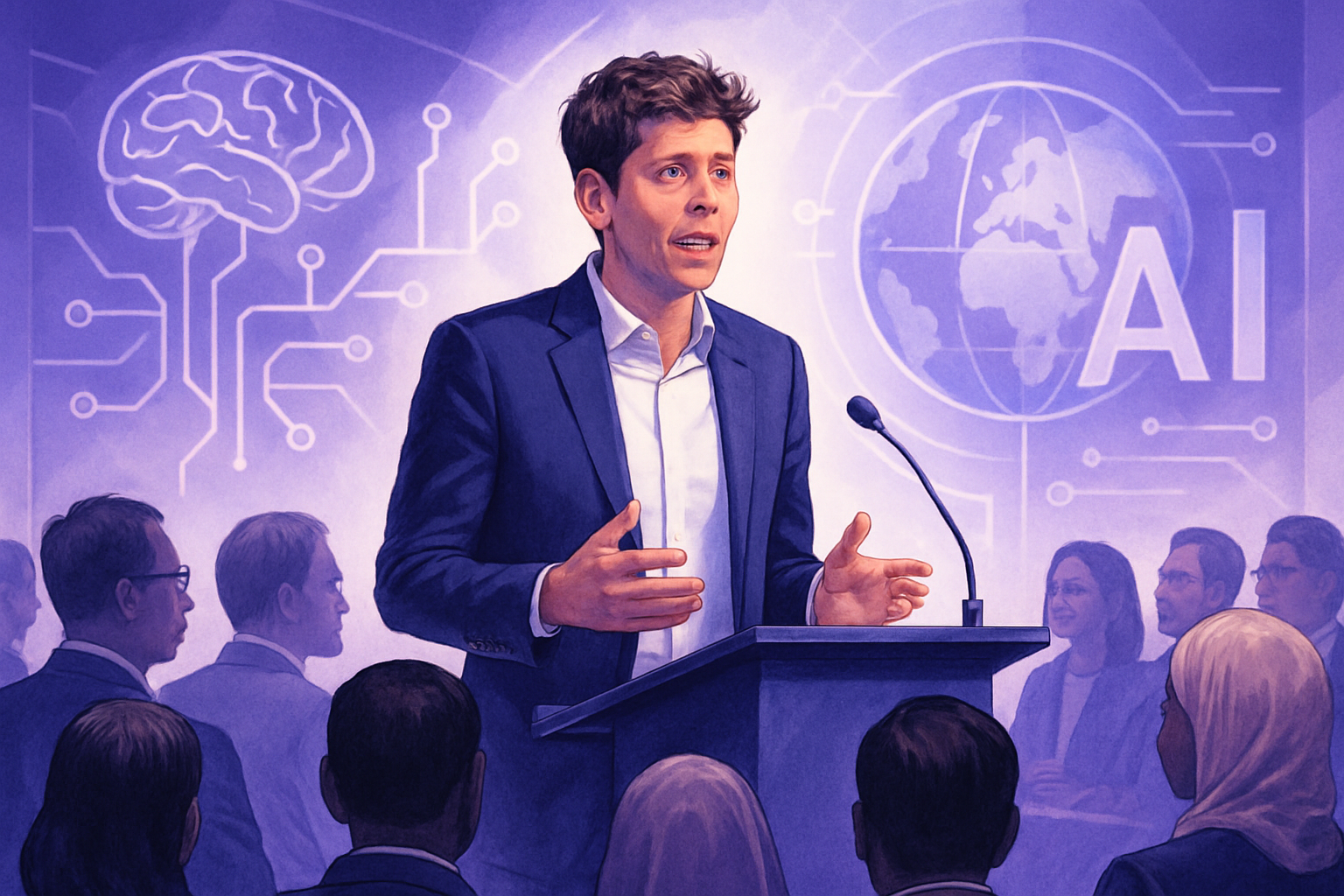
Sam Altman, the CEO of OpenAI, recently shared his ambitious vision for the future of artificial intelligence. He proposed the establishment of an international organization, led by the United States, tasked with setting global standards for AI development. According to Altman, current AI systems, which would have been considered science fiction not long ago, are on the verge of reaching new milestones with even more impressive capabilities in the coming year.
Altman emphasized the need for a global framework for AI, noting that the industry already resembles a work of fiction. In an op-ed published in the Financial Times, he stated that AI proves its economic value, its importance for national security, and its role in accelerating scientific discoveries every day. He predicts that in the near future, AI systems will provide immense value to the world through their astonishing powers.
The Impact of AI on Human Life
Altman argued that artificial intelligence is redefining the material conditions of human life on a scale comparable to the advent of electricity, if not beyond. This radical transformation, he believes, requires a coordinated global response to maximize benefits while minimizing potential risks.
His statements come at a crucial time for AI, a rapidly expanding technology that, according to Altman, necessitates a global framework. He recently discussed this proposal with world leaders and other tech executives at the G7 conference in France. The idea is to create an international forum led by the United States.
An International Organization to Regulate AI
Altman proposes that this organization include government representatives, independent technical experts, and other stakeholders. It would be responsible for establishing standards for the AI industry and making the technology accessible to nations and companies that adhere to these rules. This structure could also serve as a governance mechanism for laboratories, protecting against commercial pressures that could lead to dangerous races.
He highlighted the importance of a global standard to prevent any single country from having disproportionate influence. Such international cooperation could prevent excessive power concentration and ensure that the benefits of AI are shared equitably.
The Challenges of AI Regulation
Altman did not directly mention the request from the U.S. government that OpenAI agreed to comply with, which initially limited the release of certain AI models to a group of trusted partners. However, OpenAI clarified that these limitations should not become the long-term norm.
This request comes amid tensions with the Department of Commerce, which briefly imposed export controls on Anthropic, a competitor of OpenAI. These events unfold as OpenAI considers going public, adding a layer of complexity to the situation.
Drawing Inspiration from Existing Regulations
Altman suggested that the AI industry could draw inspiration from existing regulatory bodies, such as the International Atomic Energy Agency (IAEA), which monitors nuclear energy development and ensures that countries do not seek to acquire nuclear weapons. Even during times of international tension, such cooperation has been possible, with the IAEA being established at the beginning of the Cold War.
For his part, Dario Amodei, CEO of Anthropic and a former colleague of Altman, advocated for AI regulations to be modeled after those of the Federal Aviation Administration. He went further by suggesting that the federal government should have the power to halt the release of an AI model if third-party testing reveals unacceptable risks.
Amodei also mentioned the possibility that, in the near future, the most powerful AI systems could pose a threat to humanity, necessitating stricter regulatory measures than those currently being considered.
Brief IA — L'actualité IA en français
L'essentiel de l'actualité de l'intelligence artificielle, décrypté et expliqué chaque jour.