Sam Altman: Mathematicians Embrace AI Sooner Than Expected
OpenAI claims solutions to notoriously difficult problems, and Sam Altman asserts that mathematicians are moving towards acceptance. However, academic voices are contesting the method and pace, while Terence Tao describes a profession now centered on verifying the work of models.
Terence Tao Announces the End of an Era and OpenAI Claims 700 More Solutions
Terence Tao, a professor at UCLA who earned his PhD at the age of 20, believes that the romantic era of mathematics is over. He describes an adaptation where academics are dedicating more time to verifying the work produced by AI rather than solving problems individually. According to him, this evolution leads to a loss of certain aspects of the profession. Meanwhile, OpenAI announced this month that it has solved over 700 additional mathematical problems.
A Sponsorship Withdrawn and a Competition Maintained in November
At Caltech, students organized a "mathathon" encouraging the use of AI to solve ancient mathematical problems. OpenAI withdrew its sponsorship after an open letter signed by over 700 academics criticized the competition for promoting "mush" from AI. The organizers modified the rules, and the event is still scheduled for November.
Le brief IA que les pros lisent chaque soir
Les 7 actus IA du jour, décryptées en 5 min. Gratuit.
Inclus dès l'inscription : notre sélection des meilleurs guides & comparatifs IA.
Choisissez votre rythme
Gratuit · Pas de spam · Désabonnement en 1 clic
Altman Describes a Rapid Shift from Distrust to Acceptance
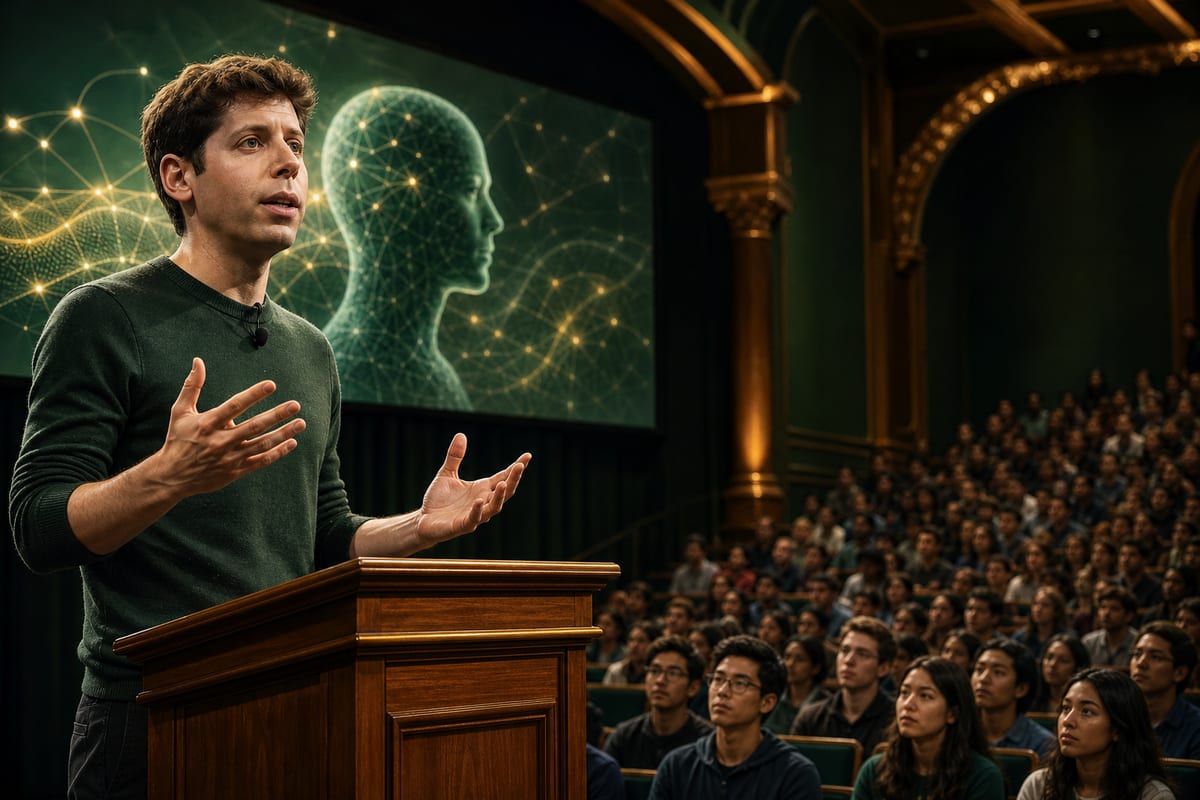
During a conference at Stanford in front of hundreds of students concerned about their future, Sam Altman described the reactions of the mathematical community to the emergence of AI: first disbelief and pain, then anger towards OpenAI, followed by acceptance where some are considering a different, even better, career by integrating AI. Altman claims he does not believe in an AI-related job apocalypse and argues that, in mathematics, the upheavals have occurred faster than in other fields, calling this cycle the quickest he has observed.
Navier-Stokes and Data Usage Accusations at the Root of Tensions
OpenAI has been claiming advancements in mathematics for several months, asserting that it has solved hundreds of problems. In September, the company announced that its models had solved the Navier-Stokes equations, a challenge recognized since the 19th century, which provoked anger from leading mathematicians. Two academics, one at New York University and the other at Anthropic, accused OpenAI of using data from their discussions to achieve this result. Other researchers criticized the fact that AI models do not show their reasoning, leaving mathematicians with the task of verifying the solutions.
Brief IA — L'actualité IA en français
L'essentiel de l'actualité de l'intelligence artificielle, décrypté et expliqué chaque jour.