SanDisk anticipates 10 quintillion tokens annually by 2030
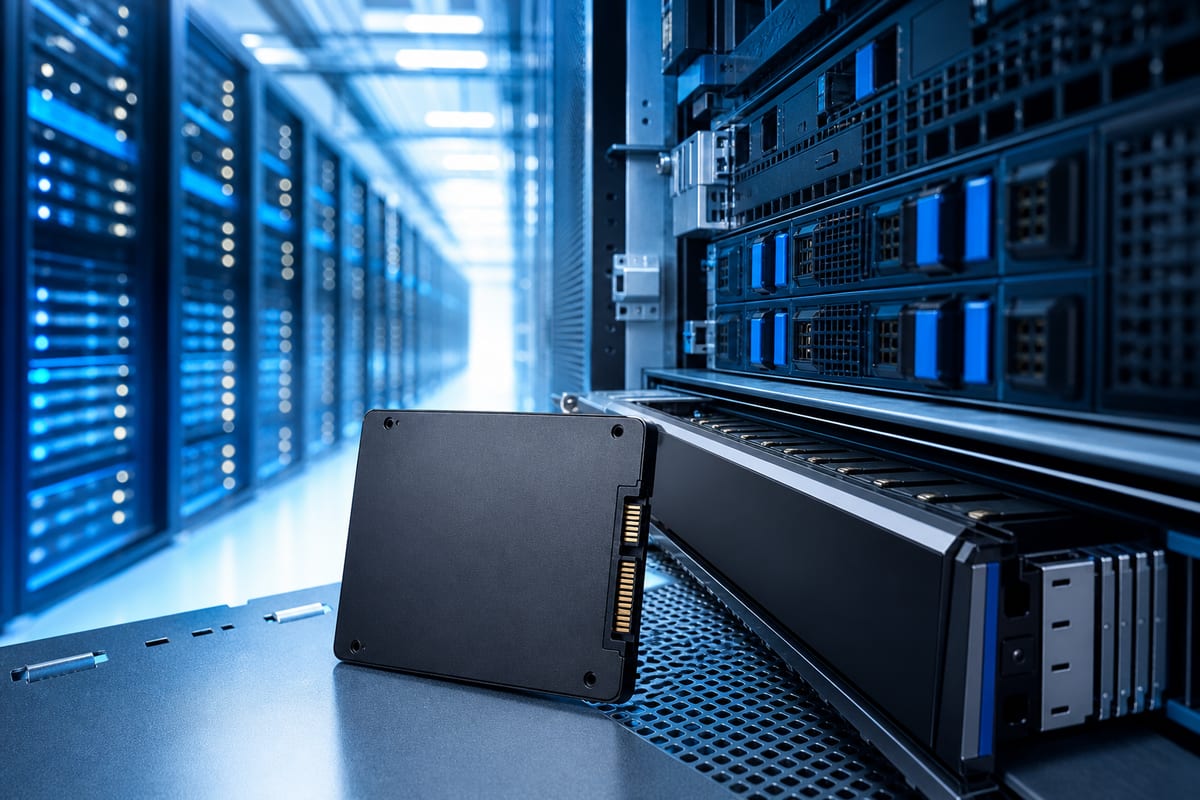
SanDisk estimates that AI systems could generate 10 quintillion tokens per year by 2030, which translates to about 317 billion tokens per second. The flash memory manufacturer primarily evaluates what the infrastructure could produce, without publishing the detailed assumptions of its model.
Energy and Components Under Strain
Electricity availability is the starting point of SanDisk's model. Linglan Wang, an analyst at Gartner, warns that AI capabilities are now limited by the available energy.
Components are also a cause for concern. Jim Schneider from Goldman predicts at least one more year of chip shortages. Pua Khein-Seng, CEO of Phison, reports an estimate from a NAND manufacturer: new capacity would require about four years before mass production. Supply tensions are expected to continue until 2030.
SanDisk Proposes Storing Cache on SSD
SanDisk, a flash memory manufacturer, markets enterprise SSDs for these infrastructures. Its argument is based on KV cache, the state of attention created when a model reads a prompt. During long multi-step sessions, agents are required to maintain it.
According to the company, storing all this data in high-bandwidth memory, a rare resource, will not always be feasible economically or technically. To avoid repeating already completed calculations, it suggests storing part of the cache data on SSDs. Its communication uses the term "token batteries," while acknowledging that no universal formula translates a volume of tokens into storage needs.
This cache preservation already exists with LMCache, Nvidia's Dynamo, and BlueField-4 CMX, as well as with WEKA and Phison. After the Future of Memory and Storage conference this summer, Nvidia emphasized the importance of storage on par with the silicon it powers. According to Nvidia, reading the cache from flash memory rather than from DRAM allows each GPU to support longer contexts and more simultaneous users.
SanDisk Estimates Capacity Rather Than Demand
For 2026, the estimate published under the name Tokenomics 2030 reaches about 150 quadrillion tokens, or approximately five billion tokens per second. SanDisk clarifies that its figures are based on internal analyses and are intended for illustrative purposes; no external data is cited to support them. Jeff Fochtman from SanDisk attributes the formation of the team to Eric Spanneut, senior vice president of product management at the company.
Le brief IA que les pros lisent chaque soir
Les 7 actus IA du jour, décryptées en 5 min. Gratuit.
Inclus dès l'inscription : notre sélection des meilleurs guides & comparatifs IA.
Choisissez votre rythme
Gratuit · Pas de spam · Désabonnement en 1 clic
The calculation does not start from expected usage but from the production that global facilities would be capable of supporting. It incorporates the power allocated to inference, the number and capabilities of accelerators, computing and memory bandwidths, networking, and storage. It also includes anticipated improvements in equipment utilization and software efficiency. Thus, it is more of a capacity ceiling than a consumption forecast.
The detailed parameters remain unknown, particularly the gigawatt power that SanDisk retains for inference in 2030. The trajectory corresponds to a multiplication of more than 60 times in four years, representing nearly tripled production each year until the end of the decade.
Google and I/O Fund Publish Their Volumes
At Google I/O in May 2026, Sundar Pichai, CEO of Alphabet, announced that Google processes 3.2 quadrillion tokens each month, compared to 480 trillion the previous year. However, Google speaks of processing, while SanDisk refers to generation, and neither specifies exactly what scope is accounted for.
In the third quarter results of 2026, Alphabet announced that the APIs of its own models were approaching 32 billion tokens per minute. This throughput increased by 40% compared to the previous quarter and was more than four times that of the previous year.
In July, I/O Fund shared a tracking tool placing the sector's volume near 370 trillion tokens daily, or about 135 quadrillion per year. However, the method of compiling this estimate has not been explained. SanDisk itself presents the token as an indicator of computational work, not of intelligence or value.
A prolonged reasoning of the model increases the count, as do repeated requests until a usable result is obtained. Therefore, a production multiplied by 60 would not necessarily correspond to useful work multiplied by 60.
Goldman Predicts Significantly Lower Consumption
Goldman Sachs Research projected in May a consumption of 120 quadrillion tokens per month by 2030. Its scenario anticipates a multiplication by 24 between 2026 and 2030, primarily driven by AI agents.
Brief IA — L'actualité IA en français
L'essentiel de l'actualité de l'intelligence artificielle, décrypté et expliqué chaque jour.