Satlyt raises $8M and launches its AI on a satellite
Le brief IA que les pros lisent chaque soir
Les 7 actus IA du jour, décryptées en 5 min. Gratuit.
Inclus dès l'inscription : notre sélection des meilleurs guides & comparatifs IA.
Choisis ton rythme
Gratuit · Pas de spam · Désabonnement en 1 clic
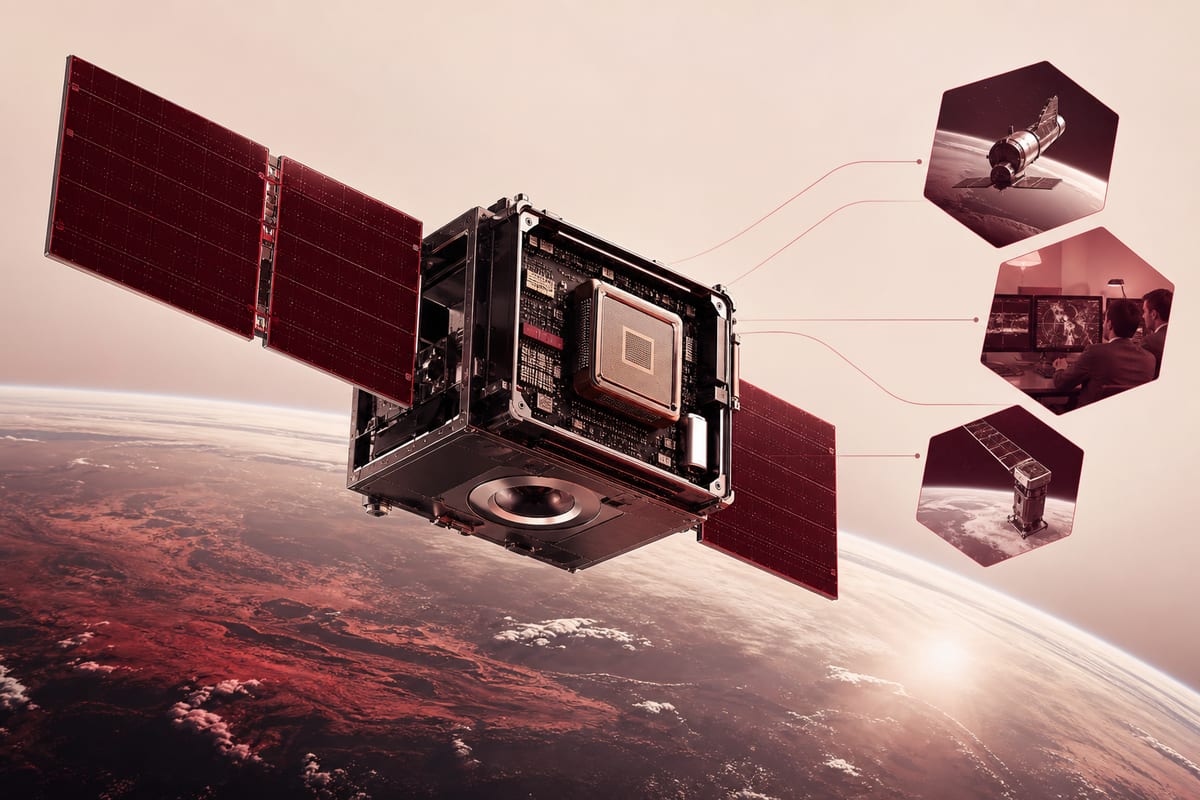
Satlyt, co-founded by engineer Rama Afullo, aims to execute AI models directly onboard satellites and distribute computations among spacecraft. The startup has raised $8 million and is preparing a flight with three clients, including NASA, after already demonstrating a transmission reduction of over 60% during an orbital test.
A mission with three clients and a test showing over 60% gain
During an orbital demonstration, the Gemma model deployed by Satlyt achieved a reduction of over 60% in the size of a transmission related to onboard software errors. According to Rama Afullo, such efficiency can represent savings of hundreds of thousands of dollars per satellite per year. With data transfer to Earth remaining costly and often slow, local execution and decision-making onboard are presented as a lever for savings, whether for processing anomalies or sensor data without systematic return to the ground. The next implementation is planned aboard a vessel built by the Indian startup TakeMe2Space and involves three clients: NASA, which is funding tests of cloud computing protocols in orbit; Stellerian for image processing loads; and TakeMe2Space to demonstrate third-party software hosting. The software is set to launch Thursday on a SpaceX rocket, alongside the first prototype of Google's Project Suncatcher.
The product: embedded AI without building spacecraft
Satlyt is developing software that allows AI models to run directly on satellites. The goal is to distribute large computing tasks among multiple spacecraft without dealing with the underlying infrastructure, similar to platforms like VMWare or Snowflake. The company does not plan to build its own spacecraft and wants to run its software on satellites owned by different companies. Two demonstration missions have already validated components of this approach.
Next step: shared computing on two satellites
Currently, there are few powerful GPUs in orbit, which directs use cases toward the loads processed by Satlyt. The company plans to conduct a test next year aimed at proving the functionality of a shared computing system between two different satellites. If this experiment is successful, it intends to offer an orbital computing cloud, acting as an external provider for spacecraft manufacturers.
$8M raised, Non Sibi as lead investor, and a measured bet
Satlyt has raised $8 million in a round led by Non Sibi Ventures, based in Houston. Bernard Harris, a partner at the fund and a former NASA astronaut for over 20 years, helped shape the firm's conviction in this business model. According to partner Kent Lucas, the investment is partly due to the fact that Satlyt is not dependent on the most ambitious vision of space data centers, which face uncertain economies and delays due to launches. He believes that success can be driven simply by the number of satellites placed in orbit, without the need for data centers in space.
Origins, ambition for 20% of satellites, and timeline
Before Satlyt, Rama Afullo led cloud products at Google and briefly worked in 2024 for Starlink, after which he co-founded the company between Sunnyvale and Nairobi. He claims to want to build the equivalent of an open Android for orbital data centers and aims for a presence on 20% of satellites by the end of the decade. He expects that almost all manufacturers will integrate advanced GPUs and processors into their spacecraft by that time and considers sending a satellite without a GPU to be self-defeating. SpaceX has already committed to orbital data centers, and Satlyt is set to appear at Disrupt in the Battlefield competition from October 13 to 15 in San Francisco.
Brief IA — L'actualité IA en français
L'essentiel de l'actualité de l'intelligence artificielle, décrypté et expliqué chaque jour.