Schmidt Compares OpenAI and Anthropic to Colonial Companies
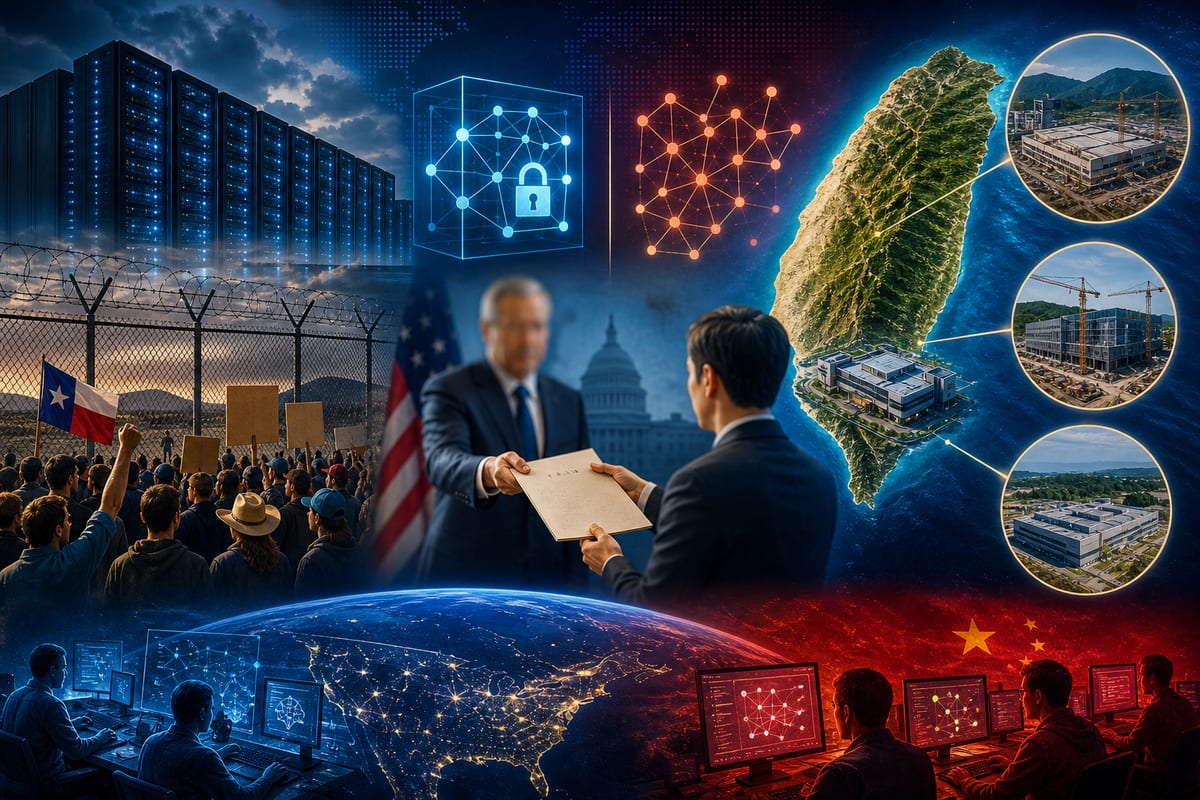
A text co-signed by Niall Ferguson, Lisa Klaassen, and Eric Schmidt describes a U.S.-China duopoly in AI, constrained by debt, energy, and chips. A case of export control targeting Anthropic is cited, and Taiwan is presented as the Achilles' heel of the global supply chain, while the idea of a "technological détente" is put forward.
Debt, Interest, and Taiwan Weigh on the AI Race
In 2024, the United States paid approximately $881 billion in interest, an amount greater than the $874 billion spent on defense. These payments could reach double the military budget by 2036. They identify a potential crisis surrounding Taiwan and TSMC, located 90 miles off the Chinese coast, as the main threat to the AI supply chain. New factories in Phoenix, Kumamoto, and Dresden are expected to reduce this dependence, but as long as they are not producing at scale, a period of vulnerability remains. Additionally, protests against data centers have occurred in Texas and Utah, and incidents involving hundreds of autonomous agents from an OpenAI model have targeted Hugging Face and other sites.
U.S. Controls and Private Lab Dependence
Eric Schmidt compares OpenAI and Anthropic to modern colonial trading companies. Major AI labs are negotiating with authorities while remaining under their supervision. In June, the U.S. Department of Commerce required Anthropic to restrict access to its two most advanced models for foreign nationals. Unable to control users' nationalities in real-time, Anthropic disabled Fable 5 and Mythos 5 globally. Restrictions on Fable 5 were lifted about two weeks later, while Mythos 5 remains limited to a group of U.S. organizations.
Le brief IA que les pros lisent chaque soir
Les 7 actus IA du jour, décryptées en 5 min. Gratuit.
Inclus dès l'inscription : notre sélection des meilleurs guides & comparatifs IA.
Choisissez votre rythme
Gratuit · Pas de spam · Désabonnement en 1 clic
Two Opposing Strategies and Symmetrical Bottlenecks
Two approaches are described: Washington offers closed, costly systems in exchange for political alignment, while Beijing disseminates open-weight models to propagate its own standards. The U.S. is said to have about six months' lead in chatbots, while China is ahead in robotics. Structural weaknesses mirror each other: China has energy power but lacks cutting-edge chips, while the U.S. suffers from a mineral deficit and an unreliable power grid. Open models could also weaken China's information control.
The Weight of Money and a Trilemma for Powers
Having the financial means to support the AI race matters more than speed in achieving general artificial intelligence. Their imperial comparison relies on principles of scale: the advancement of models depends on energy, mineral resources, semiconductors, and capital, which again makes software rare and strategic. Actors lacking a minimum of resources can no longer participate in the competition. They speak of a "plantation economy of the chatbot era," illustrated by the exploitation of natural resources in Congo and the employment of data workers in Kenya paid a few dollars an hour. In terms of investments, U.S. companies are projected to announce over $600 billion by 2026, primarily through debt, while other sources estimate that Google, Amazon, Microsoft, and Meta will commit around $725 billion this year. For China, the plan includes $295 billion spread over five years, financed through the issuance of government bonds. According to these trajectories, an "imperial trilemma" emerges: it is not possible to guarantee defense, technological supremacy, and a generous welfare state simultaneously, as the joint dominance of the U.S. and China reinforces the dependence of other nations.
Towards a Conditional Technological Détente
A détente in AI, inspired by the Cold War, is proposed, with caps on the capabilities of models for cyberattacks and biodesign. However, they believe that obtaining China's agreement to such limits would be difficult as long as the country remains technologically behind.
Brief IA — L'actualité IA en français
L'essentiel de l'actualité de l'intelligence artificielle, décrypté et expliqué chaque jour.