Schneider Electric and AI: An Industrial Revolution Underway
Schneider Electric: A Historic Player in Full Transformation
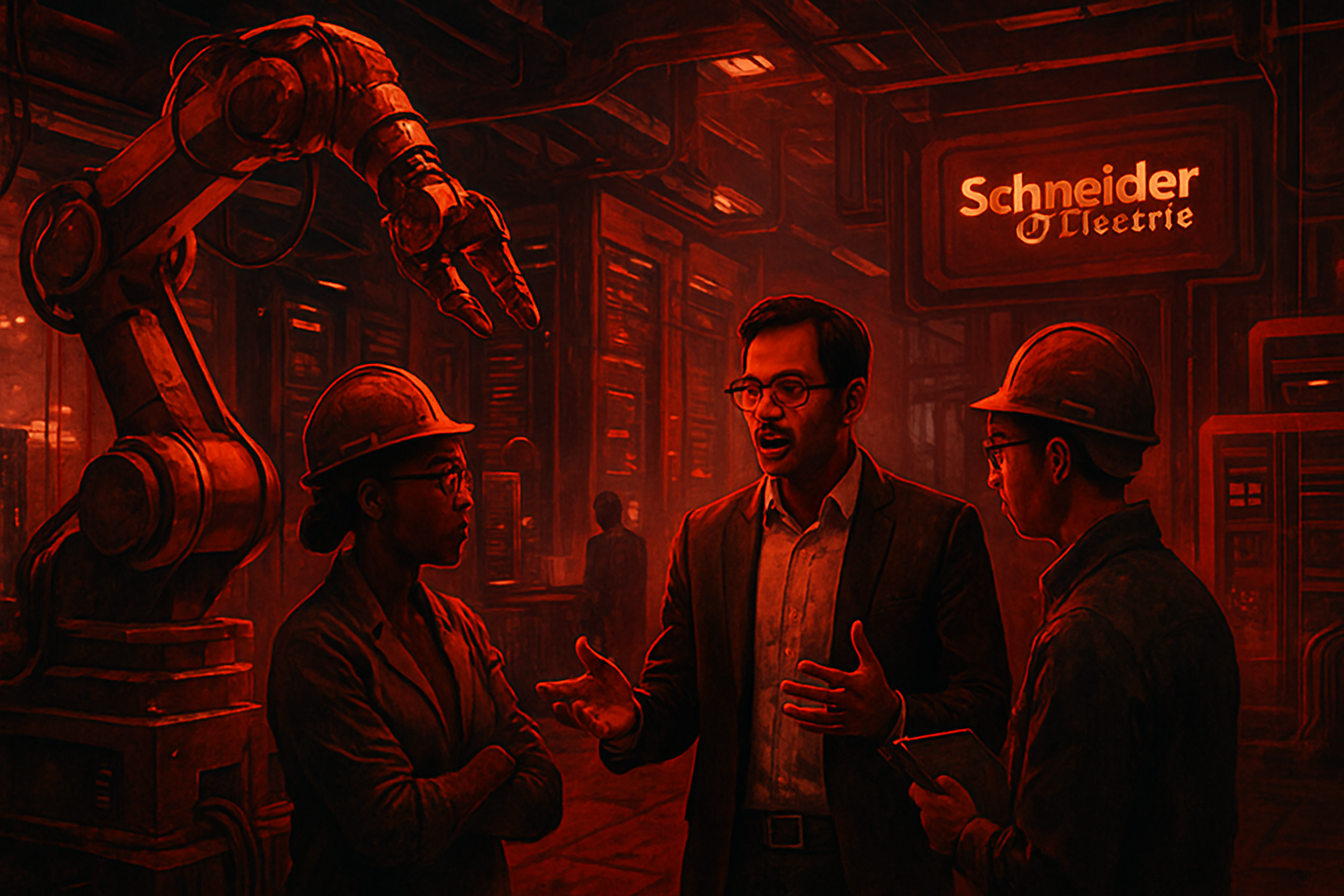
For nearly two hundred years, Schneider Electric has successfully navigated through various industrial revolutions. Originally specialized in steel and heavy machinery in the 19th century, the company has gradually established itself as a global leader in energy management and automation. Today, through its venture capital fund SE Ventures, endowed with one billion euros, Schneider Electric is preparing for a new transformation. This time, it is betting on artificial intelligence (AI) and its interaction with the physical world, particularly in the areas of data centers, electrical networks, robotics, and industrial automation.
A Vision Beyond Software
Amit Chaturvedy, who leads SE Ventures, sees in AI opportunities that far exceed the realm of software. With the growing demand for computing power, energy infrastructure is under significant strain, accelerating reindustrialization. Schneider Electric is therefore supporting startups that develop essential technologies for the AI economy. These investments cover a wide range, from data center infrastructure to the resilience of electrical networks, not to mention robotics and industrial AI.
A Promising Portfolio
SE Ventures can boast eight unicorns in its portfolio and has already made twelve exits, the most recent being Fabric8Labs, a company specializing in metal 3D printing, acquired by the Japanese electronics giant TDK Corp. Schneider Electric does not just invest; it often takes seats on the boards of the companies in its portfolio, seeking to provide real added value. About 80% of the supported startups maintain a business relationship with a unit of Schneider Electric, often in the form of partnerships aimed at serving the company's customers.
Le brief IA que les pros lisent chaque soir
Les 7 actus IA du jour, décryptées en 5 min. Gratuit.
Inclus dès l'inscription : notre sélection des meilleurs guides & comparatifs IA.
Choisissez votre rythme
Gratuit · Pas de spam · Désabonnement en 1 clic
Three Strategic Investment Axes
Amit Chaturvedy has identified three key areas for future investments:
-
AI Integration: AI is increasingly being integrated into various systems, requiring suitable infrastructures for training and inference of models. Companies like Together AI and Hammerhead AI focus on data center efficiency, a crucial issue as capital investments decline.
-
Interconnection with the Electrical Grid: Demand on the electrical grid now exceeds that related to vehicle electrification. It is imperative to strengthen the grid's capacity to meet these new requirements, making grid resilience a promising investment area.
-
Transformative Impact of AI on Industry: AI is transforming the industrial sector, particularly through robotics, where versatile models allow the same hardware to perform multiple tasks. Companies like Skild AI illustrate this evolution.
Energy Challenges to Overcome
Chaturvedy emphasizes that the main obstacle to the expansion of AI is energy. He proposes short-term solutions, such as optimizing energy costs in data centers, and long-term solutions, like creating new energy generation capacities, primarily through renewable energy sources.
Reindustrialization in Response to Geopolitical Challenges
In light of geopolitical tensions, Chaturvedy believes that America and Europe have no choice but to reindustrialize. The United States, in particular, benefits from a significant technological advantage, with strong innovation capacity in areas such as robotics, data center creation, and energy generation. He concludes that AI could transform every manual worker into a knowledge worker, making innovation accessible to all, although not all jobs will return due to inflation and the cost of living.
Brief IA — L'actualité IA en français
L'essentiel de l'actualité de l'intelligence artificielle, décrypté et expliqué chaque jour.