Scikit-LLM in the scikit-learn API: Key Features and Costs
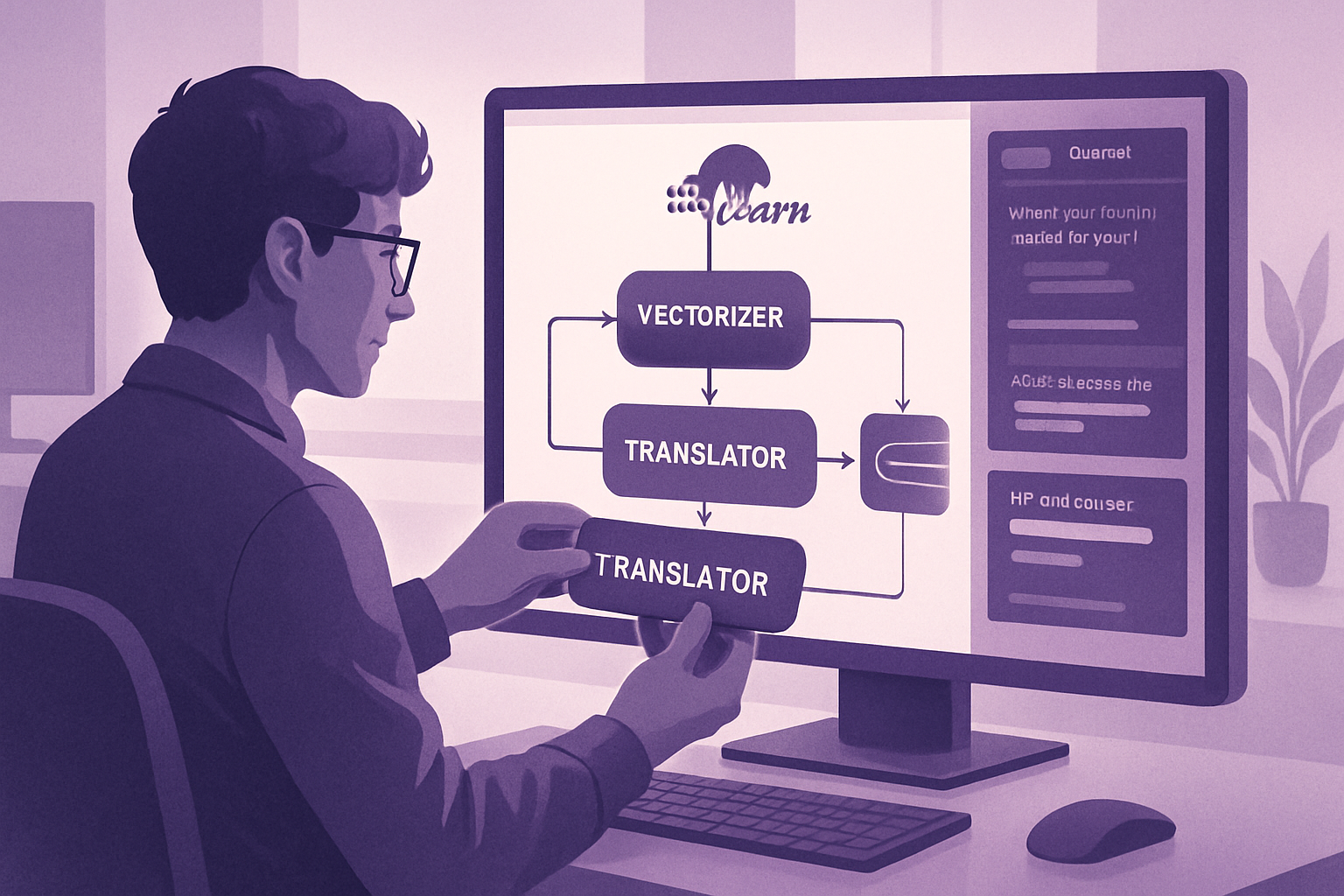
Compatible scikit-learn estimators allow for the integration of language models into pipelines and cross-validation. Their usage relies on API calls per sample and a token budget to consider. Here’s an overview of the main components and their implications.
API Calls Multiply Costs with CV and Grid Search
A cross_val_score with cv=3 implies three times the API calls. This volume increases even further when a grid search is added. The cost in tokens is thus a point of caution for the use of these estimators, where usual scikit-learn practices do not incur fees. The associated cheat sheet emphasizes token planning.
Scikit-LLM Offers Language Models Tailored for Estimators
Scikit-LLM integrates language models into the scikit-learn estimator API. Each model has the fit method as well as predict or transform, allowing for immediate insertion into a Pipeline or during cross-validation. Typically, the fit method memorizes all labels, while processing occurs during prediction, with an API request for each sample.
Le brief IA que les pros lisent chaque soir
Les 7 actus IA du jour, décryptées en 5 min. Gratuit.
Inclus dès l'inscription : notre sélection des meilleurs guides & comparatifs IA.
Choisissez votre rythme
Gratuit · Pas de spam · Désabonnement en 1 clic
Zero-shot and Dynamic Few-shot: Uses and Precautions on Labels
ZeroShotGPTClassifier is presented as the most common estimator. It accepts a fit(None, [candidate_labels]) and considers these labels as the task specification. Vague labels lead to vague results and should be formulated as descriptions. When zero-shot shows its limits, DynamicFewShotGPTClassifier is offered as the preferred option over simple few-shot: it retrieves, for each sample, the closest examples by class, whereas simple few-shot reinjects the entire training set into each prompt.
Vectorization and Translation: Two Building Blocks to Enrich Pipelines
GPTVectorizer transforms text of any length into a fixed-width vector, allowing for the use of classic scikit-learn components downstream, such as logistic regression on the embeddings. GPTTranslator, as a transformer, can be inserted before a classifier trained only in English, avoiding retraining on a multilingual corpus. A cheat sheet compiles these elements for a quick start or regular reference. More broadly, these building blocks offer a structured alternative to ad hoc scripts based on API calls and parsing, while maintaining classification capabilities, with an approach described as more reusable.
Brief IA — L'actualité IA en français
L'essentiel de l'actualité de l'intelligence artificielle, décrypté et expliqué chaque jour.