Scorpion Antivenom: Claude Only Delivered Binders
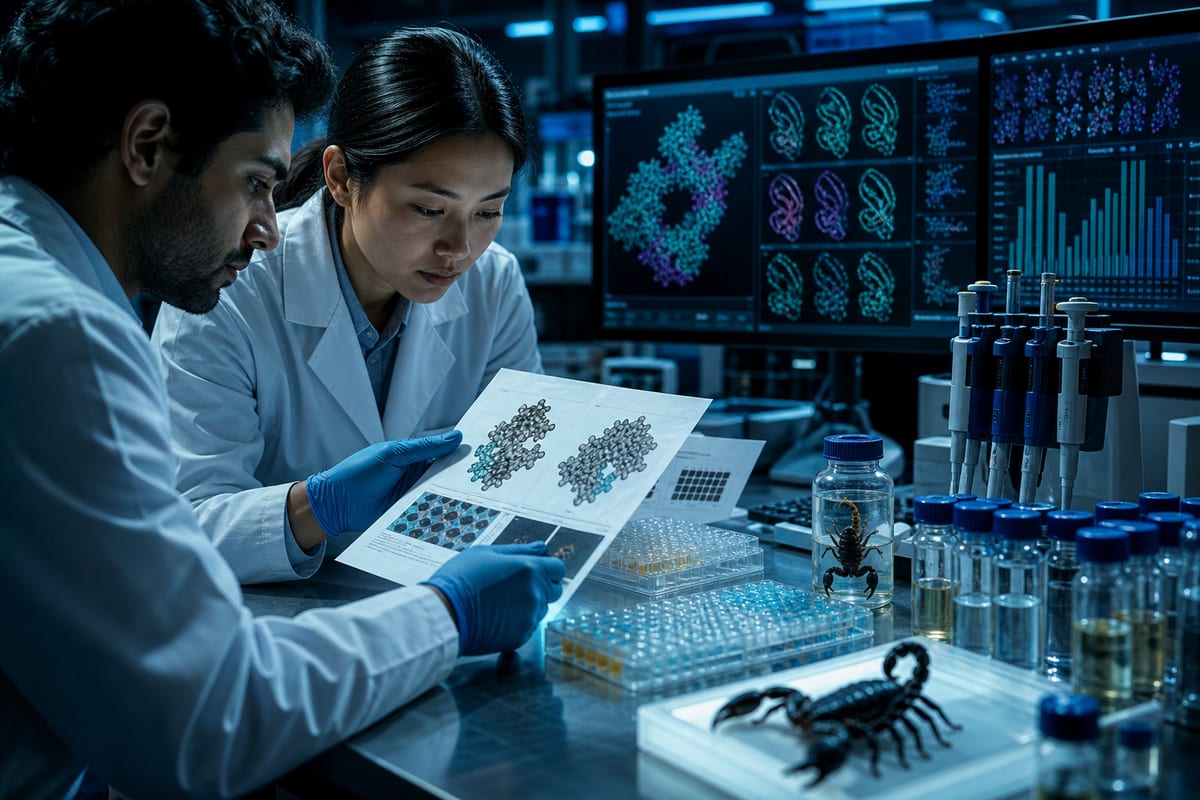
An investment company and Anthropic tested an unpublished version of Claude to design an antivenom for scorpion stings. Bindings to toxins were measured, but no drug emerged from the process. Scientists consider the translation into treatment to be much more difficult. Citrini, however, presents the operation as a beacon for investment.
The tests produced 17 binders, with no evidence of neutralization
Two external laboratories, Adaptyv Bio and Twist Biosciences, evaluated the generated proteins, and seventeen of them showed binding to their targets, covering four of the five targeted toxins. None bound to more than one toxin, according to Citrini. The team acknowledges that no experiments tested whether these proteins actually stop the functioning of the toxins, which does not allow for claims of neutralization or therapeutic safety or efficacy. Researchers from the Technical University of Denmark consider the results technically promising but the enthusiasm premature, describing the conclusions as far from a drug and exaggerated; they list unknowns regarding safety, stability, in vivo behavior, and developability, estimating that the translation into treatment is long and difficult. Andreas Bender reminds us that established methods, such as high-throughput screening, already yield many results without AI and that designing binding proteins is partly a solved problem; according to him, it is the demonstration of efficacy in living systems that is lacking here. Benard Valle and Ljungars also note that the most innovative aspect lies in the autonomous discovery process, not in the biological results. The outsourced trials cost approximately $150,000.
An unpublished model, 320,000 candidates, and 64 hours of computation
The project aimed, using Claude, to create proteins capable of binding to the toxins present in scorpion venom, an area where antivenom production proves to be costly and complex. Relying on a 35-page prompt and about 300 sub-agents, Anthropic states that Claude produced nearly 320,000 proposals, reduced to 180 designs after a selection process, all within 64 hours. An additional thirty-one designs were added with Claude's support, bringing the total to 211. The collaboration began when Citrini hit the biosafety guardrails of the model and sought a partner; Anthropic agreed to lift some restrictions and open access to a more advanced model, provided work was conducted in its offices. The laboratory covered a computation and token bill of about $50,000. It is not established why the biological tests were not conducted in Anthropic's biology lab in California.
Le brief IA que les pros lisent chaque soir
Les 7 actus IA du jour, décryptées en 5 min. Gratuit.
Inclus dès l'inscription : notre sélection des meilleurs guides & comparatifs IA.
Choisissez votre rythme
Gratuit · Pas de spam · Désabonnement en 1 clic
Citrini claims a learning success and admits not being a biotech
Citrini describes the experience as a success in a certain way, arguing that it sheds light on investment opportunities related to AI-assisted drug discovery. The company explains that it did not extend the work, accusing critics of nitpicking, and reminds that it is a research investment company and not a biotech startup. The team had initially indicated that it did not master AI applied to biology, while sharing its trials online and publishing a detailed post. Despite the partnership with Anthropic to test an unpublished version of the model, the operation did not result in a drug. In a video, Citrini described the AI part as free, without mentioning that Anthropic covered the computation costs. Citrini and Anthropic did not respond to requests for comments.
IPO on the horizon for Anthropic and Citrini's tumultuous past
Anthropic, which is developing activities in drug development and life sciences, is just weeks away from a highly anticipated IPO. For its part, Citrini has already made headlines with a fictional narrative of an economic collapse related to AI, which was widely circulated and shook markets, and claims to have visited the Strait of Hormuz in April. The details of its optimistic pitch on companies likely to benefit from the rise of AI in pharmaceutical research have been reserved for subscribers, but it is reported that players in the testing segment, including Charles River Laboratories, were mentioned; this company provides primates for animal research.
Brief IA — L'actualité IA en français
L'essentiel de l'actualité de l'intelligence artificielle, décrypté et expliqué chaque jour.