Scout Motors Trains Its Recruits with AI in Their Earpiece
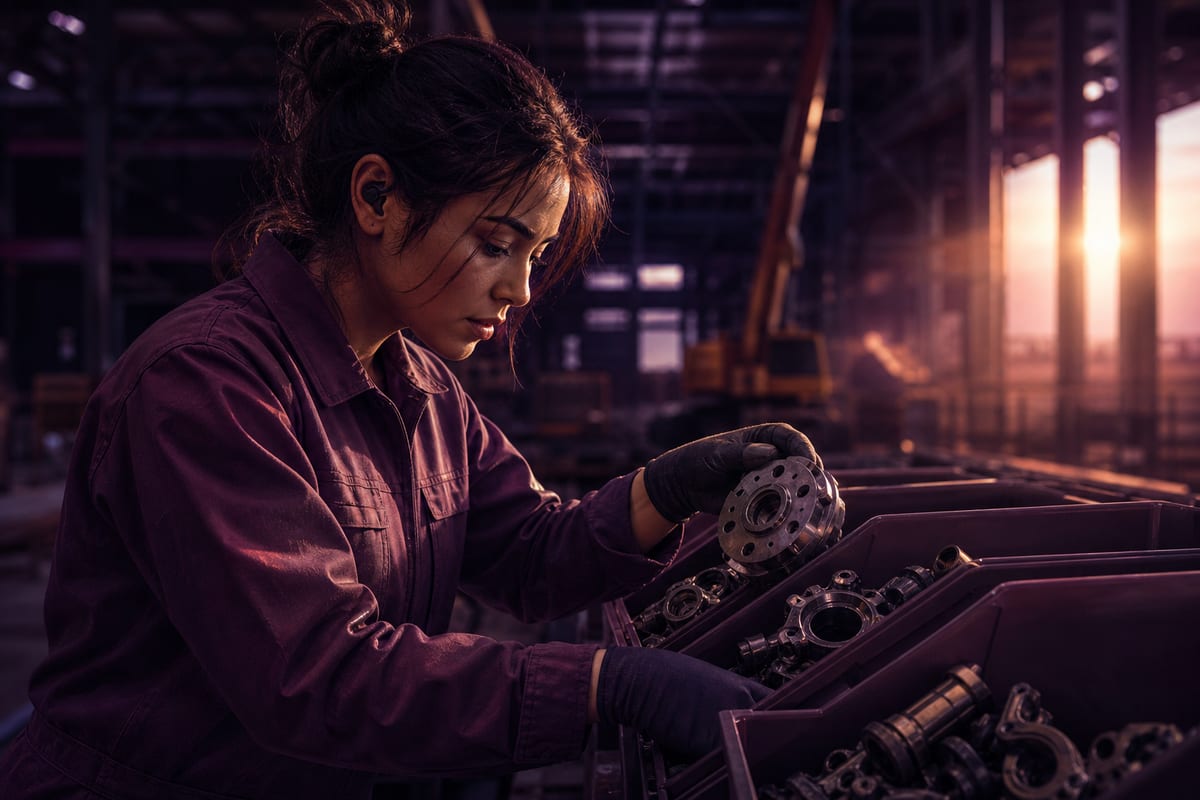
Scout Motors claims to train its workers with an AI assistant worn in an earpiece, which accompanies them during task execution. The manufacturer is also utilizing these tools for recruitment and onboarding at its factory, which is still partially under construction, in Blythewood, South Carolina.
Scout Aims for Over 4,000 Positions
To reach its full capacity by 2028, the factory needs to fill over 4,000 positions. The region has few employees from the automotive industry, and Scout says it is looking for candidates from across the country.
No workers using this technology were observed during the site visit. In a conversation with journalists, Scout Motors CEO Scott Keogh assessed the return on investment based on the time required for a new hire to become productive. While companies seek efficiency gains and employees fear job losses related to AI, Scout's executives did not directly address this latter concern.
The Algorithm Suggests Assignments for New Hires
According to Todd Johnson, Vice President of Manufacturing at Scout Motors, teams input the backgrounds of new employees into an AI system designed to suggest their assignments. Examples range from a former forklift operator who could be directed to logistics to someone experienced in painting who might become a painter. A recruit without final assembly experience might find a better fit in bodywork.
Management attributes to the algorithm the potential ability to identify less obvious matches between skills and positions that might escape a human recruiter. They hope to access candidates without traditional industrial backgrounds, recruit more locally, and introduce other ideas into the workshops. They specifically cite the case of a person hired after working at the DMV.
Instructions Follow the Trainee's Actions
Scott Keogh contrasts manual learning followed by an assessment with hands-on training from day one, aiming to improve training efficiency. He describes manufacturing as a set of elementary tasks that the system must teach separately. To prepare parts, his example involves retrieving 12 from 12 boxes, then checking their order and condition, with real-time adjustable instructions.
Le brief IA que les pros lisent chaque soir
Les 7 actus IA du jour, décryptées en 5 min. Gratuit.
Inclus dès l'inscription : notre sélection des meilleurs guides & comparatifs IA.
Choisissez votre rythme
Gratuit · Pas de spam · Désabonnement en 1 clic
The executive assures that just a few minutes are enough to teach this operation. The employee would then perform about 15 cycles, gaining speed and mastery before moving on to another task. The executives partly admit that such a simple operation does not necessarily require AI, but they claim significantly higher productivity compared to classroom training, with increasing advantages for complex learning. Keogh also links the rapid progression of recruits to the pace of ramping up the site.
Ryan Decker, Vice President of Strategy and Brand at Scout Motors, describes a program that the company is particularly committed to. According to him, the training can take into account linguistic differences, technical knowledge, and learning styles, rather than imposing a uniform content on 10 people over 10 days. The data collected can then be reused to adjust recruitment, training, and assignments.
Decker states that the reactions of one group can be used to modify the instructions given to the next. He envisions a "1%" improvement for each successive group and expects, after 1,000 repetitions, a system fine-tuned to convey information as effectively as possible. These figures express his expectations, not measured results.
Scout Envisions Assistance Right in the Workshops
The next announced step involves bringing learning tools into production workshops and service centers. Scout anticipates improved on-site productivity and support for employees throughout their careers. The manufacturer is also exploring augmented reality glasses to visually guide trainees and ultimately envisions autonomous use by owners at home.
According to Ryan Decker, the AI has received machine manuals and industrial documents from various countries, specialties, and decades. He describes this repository as "hundreds of years of accumulated know-how in business," which the assistant could provide in real-time, both during and after training. He considers such access nearly unachievable with binders and PDFs.
Brief IA — L'actualité IA en français
L'essentiel de l'actualité de l'intelligence artificielle, décrypté et expliqué chaque jour.