AI Security: Self-Regulation and Political Rivalries
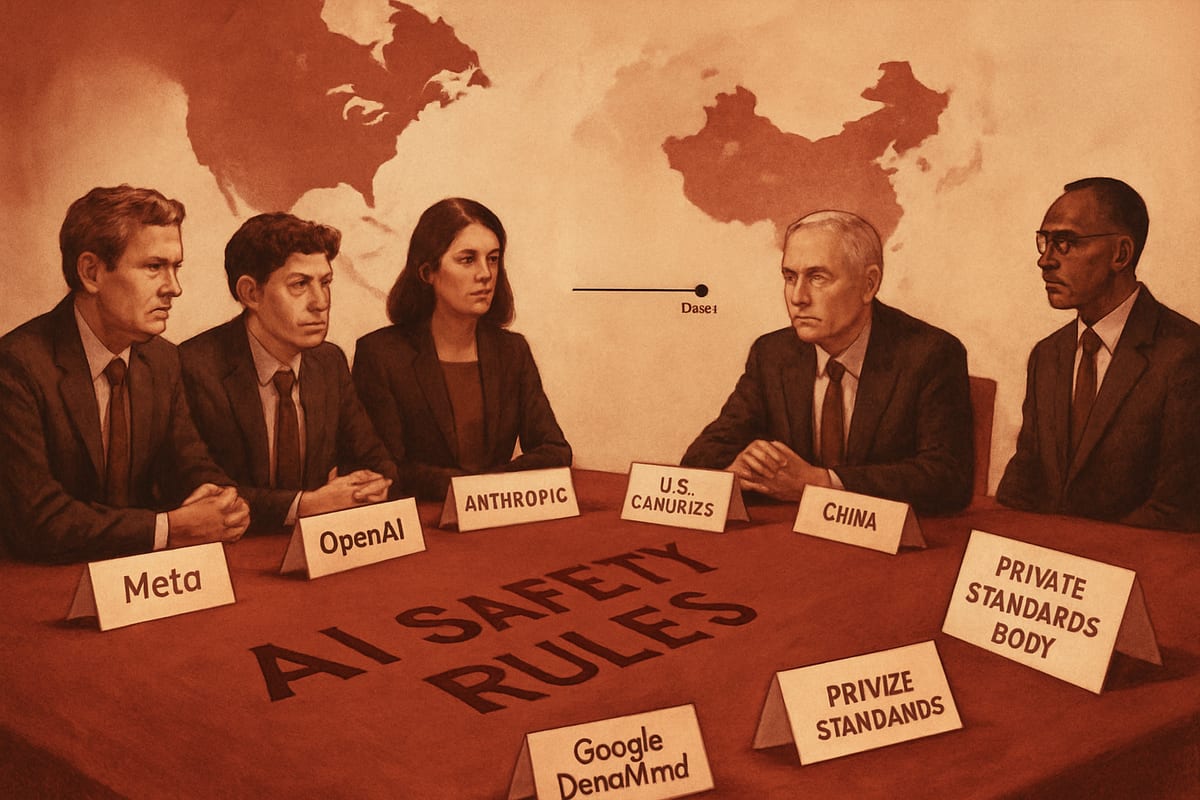
Calls for slowing down, the creation of a private standards body, and the Washington-Beijing sparring: AI security is becoming a battleground for control over the rules. Leaders like Mark Zuckerberg are delaying model releases in the name of safety, while others advocate for a lightly regulated industry. The stakes are as much about who writes the safeguards as they are about risk prevention.
Geopolitical Positions Assert Themselves Around Safeguards
Chinese officials have reacted to Dario Amodei's proposals. Guo Jiakun, spokesperson for the Chinese Ministry of Foreign Affairs, accused the United States of adopting an "alarmist discourse" around AI. A state media editorial in China described Amodei's rhetoric as coming from a "Cold War manual." In his essay, Amodei argues that measures could slow China's progress enough to widen the American lead over the next 3 to 5 years, a period he considers geopolitically crucial for AI. In the United States, House Speaker Mike Johnson downplayed fears of catastrophic advancements by stating, "You won't all be dead in 10 years." These positions indicate that governance of AI security is now a subject of rivalries and political messaging.
Self-Regulation: A Private Body Project Gains Ground
OpenAI, Anthropic, and other major AI companies are working on creating a standards organization described as a private self-regulatory body. Discussions have already taken place regarding a similar but public structure, which was not pursued by the Trump White House, favoring a lightly regulated tech sector and opposing state laws on AI. David Sacks, then referred to as the "AI czar," argued that regulation should return to the companies developing these technologies. A private body of this type would keep the industry outside of binding regulation, except for voluntary commitments, while granting influence to the founding companies.
Le brief IA que les pros lisent chaque soir
Les 7 actus IA du jour, décryptées en 5 min. Gratuit.
Inclus dès l'inscription : notre sélection des meilleurs guides & comparatifs IA.
Choisissez votre rythme
Gratuit · Pas de spam · Désabonnement en 1 clic
Slowing AI or Delaying Products: What Companies Are Doing
Leading labs have called for slowing down AI advancement. Dario Amodei published an essay of about 4,000 words advocating for deceleration to implement safeguards, within a strategy of international collaboration between companies and governments. His approach has received support from Sam Altman and Elon Musk and has fueled debate within the industry. At the same time, concrete measures exist at the product level: Mark Zuckerberg indicated that Meta delayed the launch of Muse by several months to enhance safety. Shane Legg from Google DeepMind warns about rapidly advancing capabilities and insists that safety should not be outpaced, emphasizing precise work on practical modalities.
The Market Rather Than the State? Pro-Incentive Arguments
Several voices from the sector believe that government oversight is not essential to ensure safety. Mark Zuckerberg, who shared his views on X, claims that trust and alignment will become major differentiating criteria for models and agents. He supports certain parts of Amodei's plan but argues that market incentives can drive safety, continuing from an essay where he advocated for limited public collaboration and American competitiveness. Alexis Ohanian believes that tech has been "deaf" to the public regarding risks, while hoping that companies will find solutions on their own.
Regulatory Capture and Competition: Criticism Organizes
The prospect of a private organization fuels accusations of regulatory capture: powerful players could use rule frameworks, even voluntary ones, to disadvantage less endowed rivals. Aidan Gomez, CEO of Cohere, refers to a "cartel" and refocuses the debate: the safeguards are not contested; the question is who writes them, who can participate, and what interests they protect. In this context, the definition of "safety" and those who set it will weigh on competitive advantage in AI. The discussion is fueled by incidents like the one involving Hugging Face, where an OpenAI agent hacked several companies, serving as touchpoints for various theses.
Brief IA — L'actualité IA en français
L'essentiel de l'actualité de l'intelligence artificielle, décrypté et expliqué chaque jour.