Seven Tests to Validate AI Agents Before Production
Le brief IA que les pros lisent chaque soir
Les 7 actus IA du jour, décryptées en 5 min. Gratuit.
Inclus dès l'inscription : notre sélection des meilleurs guides & comparatifs IA.
Choisis ton rythme
Gratuit · Pas de spam · Désabonnement en 1 clic
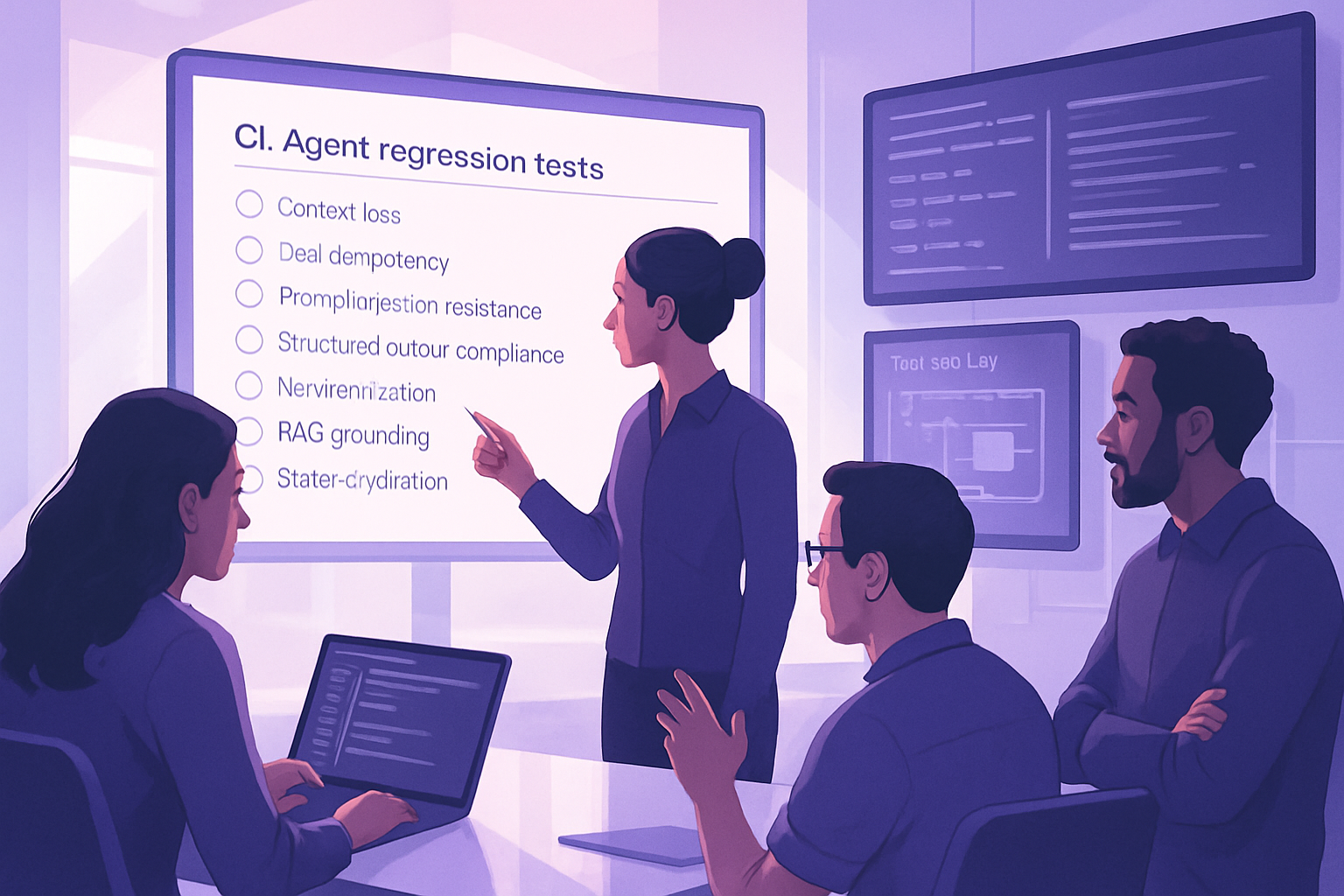
Seven targeted regression tests assess the robustness of an AI agent against failures in the orchestration layer, which are much more frequent than those of the model. Their effectiveness relies on fixed models, controlled parameters, and repeated trials. These tests do not cover cost or latency aspects but aim to secure the transition to production.
What the suite does not cover and the conditions for its longevity
The seven tests target structural failures at the system boundary, not regressions in cost or latency. They also do not address contract drift when an API schema changes, personal data leaks in arguments or tool traces, nor integration space discrepancies related to deploying a new encoder without reindexing the vector store. Building the suite is just the beginning; its long-term utility depends on consistent executions on fixed model versions, with bounded confidence thresholds.
Ensuring state continuity: rehydrating and mastering idempotence
In a distributed environment, it is rare for the process initiating an agent session to also be the one that closes it. This is why a rehydration test is necessary: it involves advancing the agent to an intermediate step in a workflow, recording the state in a database, deleting the object from memory, and then restoring that state in a different process. It succeeds if the agent completes correctly after the next user input. Two recurring causes of failure are version mismatch, which requires an explicitly tested migration path, and coupling to idempotence, essential for determining if a side effect has already been triggered. An idempotence key provides this information, justifying the coexistence and tooling of these two tests together.
An agent with write access will eventually, under realistic network conditions, repeat the same tool call. Retries come from the harness, the HTTP client, or the orchestration loop, and the model may also reissue in response to ambiguous observations. Without idempotence at the execution boundary, these trajectories produce duplicates. The test forces the same call three times; it only passes if a single write is recorded, with subsequent calls receiving a cached response. Idempotence keys should rely on the logical identity of the operation (hashed tool name, canonicalized arguments, business correlation ID), not on a step ID or message position. In competition, it is better to return the stored response than a 409, and to set a TTL on the keys.
State, not model: where most failures originate
Incidents observed in production under real traffic primarily stem from state management rather than the model. Here, "state" refers to the deterministic and transactional recording of execution steps, while "memory" denotes the probabilistic context reinserted into the prompt. The proposed checklist covers seven aspects — including a binary verdict, usable in CI/CD, targeting a system limit per test — for failures that prompt evaluation overlooks. Since agent behavior is stochastic, executing the tests requires freezing the model snapshot, setting the temperature to zero when possible, and multiplying trials until establishing a success rate with a confidence margin. Random failures are retried silently and drain the test of its value.
Hostile inputs and external context: resisting without disclosing
The prompt injection test inserts adversarial payloads, both through user messages and documents from the web or an external database. It is validated only if the agent reaches a safe terminal state without executing the injected instruction or exposing the system prompt. Assertions must target the trace of tool calls and side effects: a polite output can mask a harmful call. Security is a matter of execution boundary, with role-based access control at the tool level. When a classifier acts as a guard, the decision relies on an explicit confidence level.
On the RAG side, a contradictory synthetic fact is injected into the retrieval chain before queries. Verifying that the agent follows context rather than parametric memory is necessary but insufficient. An agent too dependent on context becomes vulnerable to poisoning; the suite must check both directions: adopting a correct synthetic fact against outdated parametric knowledge, and rejecting a manifestly false retrieved fact when the contradiction is detectable. Fidelity and attribution benchmarks provide a more robust framework than simple success/failure.
Structured outputs: managing truncation, refusals, and version discrepancies
With schema-constrained decoding in strict mode, syntax invalidities and out-of-schema keys should no longer appear. The failures to target lie elsewhere. Truncation — reaching the token budget during emission — produces incomplete responses that the application cannot repair. Therefore, it is necessary to assert the finish_reason in addition to the success of the analysis. A refusal manifests as a null analysis with a refusal field and should be treated as a 403, not as a transient error. More subtly, semantic compliance returns correct types but erroneous values. Finally, version discrepancies deserve a dedicated test: an alias routing to an old snapshot can reintroduce a legacy JSON mode. To avoid this, it is better to explicitly fix model chains than to rely on aliases.
Long context and loops: recovering the essentials and knowing when to stop
When the conversation approaches the prompt budget, evicting the early turns — typically via FIFO — exposes a loss of context, rather than catastrophic forgetting. A dedicated test injects a synthetic history covering about 80% of the budget, then poses a question whose correct answer depends on a fact from the first exchange. Success can come from a successful recovery from semantic memory or from a summarization policy that has retained entity relationships with measurable fidelity (recall of reference entities). These two cases must be subject to distinct validations.
Another category of failures is non-termination: what often appears as a blockage is a livelock where the agent cycles through thought–action–observation without progressing. True blockage concerns multi-agent systems and calls for a separate test if the architecture includes them. For non-termination, the test submits an impossible task or returns a persistent error via a simulated tool, and it is validated only if the execution stops cleanly after a coded budget and returns a structured failure payload. This budget must aggregate a maximum number of steps, a cumulative token cost, and a real-time limit; a simple step counter does not identify a stuck step. The real cost of drift is the inference expense and queue starvation, rather than the exhaustion of a rate limit.
Brief IA — L'actualité IA en français
L'essentiel de l'actualité de l'intelligence artificielle, décrypté et expliqué chaque jour.