SiMa.ai Launches Palette 3.0 and Promises 3.5 Times Faster LLMs
SiMa.ai launches Palette 3.0 for its Modalix AI chips, claiming text generation speeds up to 3.5 times faster, with overall power consumption unchanged. The reported gains vary depending on the tests, all conducted by the company.
SiMa.ai offers a platform for drones
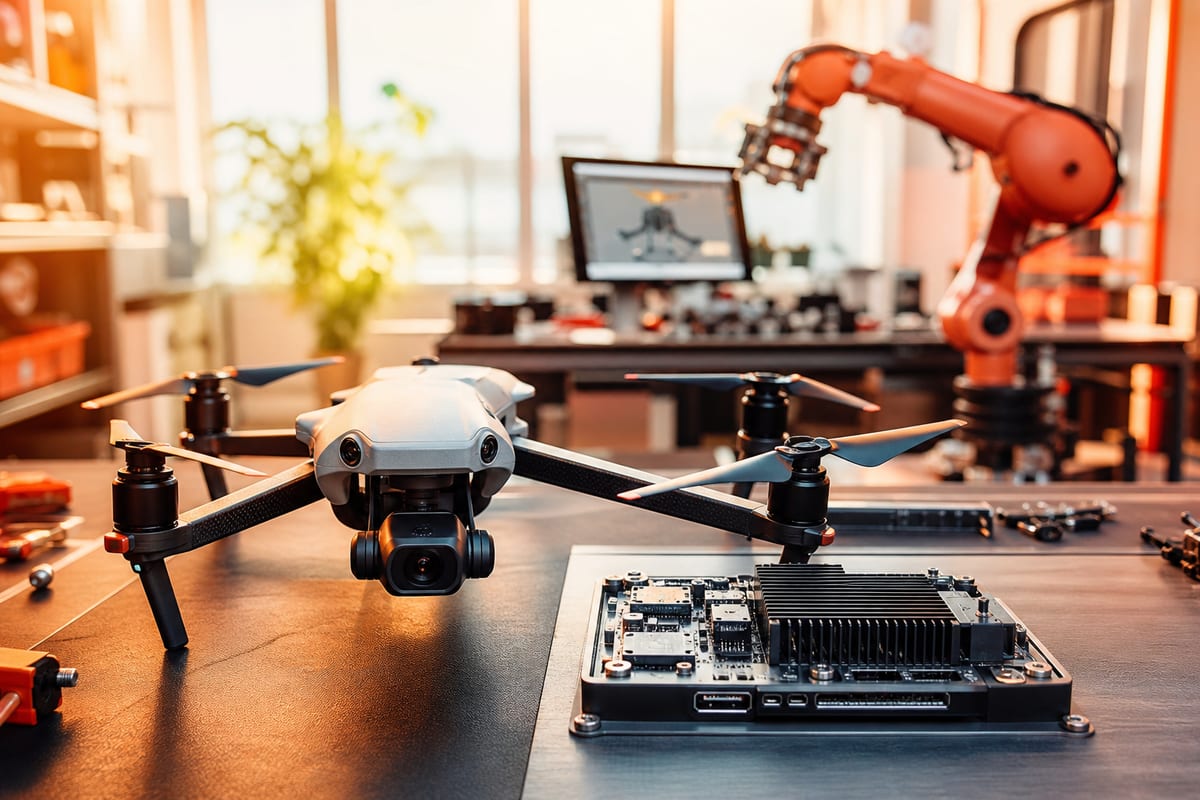
For drones, the reference platform offered by SiMa.ai performs 1080p video segmentation at 30 frames per second, according to Manuel López Roldán, head of agent software and generative AI at the company. He also announces visual odometry in about 38 milliseconds and presents the offering as a fully functional autonomy system for robotic teams, rather than just a board. ROS 2 and Nav2 can be installed; Indian engineering firm Mistral Solutions is participating in the launch.
The code is available on GitHub as open source; SiMa.ai's Developer Center hosts the documentation. Based in San Jose, the startup raised $150 million in September, achieving a valuation of $1.45 billion. Other chip manufacturers targeting edge AI have attracted funding this year: Analog Devices has agreed to acquire Alif Semiconductor, while Syntiant has filed for an IPO.
Automotive gains remain below maximum
In a car assistant trial, commands like "I'm cold" had to be converted into function calls. SiMa.ai states that all 900 evaluated requests resulted in the expected call, with acceleration ranging from 1.35 to 2.06 times. The company explains this result, which is below the maximum, as a limitation of the method: it does not accelerate the initial processing of the request.
Le brief IA que les pros lisent chaque soir
Les 7 actus IA du jour, décryptées en 5 min. Gratuit.
Inclus dès l'inscription : notre sélection des meilleurs guides & comparatifs IA.
Choisissez votre rythme
Gratuit · Pas de spam · Désabonnement en 1 clic
The claimed maximum contrasts standard and speculative decoding, with identical model and chip. In the technical measurements published at launch, SiMa.ai achieved its best result with Alibaba's Qwen3.5 9B combined with DFlash: the throughput reached 41.75 tokens per second, compared to 11.98, for about 7.5 W in each configuration. The energy required per token then decreases from 0.627 to 0.182 joules, according to the company.
Out of four evaluated models, SiMa.ai reports accelerations ranging from 2.21 to 3.49 times. These tests were based on five fixed prompts, including a mathematical proof and a Python script, with the goal of measuring gains under favorable conditions. All performance metrics are based on SiMa.ai's internal testing.
Palette runs multiple models on the accelerator
The announced acceleration relies on speculative decoding: a lightweight model proposes several tokens, units of text, that the main model controls in groups. Palette utilizes EAGLE3, DFlash, and Gemma 4 for this multi-token prediction. According to Manuel López Roldán, this version focuses on the local execution of models.
Multiple models can be sent simultaneously to the accelerator, without going through a background service. The software also allows the execution of separate Docker containers on the chip. It supports mixture of experts models, including OpenAI's GPT-OSS-20B, with the 16 GB Modalix module.
Palette 1.0 operated vision models on SiMa.ai's initial chip; Palette 2.0 integrated generative AI into Modalix in December 2025. In June, Palette Neat incorporated an agent that can generate and deploy applications from natural language instructions.
Brief IA — L'actualité IA en français
L'essentiel de l'actualité de l'intelligence artificielle, décrypté et expliqué chaque jour.