SimReady Central: 2,000 Free 3D OpenUSD Assets on Hugging Face
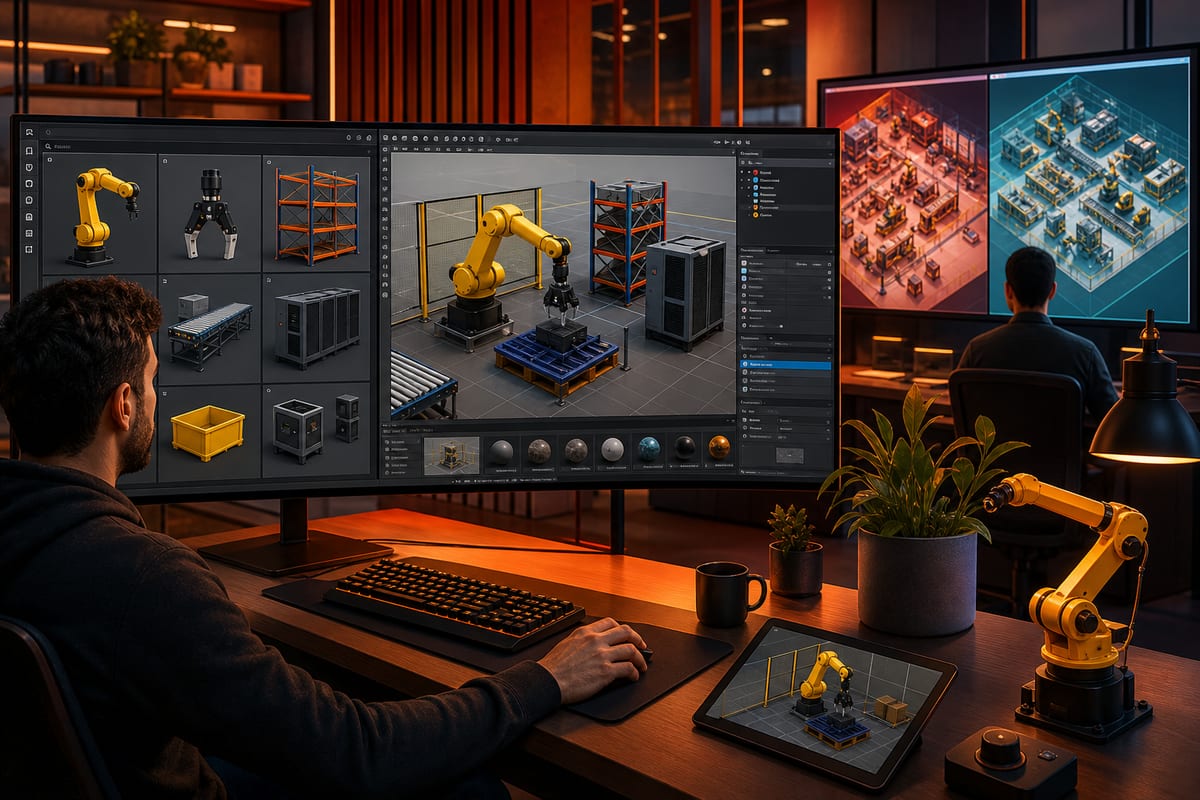
An open library offers over 2,000 "SimReady" 3D models in OpenUSD format, available for free to train robots and design digital twins of AI factories. Tools like NVIDIA USD Search and AI assistance via GPT-6 Astra simplify the search for assets and scene assembly. Several OEMs and asset providers are already publishing validated arms, grippers, racks, and cooling equipment according to common profiles.
Searching and Composing Scenes with USD Search and AI Assistance
The SimReady Central library is indexed for natural language search thanks to NVIDIA USD Search, allowing users to find assets across participating datasets. Hugging Face has integrated this capability into its platform, with USD properties and simulation metadata indexed to identify suitable assets. AI-assisted authorship offers another method of construction: models like OpenAI's GPT-6 Astra can be used with asset search and scene authorization tools to find assets, generate assembly code, and create scenario variations. OEMs can also rely on Astra to prepare and refine their OpenUSD assets before validation. In the described workflows, Astra is designed to query the SimReady search API, load assets into an OpenUSD scene, generate Python code, configure the task, and produce a preview. For layout comparisons, Astra would assemble two OpenUSD scenes and generate control scripts; developers could then inspect placements, access paths, and reported issues.
Two Typical Workflows: Pick-and-Place and AI Factory Layouts
The first scenario illustrates the creation of a pick-and-place cell in a warehouse using Isaac Sim with PhysX, utilizing SimReady assets available on Hugging Face. The procedure involves using nvidia-simready-central.hf.space to identify a FANUC arm, a compatible Robotiq gripper, and warehouse assets, then generating Python code to assemble the scene, configure the task, and produce a video preview. Scripts, asset versions, and execution details are included to ensure reproducibility. A second scenario concerns the comparison of two AI factory layouts: organizing racks, cooling equipment, and infrastructure within precise spatial constraints, checking for overlaps and clearances, and reporting any issues. Each variant is recorded in an OpenUSD scene, with the necessary scripts and versions to reproduce and compare results.
What Manufacturers Gain: Discoverable Assets and Multiple Use Cases
Manufacturers have the opportunity to transform their CAD models into SimReady assets and then publish them on Hugging Face to reach teams involved in designing robotic simulations and digital twins of factories. For OEMs specializing in AI factories like Vertiv, this involves providing racks, cooling devices, and infrastructure elements intended for digital twins. In robotics, players like Comau, FANUC, Franka Robotics, Robotiq, Standard Bots, and Universal Robots offer arms and grippers for training and evaluation environments, combinable with industrial equipment. Asset providers like Palatial contribute the NVIDIA Robotics 1K Dataset published with NVIDIA Robotics, as well as articulated assets derived from texts, images, scans, datasheets, and CAD, useful for creating training assets and scenes. In domestic robotics, LG Electronics shares assets like refrigerators and dishwashers to build training, evaluation, and synthetic data generation environments. AI-assisted CAD platforms like ForgeCAD provide articulated accessories with detailed textures for perception and manipulation. OEMs have a submission competency to validate, package, and offer their assets according to relevant profiles.
Le brief IA que les pros lisent chaque soir
Les 7 actus IA du jour, décryptées en 5 min. Gratuit.
Inclus dès l'inscription : notre sélection des meilleurs guides & comparatifs IA.
Choisissez votre rythme
Gratuit · Pas de spam · Désabonnement en 1 clic
Criteria for a SimReady Asset Defined by the SimReady Foundation
A SimReady asset is based on OpenUSD and incorporates the necessary properties for simulation workflows, beyond a simple CAD model. Depending on the use case, it may require mass information, collision geometry, friction, or even equipment geometries and electrical or thermal metadata for AI factory applications. The SimReady Foundation formalizes these requirements through specifications, profiles, and validation tools, with each profile grouping the capabilities required for a given use. Relevant features may include structural elements, physical and collision properties, contact simulation in a supported execution environment, joint structure and limits, movement of articulated equipment, object identification, and annotated synthetic data, as well as material and sensor attributes, along with rendering and simulation of supported sensors. Developers select assets whose profiles meet their needs and compose them into OpenUSD scenes, which is pertinent for training and evaluating autonomous machines requiring described physical behaviors, collisions, and sensor interactions.
Library Content and Immediate Uses for Developers
The SimReady Central library brings together over 2,000 OpenUSD assets ready for simulation, offered for free and without restriction. It covers robotic arms and grippers, warehouse equipment, shelves, and cooling infrastructure, with datasheets indicating the capabilities supported by each asset and the possibility of composing multi-provider scenes. It serves as a reusable starting point for robotic cells, industrial environments, and AI factory digital twins. Developers and AI agents can populate training environments with objects and obstacles, vary placements to evaluate behaviors, and support projects like the open-source Microduck robot. SimReady assets, prepared to limit manual additions such as collision, mass, and friction, are intended to reduce preparation work. OEMs validate their assets according to expected profiles and reach teams via Hugging Face, enabling faster testing and simulation of scenarios while maintaining control over their datasets.
Brief IA — L'actualité IA en français
L'essentiel de l'actualité de l'intelligence artificielle, décrypté et expliqué chaque jour.