Simulation: 766 Microducks Out of 768 Remain Standing
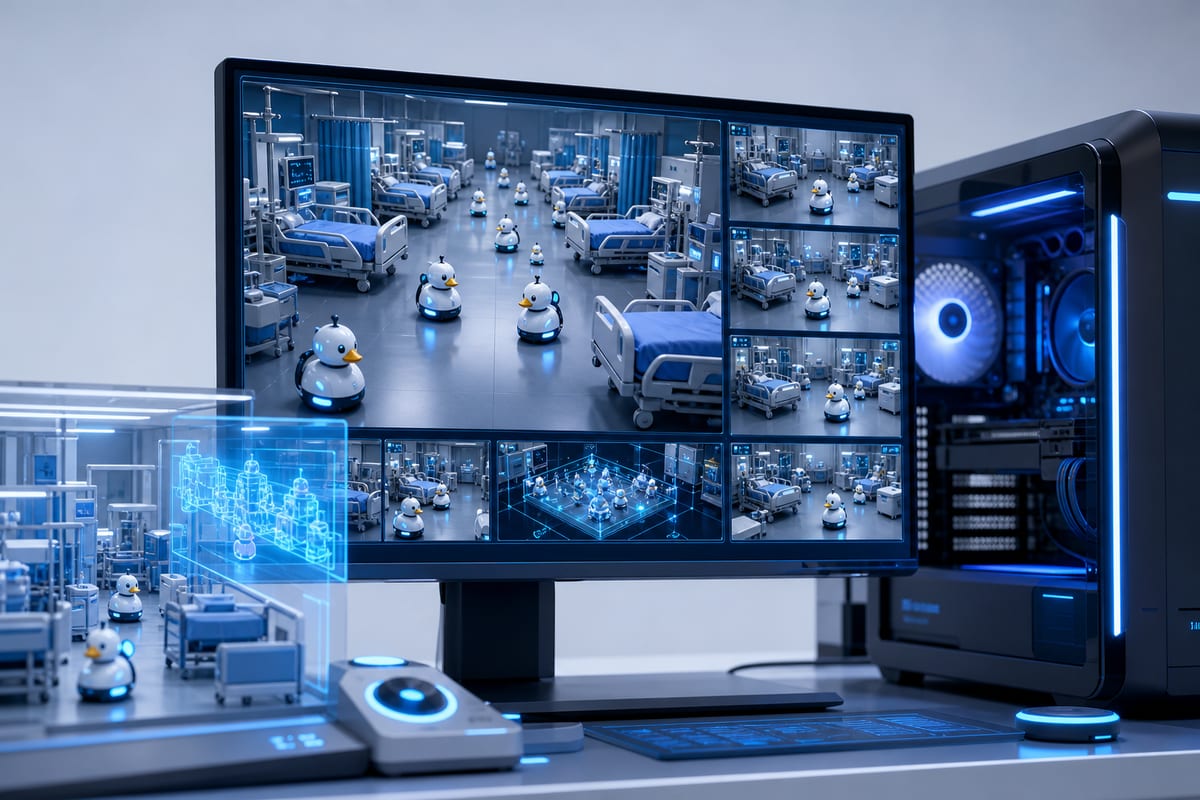
In a simulation assembled with Claude Code, developer Maziyar Panahi observed that 766 Microducks out of 768 remained standing after 14 simulated seconds. This test is part of several projects combining AI agents with NVIDIA Omniverse libraries, particularly for industrial design, warehouses, and virtual reality. Developers provide their instructions in natural language, then control the results and guide corrections.
Robots Tested in a Hospital and on a Suspension
The stability of a walking policy, meaning the AI commanding movements, must be verified in the environment intended for the robot. AI developer Maziyar Panahi piloted Claude Code with Claude Opus 5.5 to compose an intensive care unit from 13 SimReady hospital elements. These elements already had their Newton parameters: neither the furniture nor the volumes used to calculate collisions needed to be recreated.
Newton was used to multiply hospital services, with hundreds of instances executed on an NVIDIA RTX PRO 6000 GPU. Since cloud containers do not support the necessary graphical functions, Panahi and the agent recorded poses remotely and rendered them locally. The furniture was considered static for collisions, allowing for larger simulations within the solver's limits.
The Microducks employed a previously trained AI and followed a path marked by points. The test focused on 256 simulated services. Panahi estimates that the agent worked for about two hours. His open demonstration provides an initial instruction, controls, and guidelines for transitioning from a CPU service to hundreds on an NVIDIA GPU.
Jens Jebens, senior product manager for OpenUSD at NVIDIA, had Astra model an automotive suspension in PTC Onshape, then configured it in Isaac Sim. The tests led him to revise a bolt key; Jebens reports the extraction of a component, solely within the simulation.
Modifiable Robot and Warehouse Models
Omniverse provides GPU-accelerated libraries for physics, rendering, and sensors. With Onshape's SimReady Publisher, built on these libraries, CAD can feed the simulation: Sensori uses it to import its robot Yuri into Isaac Sim while preserving geometry, joints, and configuration. The team can thus examine design modifications without systematically rebuilding its simulated model.
For a warehouse, site captures present another challenge: machines and shelving can obscure the building. David Wehr, a member of NVIDIA's simulation technology team, designed a method with Astra to reconstruct the building without the objects it contains. The agent interprets panoramic photographs, produces the geometry, and then aligns it with measurements from a point cloud; OpenUSD retains the models and ovrtx provides the views to inspect. The goal is to create a modifiable environment where adding or moving equipment would help examine layout and automation projects before any physical intervention.
NVIDIA developers Dillon Bailey and Rishabh Chadha utilized SimReady Central resources in Isaac Sim to create a simulation of a robot manipulating a can. They entrusted the assembly and command generation to an agent equipped with GPT-6 Sol and Isaac Sim skills. The tests focus on joints, contacts, and grasping, from picking up to releasing; positions and trajectories can then be modified and reevaluated. A guide provides agent instructions and checks for movement and grasping.
Le brief IA que les pros lisent chaque soir
Les 7 actus IA du jour, décryptées en 5 min. Gratuit.
Inclus dès l'inscription : notre sélection des meilleurs guides & comparatifs IA.
Choisissez votre rythme
Gratuit · Pas de spam · Désabonnement en 1 clic
Wagner Verifies Interactions in the Headset
Michael Wagner, a developer in the NVIDIA Omniverse community, used GPT-6 Astra with Blender to model a study environment from two images, balancing visual quality and performance in virtual reality. An application was then developed with Claude Code to search for SimReady Central resources by voice and manipulate them in the headset. For about eight hours, the agent worked; Wagner created the application over a weekend using an NVIDIA RTX 6000 Ada workstation and a Meta Quest 3.
For its various functions, the application relies on ovstage to share the OpenUSD scene, ovrtx for rendering, ovxr for virtual reality, and ovphysx for physics. To compare physics libraries, Wagner also created a version using ovnewton, integrated into ovstage. Verifying what was actually happening in the headset was his main challenge: noticeable defects had escaped automated testing, including the shaking of objects during grasping.
Wagner communicated the symptoms to the agent, accompanied the modifications, and verified the interactions himself. Updating the grasp command at each frame eliminated the shaking. The developer recommends providing agents with rendered images and logs to examine, then directly controlling the usage. His open-source demonstration includes build instructions, an initial command, and reusable skills.
Falkor Simulates Industrial Installations
Falkor, a KONGSBERG company, offers Falkor Surface to transform CAD and engineering data into digital twins of installations using GPT-6 Astra. The platform combines Omniverse with NVIDIA RTX PRO 6000 Server Edition GPUs on Microsoft Azure. Agents designed on the Falkor engine capture real-world physics, spatial relationships, and dense technical documentation.
Engineers can develop and test their plans before going on-site, which limits delays and costly errors. A shared view is also used to inspect equipment and verify clearance spaces.
BondLab Creates Editable Objects in Houdini
To create animations with CUDA and Isaac Sim, Nick Scarcella, senior technical artist on the BondLab team at NVIDIA, piloted AI agents, primarily with Claude. For materials, lighting, and the final appearance of images, BondLab uses SideFX Houdini and ovrtx.
To recreate the portable synthesizer OP-1, Scarcella guided Astra using product photographs, manuals, and technical indications. The model exported in OpenUSD was tested in Houdini and Blender, then detailed with Astra and Opus before material and texture adjustments intended for ovrtx. These methods produce modifiable and inspectable content in artists' usual tools, with rendering possible in various applications.
Scarcella also employed a public checkpoint of a robotic hand in Isaac Sim. He directed the movement and worked on materials and lighting in Houdini with Claude's assistance. Together with his colleague Steven Dvornik, he created Echos: translucent hands overlap before merging into a unique animation, a visual interpretation of robotic training. Scarcella also makes his Houdini MCP tools and agent skills available.
Brief IA — L'actualité IA en français
L'essentiel de l'actualité de l'intelligence artificielle, décrypté et expliqué chaque jour.