Simulation and Physical AI: The Challenge of Data and Advanced Engines
Challenges in Building Physical AI Systems
In the field of physical artificial intelligence, one of the main obstacles lies in the limited access to data. Unlike large language models (LLMs) and vision-language models (VLMs) that can be trained on massive datasets available on the Internet, robotics and physical AI systems do not have this luxury. For a robot to learn effectively, it must understand the consequences of its interactions with the real world. This includes varied scenarios such as a cup sliding, a cable being folded, or the impact of a gripper on an object at an inappropriate angle.
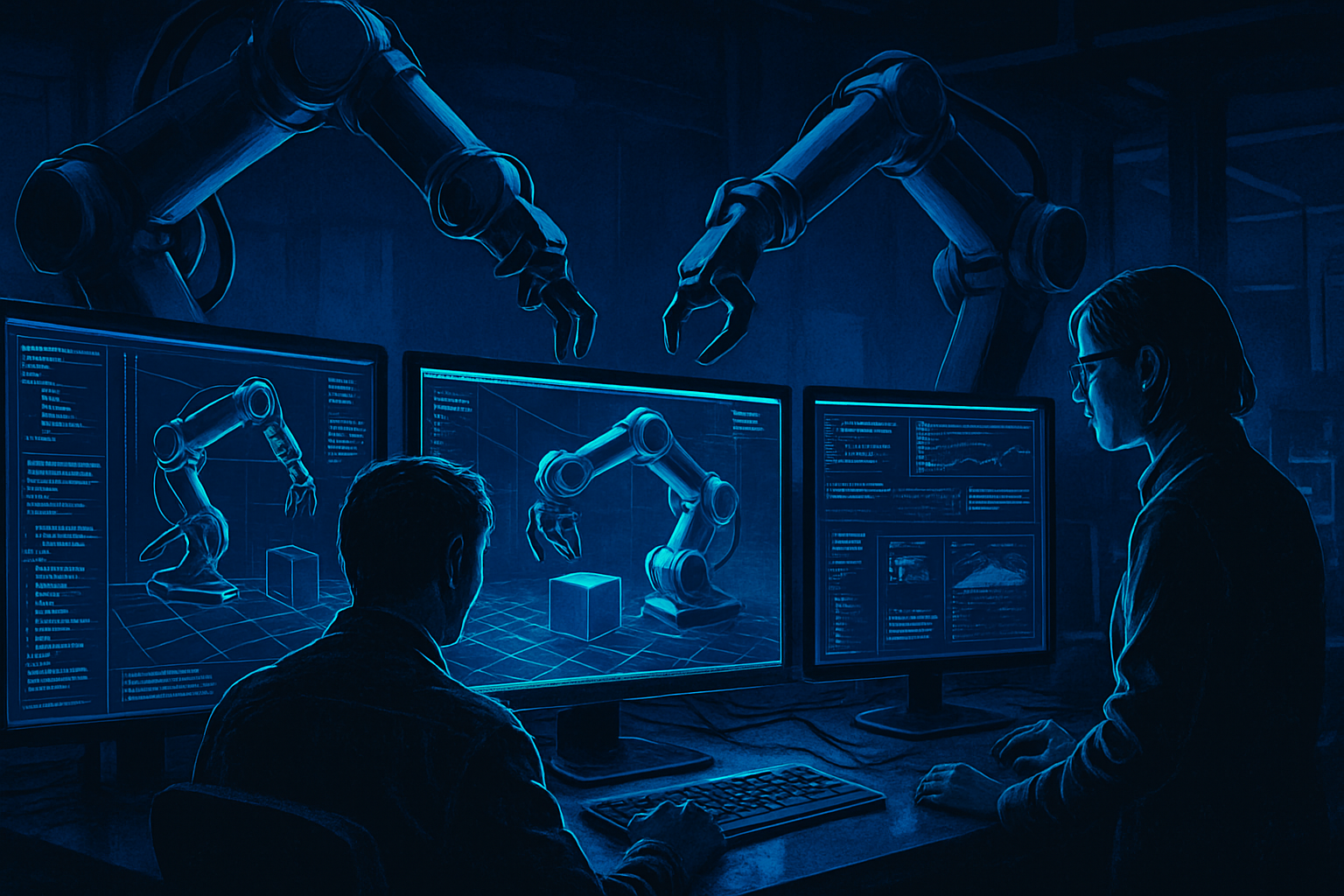
Collecting this data in the real world is not only slow and costly, but it can also be risky and sometimes impractical, especially when tasks are destructive. This is where simulation comes into play, offering a valuable alternative. Through simulation, developers can generate large amounts of data that are both photorealistic and physically accurate. By using robot teleoperation in simulation and leveraging GPU parallelism, it is possible to produce thousands of hours of robotic experience at a cost significantly lower than that of real-world data collection.
Evolution of Robotics Simulators
Historically, robotics simulators primarily served to debug geometry, test controllers, or visualize robot movement. Today, their role has evolved to become an essential component of model development. Research and development teams use them for various tasks:
- Generating perception datasets
- Training reinforcement learning policies
- Collecting demonstrations
- Augmenting real-world data
- Evaluating models
- Testing policies in rare or adversarial scenarios
This transformation explains why many industrial research laboratories and academic groups are investing in simulation engines capable of meeting these new requirements.
The Three Computers Paradigm
To understand these requirements, one can refer to the three computers paradigm:
-
Training Computer: This is a large GPU cluster used to process data and train foundational AI models.
-
Simulation Computer: A workstation or GPU cluster that uses GPU-accelerated physics and RTX rendering to generate robotic experiences, sensor data, and simulated interactions.
-
On-Robot Computer: An edge device, such as an NVIDIA Jetson AGX Thor system, that executes the trained policy or model during deployment.
Le brief IA que les pros lisent chaque soir
Les 7 actus IA du jour, décryptées en 5 min. Gratuit.
Inclus dès l'inscription : notre sélection des meilleurs guides & comparatifs IA.
Choisissez votre rythme
Gratuit · Pas de spam · Désabonnement en 1 clic
Each of these computers plays a distinct role depending on the latency, throughput, accuracy, and deployment requirements of the task.
Choosing a Simulation Engine
Today, many simulation engines are available, each designed for specific use cases such as humanoid robots, aerial vehicles, ground robots, autonomous vehicles, quadrupeds, and dexterous manipulators. These engines also differ in their support for reinforcement learning, batch simulation, rich contact physics, photorealistic rendering, and sensor simulation.
Developers often need to ask fundamental questions to choose a simulation engine:
- Do I need scalable synthetic data generation workflows?
- Do I need to perform reinforcement learning?
- What type of sensor support does a given simulation engine offer?
- What 3D asset formats does the simulation engine support?
- What fidelity and environmental scale are required?
These factors help developers determine which simulation engine will best meet their development needs.
Overview of Popular Simulation Engines
Among the most popular simulation engines are NVIDIA Isaac Sim, Isaac Lab, MuJoCo, PyBullet, Drake, and Genesis. Each of these engines is suited for specific use cases, such as scalability in reinforcement learning, synthetic data generation, or testing algorithms and/or models in simulation.
-
MuJoCo (Multi-Joint dynamics with Contact) is a fast and accurate open-source physics engine primarily designed for robotics, biomechanics, reinforcement learning, control, and simulation of articulated systems.
-
MuJoCo Warp (MJWarp) is a GPU-accelerated implementation of MuJoCo, written in NVIDIA Warp, a Python framework for writing CUDA-accelerated differentiable kernels, suitable for robot learning and physical simulation.
-
Isaac Sim is an open-source robotics simulation framework built on NVIDIA Omniverse, offering high-fidelity physics and photorealistic rendering.
-
NVIDIA Isaac Lab 3.0 is an open-source, GPU-accelerated simulation framework ready for agents, designed to train and evaluate robotic policies at scale.
Modern GPU-Accelerated Physics for Robotics
Modern simulation frameworks for robotics rely on advanced digital physics: rigid and soft body dynamics, contact and friction models, joint constraints, actuators, sensors, and temporal integration. At each simulation step, the engine estimates how bodies move under the influence of forces, torques, collisions, gravity, constraints, and controller inputs.
Newton is an open-source, GPU-accelerated, extensible, and differentiable physics engine developed by NVIDIA, Google DeepMind, and Disney Research. It integrates MuJoCo Warp as a key physics backend, providing researchers with a path toward scalable and simulator-independent physics.
Brief IA — L'actualité IA en français
L'essentiel de l'actualité de l'intelligence artificielle, décrypté et expliqué chaque jour.